


Bullish "short squeeze," London copper "spot price spread" skyrockets to $100! The three major bulls want more spot copper than the total LME inventory

The LME copper futures contract expiring on Wednesday once traded at a premium of $100 over the contract expiring the next day, reaching a new high since 2021 and marking a rare extreme fluctuation since 1998. With the January contract nearing expiration, three entities hold over 30% of the long positions, which could demand delivery of more than 130,000 tons of copper, exceeding the LME's immediately available inventory
The London Metal Exchange copper market has once again shown signs of short-term spot tightness.
On Tuesday, the Tom/Next spread for LME copper futures surged to $100 per ton, reaching the highest level since the historic supply squeeze in 2021. This spread was still in a contango state the previous trading day, and the sharp reversal in a short time has become one of the rare extreme fluctuations since 1998.
The Tom/Next spread reflects the price difference between deliveries tomorrow and the next trading day, serving as a core indicator of short-term physical supply and demand in the LME market. Under normal circumstances, this spread typically reflects limited funding and storage costs, with small fluctuations.
Analysts believe that for traders, the soaring spread directly raises the cost for shorts to roll over their positions before contract expiration, while reinforcing the signal that the ability to deliver spot in the short term has become a dominant variable.
Earlier this month, LME copper prices had already risen to record highs, with the market's sensitivity to supply constraints continuing to increase. The latest spread movement adds new instability to an already tight market structure.
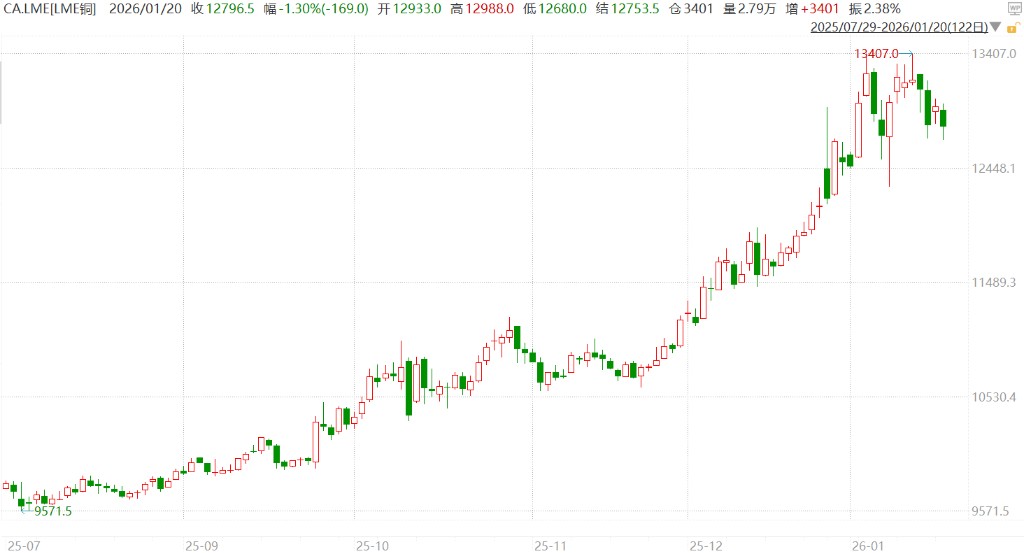 (On January 14, LME copper prices rose to a new high of $13,407)
Approaching contract expiration, long positions amplify short-term spot tightness
The LME copper futures contract expiring on Wednesday was at one point priced at a premium of $100 over the contract expiring the next day, a phenomenon known as "backwardation," which typically indicates rising spot demand.
After reaching a high during the trading session, the spread retreated and closed at $20 per ton at noon London time, but overall volatility remains unusual.
This uncontrolled spread occurred as the LME January copper contract is nearing expiration. According to LME data, as of last Friday, three entities collectively held long positions amounting to at least 30% of the open interest.
If these positions are held until expiration, they could demand delivery of over 130,000 tons of copper, a scale that exceeds the immediately available inventory in the LME storage system.
In this structure, the scarcity of short-term deliverable resources is rapidly amplified, and the Tom/Next spread becomes a concentrated reflection of the long-short game, significantly raising market attention to delivery risks.
Rising costs for shorts to roll over, cross-market and inventory structure exacerbate volatility
As the Tom/Next spread rises, traders holding short positions who choose to roll over will face significantly increased cost pressures.
Although the LME has rules requiring large long positions to lend spot to the market at capped levels under specific holding ratios to alleviate short-term imbalances, this round of spreads has at one point exceeded the previous institutional upper limit of about $65 per ton, indicating that the buffer space has been rapidly consumed in a short time.
Meanwhile, the forward structure of copper prices is also signaling tightness, with the LME curve maintaining backwardation in several distant contracts, and the market's pricing of future supply and demand relationships continues to tighten. Although the total global copper inventory is currently at an acceptable level, the distribution of inventory is uneven, with limited deliverable resources in some regions, making short-term price differentials more sensitive to delivery pressure.
As LME spot prices strengthen, the previous premium of New York Comex copper contracts has significantly narrowed, and recently even turned into a discount, with changes in cross-market price differentials adjusting the flow of physical goods.
This week, there was a small-scale inflow into the LME warehouse in New Orleans, with previously vacant delivery points regaining physical inflows
