


Hugging Face looks back at the "DeepSeek Moment": How has China’s AI changed the global open-source landscape in the past year?

The world's largest AI open-source community, Hugging Face, announced that DeepSeek R-1 breaks through the triple barriers of technology, application, and psychology, leading China's AI to be fully open-sourced. Baidu's Hugging Face release volume has increased from zero to over a hundred, Tencent's Byte has grown by about 9 times, and Alibaba is deepening its ecosystem, helping China's model download volume surpass that of the United States. A foundational dependency has formed globally, with even American models being fine-tuned based on DeepSeek, as Chinese AI reshapes the global landscape
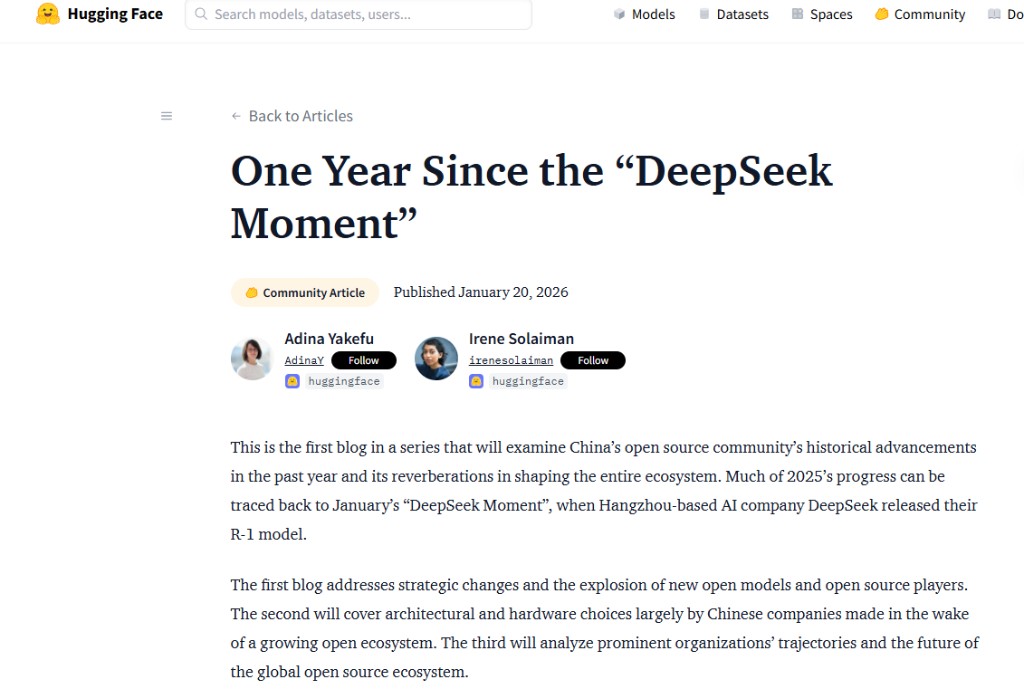
On January 20, the world's largest AI open-source community Hugging Face published an in-depth article titled "The One-Year Anniversary of the 'DeepSeek Moment'," detailing how China's AI power has reshaped the global open-source ecosystem over the past year.
The article points out that the release of DeepSeek R-1 in January 2025 became a significant watershed moment in the industry, lowering the technical and application thresholds. It not only marked a turning point in China's AI development but also triggered profound changes in the open-source model globally, leading to a comprehensive rise of Chinese models in terms of downloads and influence.
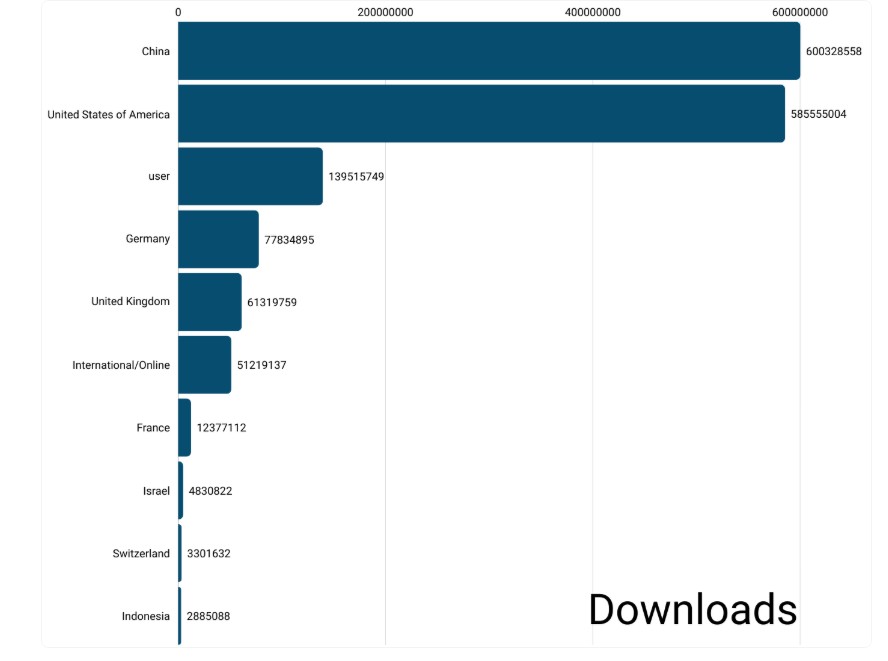
Over the past year, giants like Baidu, Alibaba, Tencent, and startups like Moonshot have significantly increased their open-source investments, with Chinese models on Hugging Face surpassing downloads from the United States. Despite the West seeking alternatives, many global startups and researchers are gradually relying on open-source models developed in China as a foundation, with Chinese AI deeply embedded in the global supply chain.
"DeepSeek Moment": Breaking the Triple Barriers
As the most important collaboration platform for global AI developers, the article released by Hugging Face first reviews the market conditions before the release of DeepSeek R-1. The article describes, "Before R-1, China's AI industry was mainly focused on closed-source models... For most companies, open-source was not the default choice." However, the emergence of R-1 changed this situation.
The author of the article believes that the true significance of R-1 lies not in whether it was the strongest model at the time, but in its ability to lower three key barriers.
First is the technical barrier. R-1 transformed advanced reasoning capabilities into downloadable and fine-tunable engineering assets, "reasoning began to behave like a reusable module."
Second is the adoption barrier. The MIT license allowed the model to quickly enter production environments, shifting community discussions from "which model scores higher" to "how do we deploy it."
Most importantly, the elimination of the psychological barrier. The article states, "When the question shifted from 'Can we do this?' to 'How do we do this well?' many companies' decisions changed." Hugging Face commented in the article that this release "provided extremely valuable resources for China's AI development: time," proving that even with limited resources, rapid progress can still be achieved through open-source and rapid iteration.
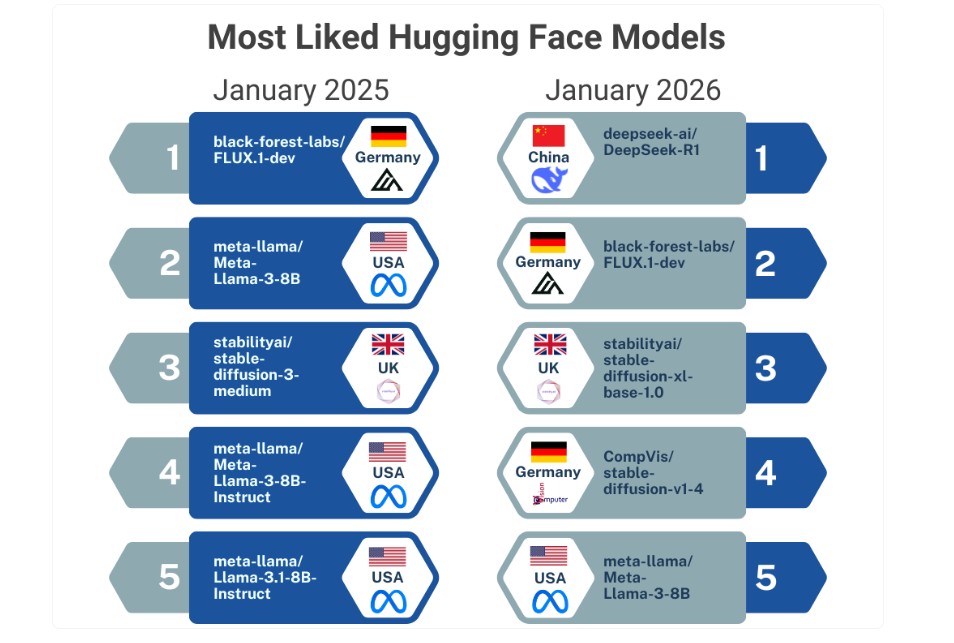
The release of DeepSeek R-1 made "open-source" no longer just a tactical choice but a long-term strategy for Chinese technology companies. The article emphasizes that over the past year, China's AI development model has undergone a fundamental shift, rapidly transitioning from an early focus on closed-source to a dominance of open-source
The Entry of Giants and Strategic Restructuring
As open source enters the mainstream, the strategies of Chinese tech companies have undergone significant changes. An article from Hugging Face points out that compared to 2024, the period following the release of R-1 has witnessed a new model in the Chinese AI landscape: "Large tech companies lead, followed closely by startups, and an increasing number of vertical industry companies are also entering this field."
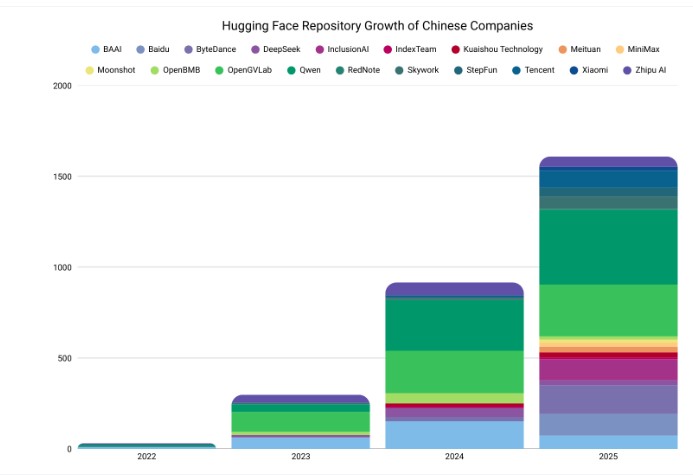
Giants like Baidu, ByteDance, and Tencent, along with startups like Moonshot, have all entered the fray, leading to a situation where the top-ranked models on Hugging Face are no longer monopolized by American developers.
The article cites data to support this trend: Baidu's release volume on Hugging Face increased from zero in 2024 to over 100 in 2025; ByteDance and Tencent's release volumes increased by eight to nine times. Additionally, the Kimi K2 released by Moonshot is seen as "another DeepSeek moment."
The article analyzes that the focus of competition has shifted from single model performance to ecosystems. Taking Zhipu AI's GLM and Alibaba's Qwen as examples, these companies not only release model weights but also build engineering systems and ecological interfaces. The article states bluntly: "At this stage, merely comparing raw model performance is no longer sufficient to win. Competition is increasingly focused on ecosystems, application scenarios, and infrastructure."
"Constrained Collaboration" and Market Dominance
Hugging Face further presents a compelling viewpoint in the article: the collective rise of Chinese AI players is not due to collaborative agreements but rather constraints.
The article states: "What appears to be cooperative behavior is best understood as alignment under shared technological, economic, and regulatory pressures." Under the combined pressure of limited computing power and cost control, companies have begun to compete on similar technological foundations and engineering paths. This homogeneity enables the ecosystem to replicate and expand itself.
This strategy has achieved significant results in market data. The article reveals: "In newly built models (<1 year), the download volume of Chinese models has surpassed that of any other country, including the United States." Hugging Face's heatmap data also shows that from February to July 2025, the open-source releases from Chinese companies became noticeably more active.
For the market, this means that the Chinese AI industry has evolved from a simple competition of model parameters to a competition of system-level engineering capabilities with greater commercial landing potential.
Global Response: Coexistence of Dependence and Catching Up
The article concludes by analyzing the global market's response to the rise of Chinese AI. Although institutions in the United States and France (such as Mistral) are accelerating the launch of open-source models to maintain competitiveness, the influence of Chinese models has permeated to the foundational level. **
Hugging Face revealed a key fact in the article: “Startups and researchers globally using open-weight models often default to or rely on models developed in China.” The article cites the example of the leading American open-weight model Deep Cogito v2.1, released in November 2025, which is actually a fine-tuned version of DeepSeek-V3.
At the same time, the article mentions that DeepSeek is widely adopted in global markets such as Southeast Asia and Africa, with its multilingual support and cost advantages being key factors for enterprises. In response to this situation, the United States launched the ATOM (American Truly Open Model) project, which explicitly cites the momentum of DeepSeek and Chinese models as a driving force, calling for coordinated efforts in the development of open-weight models.
The article concludes: “The world is still reacting, sparking a new wave of open-source enthusiasm.” Looking ahead to 2026, Hugging Face expects more significant releases from both China and the United States, while architectural trends and hardware choices will become the focus of the next phase
