Korean stocks break 5000 points! South Korea's AI strategy accelerates comprehensively, building an "Asian AI infrastructure hub"

Wallstreetcn
2026.01.22 04:14
portai
I'm PortAI, I can summarize articles.

Morgan Stanley believes that South Korea is entering a round of "infrastructure reinvestment cycle" driven by artificial intelligence, which is as significant as the semiconductor capital expenditure wave of the past decade. The rapid proliferation of AI services in South Korea is systematically driving up the long-term demand for local computing power, electricity, and the power grid. The Lee Jae-myung government has explicitly elevated AI to a national development strategy, incorporating computing power and energy infrastructure into long-term planning through projects such as the "AI Super Highway" and the National AI Computing Center

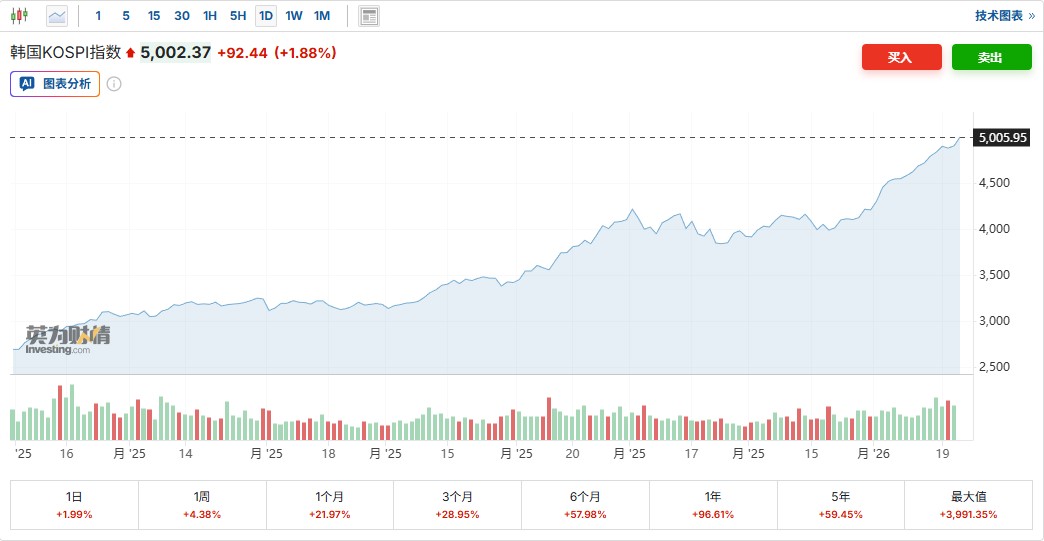
As the South Korean stock market benchmark index Kospi rises above 5000 points, an economy previously viewed more as a cyclical export market is being repriced by capital.

On Thursday, the Kospi index rose by as much as 2.2% during the session, surpassing the 5000-point target set by President Lee Jae-myung. Over the past 12 months, the index has accumulated a gain of over 95%, making it one of the strongest major stock indices globally. Among the weighted stocks, Samsung Electronics, SK Hynix, and Hyundai Motor led the gains, while the Korean won also strengthened slightly against the US dollar.

On the surface, this is a rally led by technology-weighted stocks; however, the deeper change lies in the market's re-evaluation of South Korea's position in the global AI industry chain—from a traditional cyclical exporter to a key beneficiary in the era of AI computing power and data centers. The sustainability of this rally increasingly points to an undervalued area: AI infrastructure.

Morgan Stanley believes that South Korea is entering a new "infrastructure reinvestment cycle" driven by artificial intelligence, which is as significant as the semiconductor capital expenditure wave of the past decade. Unlike previous fluctuations surrounding chip prices and export cycles, the core of this opportunity lies in the rapid proliferation of AI services, which is systematically driving up long-term demand for domestic computing power, electricity, and power grids, thereby creating a multi-layered investment theme covering data center operations, power equipment, and energy systems.

AI Service Diffusion Forces Computing Power to "Return Locally"

The core driver of the current Kospi rally remains AI.

At the hardware level, South Korea's dominant position in the global memory chip market allows it to directly benefit from the data center construction wave. For Samsung Electronics and SK Hynix, the rebound in memory chip prices has quickly translated into profit recovery and stock price elasticity, becoming one of the key drivers for the Kospi's breakthrough of 5000 points.

However, Morgan Stanley points out that the changes in AI demand are extending from the "chip price cycle" to the more fundamental infrastructure.

Over the past year, AI services in South Korea have accelerated penetration simultaneously on both the enterprise and consumer sides. On the B-side, AI has begun to be deeply embedded in high-value scenarios such as coding, video production, demand forecasting, advertising optimization, logistics path planning, and even DNA analysis; on the C-side, ChatGPT's monthly active users in South Korea have reached 18 million, and its integration with KakaoTalk is seen by Morgan Stanley as a "key leap from tech geeks to mainstream users."

More importantly, the expected rollout of AI agents by 2026 means that AI usage scenarios will shift from "assisting decision-making" to "directly executing tasks," leading to a non-linear increase in demand for reasoning computing power.

Morgan Stanley notes that against the backdrop of rapidly rising AI usage frequency and increasingly prominent constraints on networks and electricity, "locally deploying GPU clusters" is beginning to excel in both economic viability and stability. The commercial feasibility of domestic AI data centers is thus being repriced

"Neocloud" Implementation: South Korean Data Centers Enter Heavy Asset Cycle

The real turning point comes from the intensive announcements of multiple "Neocloud" level projects.

Morgan Stanley's research report outlines that in the past six months, South Korea has confirmed or is evaluating AI data center projects, including:

  • A 100MW AI data center being built by SK Telecom / AWS in Ulsan;
  • A 120MW AI data center located in Gimhae by Samsung SDS, with a budget of up to 8 trillion won;
  • The National AI Computing Center project (40MW), bid by a consortium led by Samsung SDS, with the government funding about 30%;
  • Potential projects promoted by OpenAI with SK Group and Samsung Group, focusing on locations in South Jeolla Province.

The common characteristics of these projects are: large scale, long cycle, high electricity consumption, and heavy asset burden. Because of this, the two major concerns that have troubled enterprises in the past—uncertainty in token demand and GPU depreciation risk—are being partially offset by "computing power security" and "national strategic attributes."

Morgan Stanley clearly points out that global AI giants (such as OpenAI and AWS) have begun to actively request the construction of AI-optimized data centers in South Korea, which itself is a signal of increased demand visibility.

Lee Jae-myung Government's "AI Superhighway"

If corporate investment addresses the question of "whether to build," then policy is addressing "whether it can be built."

Morgan Stanley summarizes the AI policy of the Lee Jae-myung government with four keywords: Sovereign AI, Infrastructure, Regulatory Reform, Talent Development. Among them, the "AI Superhighway" is the most practically binding aspect.

The core of this plan is not just GPUs, but the physical infrastructure that supports AI:

  • Data centers are included in "national strategic technology facilities," enjoying tax and policy support;
  • Planning for approximately 100 trillion won in public-private partnership investments;
  • Promoting a national-level AI computing center to provide computing power for startups and government projects.

Notably, the government is explicitly promoting the relocation of data centers away from the metropolitan area, which aligns closely with its goals of "revitalizing the local economy" and "decentralizing electricity consumption." South Jeolla Province thus becomes the intersection of policy and projects.

From a market perspective, this policy direction resonates with the "political significance" of the Kospi breaking through 5000 points. The index hitting a new high not only reflects asset price performance but also reinforces President Lee Jae-myung's policy commitment to improving corporate governance and repairing long-term valuation discounts. Bulls generally believe that there is still room for market repricing before the "Korean discount"—the long-term valuation suppression related to corporate governance—completely dissipates.

From Computing Power to Electricity: The Real Bottleneck Lies in the Power Grid

The expansion of AI data centers quickly touches on the structural issues of South Korea's energy system South Jeolla Province has abundant renewable energy but has long been constrained by transmission bottlenecks, preventing a large amount of green electricity from being effectively delivered. Morgan Stanley believes this is the realistic starting point for the "Energy Highway" plan.

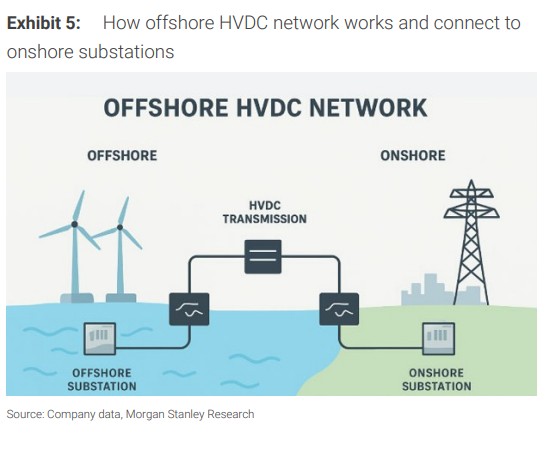
The core of the project is to reconstruct South Korea's electricity transmission network through High Voltage Direct Current (HVDC) technology. Compared to traditional alternating current transmission, HVDC has lower losses in long-distance, high-capacity transmission, making it more suitable for efficiently delivering renewable energy from coastal and rural areas to demand centers.

The plan centers on HVDC (High Voltage Direct Current) with the goal of constructing a U-shaped national transmission backbone across western, southern, and eastern South Korea over the next 20 years. Compared to traditional alternating current transmission, HVDC has significant advantages in long-distance, high-capacity, submarine transmission, and system stability. By 2030, the West Coast HVDC corridor is expected to be completed first, delivering up to 20 gigawatts of clean electricity to Seoul and surrounding areas, and then gradually extending nationwide in the 2030s.

From an investment perspective, AI data centers, grid upgrades, and renewable energy expansion are being incorporated into the same long-term capital expenditure curve.

From Index to Individual Stocks: AI Infrastructure Becomes a Repricing Pivot

After Kospi broke through 5,000 points, the market's focus has shifted from "how much further can it rise" to "where are the structural opportunities."

On the direct beneficiary side, Samsung SDS is seen as one of the most certain targets in the AI data center investment theme. Its 120-megawatt AI data center in Gumi and its leadership in the national AI computing center project place it in a core position in computing infrastructure.

On the indirect beneficiary side, the resilience of power equipment and transmission and transformation segments is being reassessed. As AI data centers continue to raise their requirements for high voltage capacity and power quality, the demand for ultra-high voltage transformers, GIS equipment, and substation EPC is accelerating, bringing companies like HD Hyundai Electric and LS Electric into investors' sights.

In the short term, Kospi's strong performance benefits from the AI hardware cycle and easing external uncertainties; but in the longer term, what is truly being repriced by the market is South Korea's role in the global AI infrastructure system.

This is also why more and more investors are beginning to understand this round of market activity as a structural transformation rather than merely a tech stock bull market. As the "Korean discount" gradually fades, AI infrastructure is becoming a key pivot connecting policy, industry, and capital markets.