


$5,400! Goldman Sachs significantly raises gold price target: The wealthy are rushing in, competing with central banks for "limited physical reserves"

Goldman Sachs analysts have found that the physical gold purchases by high-net-worth families and the buying of call options by investors have significantly increased, becoming an important increment for the rise in gold prices. The private sector has surged into the gold market to avoid policy risks, exhibiting a "buy and hold" characteristic, which effectively raises the price starting line. Coupled with central banks' continuous accumulation and the Federal Reserve's interest rate cuts, under the backdrop of unresolved macro risks, gold prices are expected to rise another 17%
The rules of the gold market have changed. Gold is no longer just a game for central banks; private sector whales are entering the arena, and they are here to hedge against "global policy risks."
According to news from the Chase Trading Desk, Goldman Sachs raised its gold price target for this year from the previous $4,900 per ounce to $5,400 per ounce in a report on January 21. Analysts believe that the key driver for gold's upward movement is the diversification of private sector investments into gold, which has already begun to materialize. This buying behavior is aimed at hedging against the uncertainties of global macro policies (i.e., concerns about fiat currency depreciation and fiscal sustainability). More critically, these are not short-term speculative funds, but rather "Sticky Hedges," meaning that buyers are unlikely to sell in 2026, effectively raising the starting point for gold prices.
For investors, this means a reconstruction of the gold pricing framework: What needs to be focused on is no longer just the pace of interest rate cuts by the Federal Reserve, but also the level of fear among wealthy families and institutions regarding "fiscal irresponsibility." As long as this concern exists, the bottom for gold prices has been permanently elevated.
Central Banks and Private Capital Compete for Limited Physical Gold, Accelerating Upward Trend
Goldman Sachs reviewed the path of gold price increases, recording gains of 15% and 26% in 2023 and 2024, respectively, primarily driven by panic buying from central banks after Russian reserves were frozen.
However, the situation underwent a qualitative change in 2025, with gold prices accelerating by 67% that year, and this momentum continued into early 2026. The fundamental reason for this acceleration is that central banks are no longer the only super buyers; they have begun to compete with private sector investors for limited physical gold reserves.
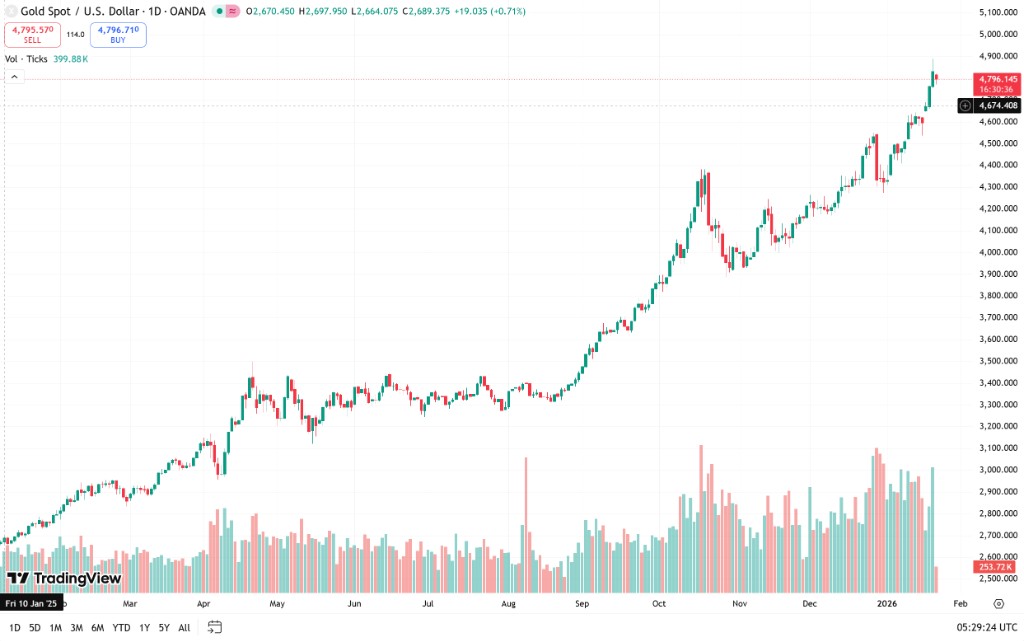
Analysts believe that this competition manifests in two dimensions: first, as the Federal Reserve cuts interest rates, traditional Western ETF purchases are rebounding; second, there is a surge in demand for new hedging tools against global macro policy risks (often related to currency depreciation themes).
Goldman Sachs specifically noted a significant increase in physical gold purchases by high-net-worth families and the buying of call options by investors. These capital flows have become an important increment for rising gold prices, leading to a widening gap between actual gold prices and the predicted values calculated by Goldman Sachs based on traditional models (ETF flows, speculative positions, central bank purchases) since 2025.
Goldman Sachs emphasized that this buying behavior effectively raises the starting line for gold price predictions, and as long as uncertainties in global macro policies (such as fiscal sustainability issues) are not fundamentally resolved by 2026, these positions will not easily loosen.
Deconstructing the $5,400 Price Target: Central Bank Gold Purchases Remain the Core Driver
Goldman Sachs expects that from the average price since January 2026 (approximately $4,600 per ounce), gold prices will rise by about 17% by the end of 2026 The composition of this increase is very clear: the continued diversification of reserve structures by emerging market central banks is the biggest driving force, expected to contribute 14 percentage points to the increase. Goldman Sachs predicts that the average monthly gold purchases by central banks will remain at a high level of 60 tons in 2026, far exceeding the average of 17 tons per month before 2022.
Another part of the increase comes from the inflow of funds into Western ETFs. Goldman Sachs assumes that the Federal Reserve will cut interest rates by 50 basis points in 2026, which will stimulate an increase in Western ETF holdings, expected to contribute 3 percentage points to gold prices.
It is noteworthy that Goldman Sachs' model assumes that the hedging demand for global macro policy risks will remain stable, meaning that this portion of the premium will not be unwound. In contrast to the rapid unwinding of hedging positions related to the 2024 U.S. election after the election results are announced, the current macro policy risks (such as debt issues) are seen as long-term, thus the related gold holdings exhibit strong "stickiness."
Focus on Two Major Reversal Signals
Despite significantly raising the target price, Goldman Sachs believes that the risk distribution for gold prices still clearly leans towards the upside.
Analysts believe that if global policy uncertainty continues to ferment, the private sector may further increase its allocation to gold, exceeding the benchmark assumption. The current forecast does not include this additional hedging demand. Additionally, due to the existing structure of bullish options requiring dealers to hedge, this mechanism will mechanically strengthen price momentum when gold prices rise, causing the sensitivity of gold prices to purchase volume (Beta value) to increase from the historical experience of 1.7% to around 2%.
Regarding when to turn bearish on gold, Goldman Sachs has proposed clear observation indicators: Due to the lack of price elasticity in gold supply (mined gold accounts for only 1% of global stock), high gold prices themselves cannot solve the problem of high gold prices. The reversal of gold prices can only stem from a collapse in demand.
Goldman Sachs pointed out two potential topping signals:
First, central bank gold purchasing demand continues to fall back to levels before 2022 (monthly average of 17 tons or lower), which usually indicates a easing of geopolitical risks;
Second, the Federal Reserve shifts from rate cuts to rate hikes, which not only increases the opportunity cost of holding gold but also alleviates investor concerns about central bank independence.
Unless we see a significant reduction in the long-term path risks of global fiscal or monetary policy, leading to the unwinding of macro hedging positions, the upward trend in gold prices is unlikely to reverse easily
