Can Japanese stocks withstand the dual pressure of yen depreciation and rising yields?

JP Morgan stated that as long as the USD/JPY exchange rate does not exceed 165 and the 10-year Japanese government bond yield remains below 3%, the upward trend of Japanese stocks is unlikely to change. Even in the event of a high-risk scenario leading to a market correction, as long as structural benefits such as corporate reforms and moderate inflation remain unchanged, the Nikkei index around 48,000 points will be seen as an excellent buying opportunity
JP Morgan's latest report on Japanese stock strategies points out that despite Japan facing a complex situation with early elections, a weak yen, and rising long-term interest rates, Japanese stocks still have room for growth before the end of 2026.
The core conclusion is: as long as the USD/JPY exchange rate does not exceed 165, and the 10-year Japanese government bond yield (JGB) remains below 3%, the upward trend of Japanese stocks is unlikely to change.
In the short term, attention should be paid to the risk of a pullback caused by the exchange rate and interest rates breaking through the "critical point," especially with the pressure of foreign capital outflows. However, from a medium to long-term perspective, improvements in corporate earnings, valuation recovery, and potential buying from domestic pension funds and other institutions will provide support for the market.
If the market experiences a pullback due to non-fundamental factors, similar to the situation in the summer of 2024, the Nikkei index around 48,000 points will be seen as an excellent buying opportunity.
Election results determine short-term direction, bullish logic remains unchanged by year-end
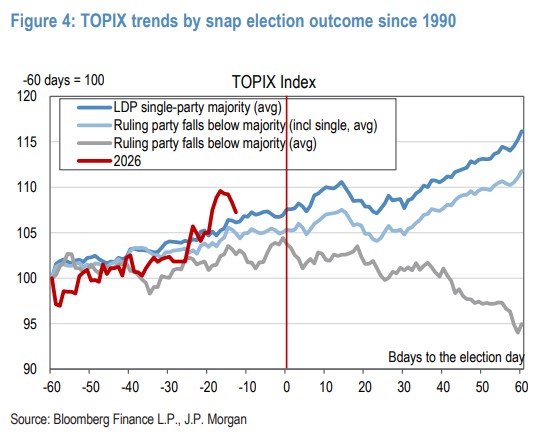
Regarding the upcoming early elections in Japan on February 8, the market's short-term reaction will heavily depend on the election results. However, regardless of the outcome, expectations for fiscal stimulus and political stability point to a rise in the stock market by year-end.
- Baseline scenario (Liberal Democratic Party (LDP) secures a majority): The Nikkei index may remain flat or slightly decline after the election but is expected to rebound, with a target of 57,000 points by the end of 2026.
- Weak scenario (LDP fails to secure a majority): The market may initially drop to around 52,000 points due to uncertainty, but fiscal expansion policies such as consumption tax reductions will limit the decline, with a potential recovery to 55,000 points by year-end.
- Strong scenario (LDP secures a stable majority): If the LDP secures more than 244 seats, the Nikkei index may immediately break through 56,000 points after the election and rise above 60,000 points by year-end.
Critical exchange rate point: 165 yen is the key watershed
The depreciation of the yen is a double-edged sword for Japanese stocks. While it can boost the profits of export companies, excessive depreciation can erode the asset value of unhedged investors and hinder real wage growth.
- Diminishing profit effect: The proportion of Japanese companies' overseas production has risen to over 20%, and they are no longer actively repatriating overseas earnings. This has led to a decrease in the sensitivity (Beta) of Japanese corporate operating profits to exchange rates from 1.0 times in the fiscal year 2016 to the current 0.6 times.
- Asset devaluation risk: For dollar investors who are unhedged against exchange rate risks, yen depreciation directly leads to a reduction in the value of their holdings (Beta of -1 times). When the profit benefits from exchange rate depreciation cannot offset the losses from asset devaluation, foreign capital is likely to sell off.
- Critical point calculation: JP Morgan calculates that the USD/JPY reaching 165 is the critical point where the momentum for stock market growth weakens. If it further depreciates to 170, concerns about the yen being out of control will intensify, potentially triggering a short-term pullback. Additionally, if the exchange rate exceeds 165, achieving positive growth in real wages in Japan will become difficult, further weakening the logic of domestic demand recovery.

Interest Rate Alert Line: 10-Year Government Bond Yield at 3%
The rise in interest rates puts pressure on Japan's financial system and stock market valuations, particularly the impact on regional financial institutions is noteworthy.
- Pressure on Regional Banks: JP Morgan estimates that if the 10-year JGB yield enters the 3.0%-3.5% range, the capital adequacy ratio of Japan's regional financial institutions may fall below the regulatory red line of 8%. This will force these institutions to accelerate losses on bonds and sell stocks to replenish capital.
- Valuation Comparison: Currently, the dividend yield of the Tokyo Stock Exchange Index (TOPIX) is about 2%, with the total return exceeding 3% after stock buybacks. Once the 10-year JGB yield breaks through 3%, the attractiveness of stocks relative to bonds will significantly decline, triggering a rebalancing of asset allocation.
- Policy Response: It is expected that the Bank of Japan and the Ministry of Finance will take action (such as suspending quantitative tightening QT, resuming bond purchases QE, or adjusting pension asset allocation) to avoid a rapid breach of the psychological barrier of 3% in yields.
Capital Flow: Short-Term Foreign Selling Pressure vs. Mid-Term Domestic Support
Capital flow is key to determining short-term market volatility but also provides a supporting logic for the medium to long term.
- Short-Term Risks: Rising interest rates may trigger regional banks to sell stocks, leading to follow-on outflows of foreign capital. This negative feedback in the capital market is the main downside risk for the short-term market.
- Mid-Term Support: Domestic institutional investors in Japan have significant repatriation potential. From the end of 2012 to the end of 2024, Japanese corporate pensions and public pensions will transfer 40 trillion yen and 147 trillion yen of assets to overseas securities, respectively. As domestic yields rise (e.g., the 10-year JGB yield exceeds the assumed return rate of 2.14% for corporate pensions), this portion of funds is expected to flow back into Japanese government bonds and the stock market, becoming a stabilizer for the market.
Risk Scenario Analysis: If "Dual Pressure" Gets Out of Control
JP Morgan has quantitatively predicted market performance under two scenarios:
-
Scenario One (Moderate Risk): The USD/JPY exchange rate reaches 160 by the end of the year, with the 10-year JGB yield at 2.5%. In this scenario, driven by fiscal expansion and moderate profit growth, the Nikkei index is expected to reach 54,000 points by year-end.
-
Scenario Two (High Risk): The USD/JPY depreciates to 170, with the 10-year JGB yield rising to 3.5%. At this point, although the depreciation of the exchange rate brings about a roughly 5% increase in EPS, the effects of valuation contraction (P/E decline) and asset impairment will dominate. The Nikkei index is expected to face a correction of about 10%, falling to around 48,000 points.
Even if a high-risk scenario leads to a market correction, as long as structural benefits such as corporate reform and moderate inflation remain unchanged, the Nikkei index around 48,000 points will be seen as an excellent buying opportunity