From 4 weeks to a few days: Wall Street understands "TACO," the trial period for Trump’s policies has clearly shortened

Wall Street has deeply embedded the "TACO" logic, with the response cycle to the threats of Trump’s policies shortening from weeks to days. The tariff turmoil with Greenland led to a one-day evaporation of a trillion dollars in the U.S. stock market, and the pressure forced Trump to quickly concede, highlighting the high sensitivity of his decisions to stock market fluctuations. Analysts warn of the "boiling frog" risk, as investors are hedging against potential extreme policy shocks by increasing their holdings in assets like gold
Wall Street investors are becoming adept at navigating the rhythm of threats posed by Trump’s policies. The latest Greenland tariff controversy shifted from threat to concession in just a few days, far shorter than the typical 4 to 6-week cycle, with the "TACO" (Trump Always Chickens Out) mentality deeply embedded in market pricing mechanisms.
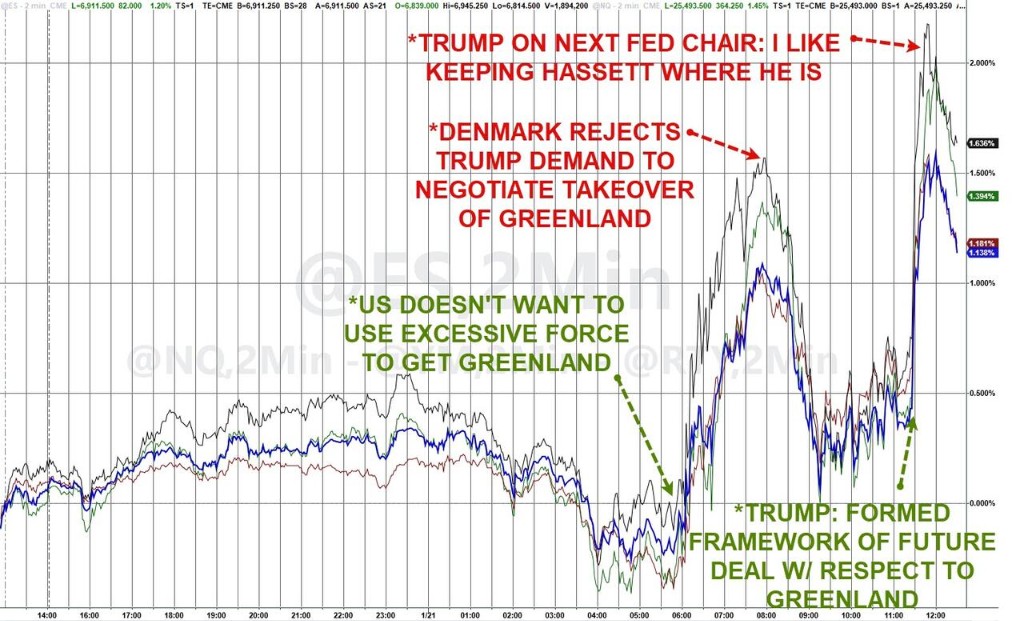
On Wednesday, the 21st, Eastern Time, Trump announced that he had reached a framework agreement with NATO Secretary General Jens Stoltenberg regarding Greenland, thereby postponing the planned tariffs on European countries that were set to take effect on February 1. According to Xinhua News Agency, Trump stated after meeting Stoltenberg in Davos, Switzerland, that he would not impose tariffs on the eight European countries opposing the U.S. acquisition of Greenland as originally planned. The day before, the U.S. stock market had evaporated over $1 trillion in a single day, marking one of the most severe sell-offs since April. Although Trump referred to this drop as "peanuts," the timing of the policy shift highlighted the influence of market volatility on his decision-making.
"The government is clearly sensitive to stock market trends," said Kristina Hooper, chief market strategist at Man Group, which manages $214 billion in assets. "This is very evident in the decision to back down." Corpay chief market strategist Karl Schamotta stated that Trump's comments on Wall Street's reaction "sent a signal that hit his sore spot."

This dynamic is changing market behavior patterns. Investors are increasingly convinced that Trump will compromise under market pressure, while also being forced to adapt to more extreme policy threats. Ninety One portfolio manager Jason Bobora-Sheen warned: "The risk facing the market is that this dynamic could bring the 'wolf' closer than expected one day."
Market Forces Prompt Rapid Turnaround
The market turmoil triggered by Trump's Greenland tariff threat prompted a swift reversal in policy stance. After the U.S. stock market suffered over $1 trillion in losses on Tuesday, by Wednesday afternoon, Trump had abandoned his tariff plans against European allies.
White House spokesperson Kush Desai defended, stating: "Anyone doubting President Trump's willingness to follow through when others refuse to reach an agreement should ask Maduro or Iran what they think."
Investors first experienced "TACO" during the market turmoil following April 1. At that time, the scale and scope of Trump's trade war shocked investors, leading to a sharp decline in U.S. stocks and turmoil in the bond market. However, the subsequent rebound was equally fierce, causing significant losses for investors who sold stocks.
Significant Compression of Policy Testing Cycle
Global investors have become accustomed to the pattern of Trump’s policy statements—typically announced over weekends when the stock, bond, and currency markets are closed.
Charles-Henry Monchau, chief investment officer at Swiss bank Syz, previously described a "Trump tariff cycle timeline" of 4 to 6 weeks: starting with the "shock phase," where the stock market declines and volatility rises, followed by U.S. officials soothing the market, and finally concluding with a commitment to resolution "This time (the Greenland incident) is going to be much shorter," Monchau said, "perhaps because the risks are too high for everyone."
Other cases include the sharp decline of the dollar last July when it was reported that Trump asked lawmakers about the possibility of firing Federal Reserve Chairman Powell. After Trump stated that he "did not intend to take any action," the dollar quickly rebounded.
Luca Paolini, Chief Strategist at Pictet Asset Management, pointed out:
"The difference now compared to then is that Trump has much less political capital. With the midterm elections approaching, the pain threshold is much lower."
Some investors are concerned that the widespread expectation of TACO may weaken the market's ability to respond to economic or political shocks. During the peak of the Greenland crisis, a government bond market investor stated that they were trying to "actively avoid all the Greenland noise" — the bond market's reaction was indeed milder than that of the stock market.
Michael Krautzberger, Chief Investment Officer of Public Markets at Allianz Global Investors, stated before Trump's retreat this week:
"If I were an advisor to certain European governments, I would say: you almost need to create a bit of market volatility because Trump cares about this more than other politicians."
When Trump returned to the U.S. on Thursday, the S&P 500 index closed up 0.6%. Futures indicated a further rise of 0.2% on Friday.
Investors Adjust Response Strategies
In the face of the new normal, some cross-market investors are choosing to tactically reduce positions before high-risk speeches and events, while maintaining long-term holdings in commodities like gold that may benefit from increased uncertainty.
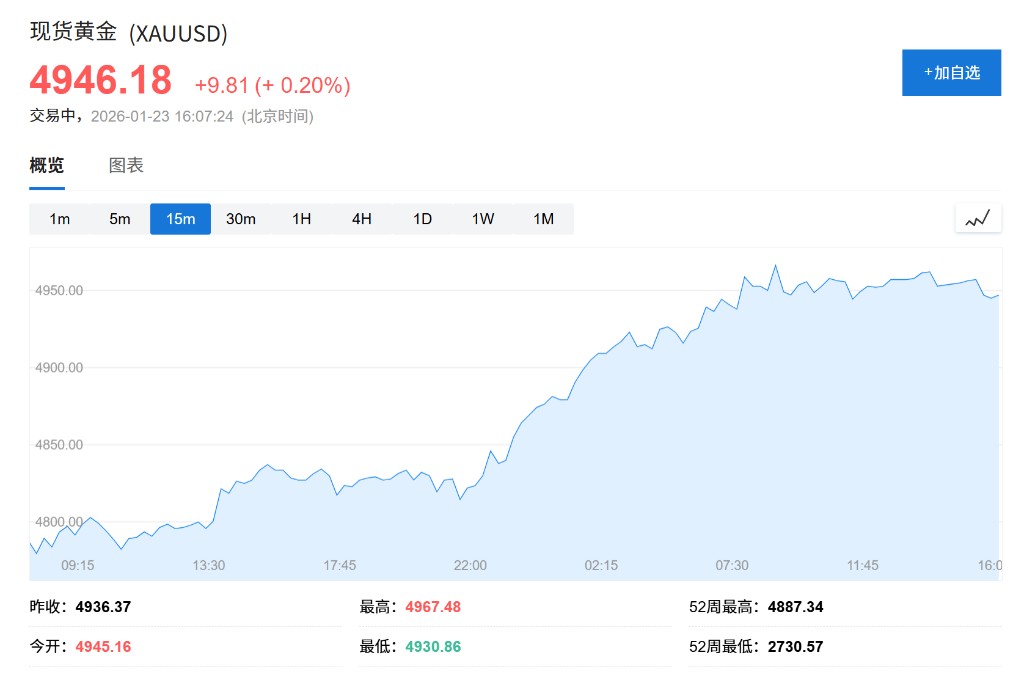
Gold continued its record-breaking rise this week, continuing to climb even after Trump's shift in Greenland policy, trading close to $5,000 per ounce.

Trevor Greetham, Head of Multi-Asset at Royal London Asset Management, stated that he has been buying gold to hedge against the risks of Trump implementing certain extreme policies, such as limiting the independence of the Federal Reserve during Powell's successor's term.
"It feels like the market is a bit like a frog in boiling water, with the temperature constantly rising," he said, "(the risk is) you become immune to triggers that would have caused a significant sell-off 10 or 20 years ago."