


The Bank of Japan "hawkish hold" does not want a collapse in the bond market, so it can only sacrifice the yen?

The Bank of Japan maintained its interest rates and raised its growth forecast, signaling a "hawkish hold," but the Governor's simultaneous commitment to maintaining stability in the bond market intensified the depreciation pressure on the yen. The USD/JPY exchange rate once approached the critical psychological level of 160, with sharp intraday rebounds triggering market speculation about official intervention. Analysts pointed out that if the central bank continues to avoid the fundamental choice between "protecting the bond market" and "stabilizing the exchange rate," relying solely on technical interventions will be insufficient to reverse the long-term weakness of the yen, and the exchange rate is likely to continue to act as a "pressure relief valve" in the policy dilemma
The Bank of Japan is caught in an irreconcilable policy dilemma—needing to stabilize the bond market, curb excessive depreciation of the yen, and support economic growth. In the absence of effective balance among these goals, the yen has been forced to become a "pressure relief valve" for absorbing policy contradictions.
Rich Privorotsky, head of Goldman Sachs' Delta-One business, analyzed that the Bank of Japan's attempt to convey tightening signals through a "hawkish hold" while promising to maintain bond market stability has not only failed to support the yen but has also intensified its depreciation pressure. Any market intervention lacking fundamental monetary policy adjustments is unlikely to reverse the long-term weakness of the yen.
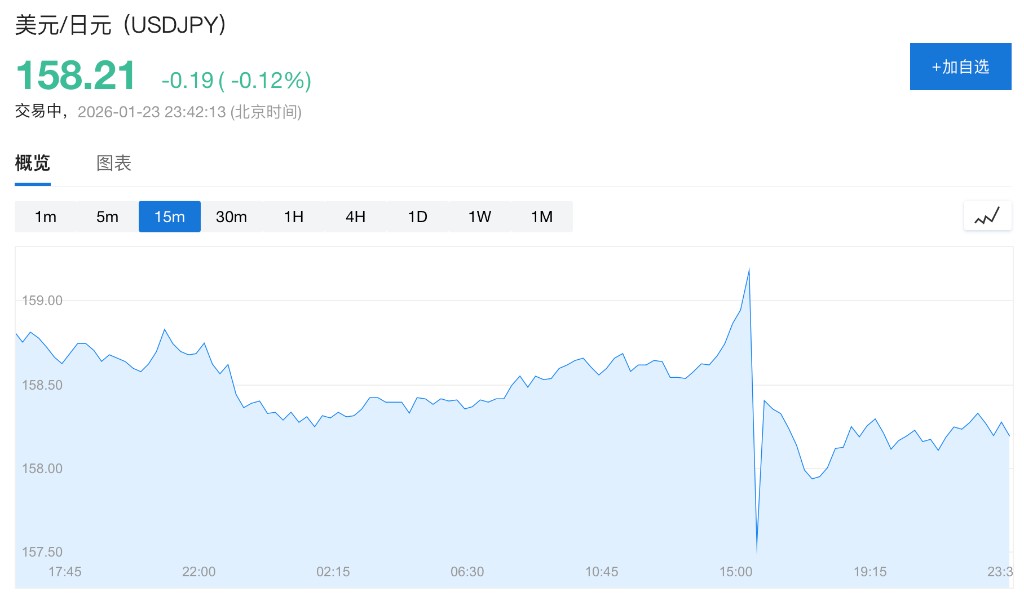
On January 23, the Bank of Japan maintained its policy interest rate but raised its economic growth forecast and signaled the possibility of further interest rate hikes in the future. However, this hawkish stance did not prevent the yen from weakening, with the USD/JPY exchange rate approaching the critical psychological level of 160, followed by a sudden sharp increase in the exchange rate, triggering widespread speculation about official intervention. Finance Minister Shunichi Suzuki did not respond directly to this.
It is noteworthy that Bank of Japan Governor Kazuo Ueda expressed a high level of concern for market functionality at a press conference, clearly articulating worries about long-term interest rate fluctuations and emphasizing that the central bank would be prepared to take measures if the market experienced disorderly fluctuations. Although this statement did not formally restart Yield Curve Control (YCC), it effectively retained some form of soft policy support, signaling to the market that the central bank would still intervene when necessary to maintain bond market stability.
Hawkish Policy Signals but Yen Under Pressure
Rich Privorotsky, head of Goldman Sachs' Delta-One business, analyzed that the Bank of Japan's decision can technically be viewed as a "hawkish hold." The central bank not only raised its growth expectations but also maintained a hawkish inflation forecast. Kazuo Ueda even hinted at the possibility of an earlier rate hike, stating:
"April is a relatively concentrated period for adjustments, which is one of the factors the committee considers when discussing future rate hikes."
However, Ueda mentioned at the press conference that in "unconventional circumstances," there might be flexible operations to promote market stability. This situation led to the yen continuing to weaken after the decision. The market's immediate reaction to the Bank of Japan's policy statement was logical: short-term interest rates rose, began to flatten, and the yen weakened.
Privorotsky wrote in the report:
"Ueda's remarks effectively hinted at a possible restart of YCC, which directly triggered yen selling... Subsequently, the rapid rebound in the exchange rate seemed to suggest a small-scale intervention jointly implemented by the Ministry of Finance and the central bank. The Bank of Japan is trying to suppress (bearish for the yen) while also attempting to intervene in the foreign exchange market to support the yen; this policy contradiction may trigger new market turmoil."
The 160 Level Becomes a Warning Line
During Japan's four interventions in the foreign exchange market in 2024, the USD/JPY exchange rate was consistently around 160, providing the market with a relative exchange rate level to judge future interventions. The fluctuations in the exchange rate on Friday occurred close to this psychological threshold, making investors alert, as any fluctuations near this point could trigger expectations of intervention. **
Tokyo Central Tanshi foreign exchange trader Tominaga Takayuki stated:
"In addition to the possibility of official exchange rate inquiries, the weakening of the yen after Ueda's press conference may trigger some preset trading instructions. Although the direction of the yen is very difficult to predict, market sentiment has clearly shifted. If the exchange rate approaches the 160 level again, it will further impact market expectations."
Despite a significant increase in trading volume last week, it is not outstanding compared to the trading scale during previous market fluctuations. This may lead to an overall tightening of liquidity in the foreign exchange market, making relatively small capital flows capable of driving significant changes in exchange rates.
Structural Dilemma Difficult to Resolve
Japan's monetary policy is facing a deep-seated dilemma: if it continues to avoid making a clear strategic choice between "maintaining the bond market" and "stabilizing the exchange rate," and attempts to rely solely on technical operations to maintain both, it may lead to a continuous erosion of policy credibility and create a vicious cycle that reinforces market volatility.
Goldman Sachs analyst Privorotsky pointed out: if the market begins to believe that yield curve control (YCC) may return in some form, the yen may face a larger depreciation. Goldman Sachs believes that it is extremely difficult for the Bank of Japan to achieve strong growth, high inflation, stable interest rates, and a stable exchange rate simultaneously. Although capital repatriation provides some support for the yen, it still plays the role of a "pressure valve" in the policy squeeze.
Behind the foreign exchange market's solitary bearing of policy pressure is the dilemma faced by the Bank of Japan: it must maintain bond market stability through loose policies while also addressing the inflation and social pressures brought about by yen depreciation. If it is unwilling or unable to raise interest rates, foreign exchange market intervention seems to be the only repeatedly utilized option.
However, against the backdrop of an unclear timing for the Federal Reserve's interest rate cuts and the significant disparity between US and Japan interest rates, whether unilateral intervention can reverse the long-term trend remains a question hanging over the yen. Institutions like Goldman Sachs believe that interventions lacking structural adjustments can only serve as temporary "band-aids" for the market, while the yen, as the "cost" of the policy dilemma, may be laying the groundwork for the next round of more severe financial volatility
