Metal frenzy reaches a climax! Silver breaks 100 for the first time, gold approaches 5,000 USD, and London copper rises above 13,000

Trump stated that the U.S. is mobilizing heavy troops towards Iran, with many vessels heading in that direction, which is seen as a driver for metals to rise on Friday. The "fear of missing out" (FOMO) mentality also boosted silver and gold prices. Additionally, silver received support from industrial demand and Chinese buying, while gold became a hedge against Trump's uncertainty. The disruption in supply from the Mantoverde copper-gold mine in Chile and the weakening dollar both contributed to the rebound in London copper
On Friday the 23rd, a new wave of price increases swept through the global metals market.
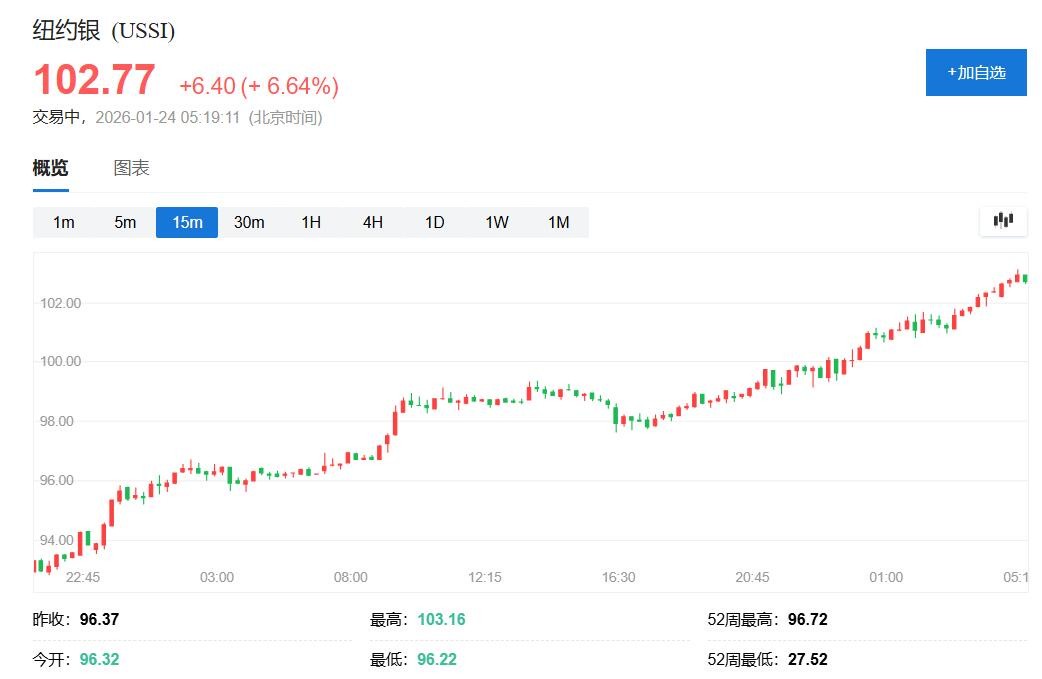
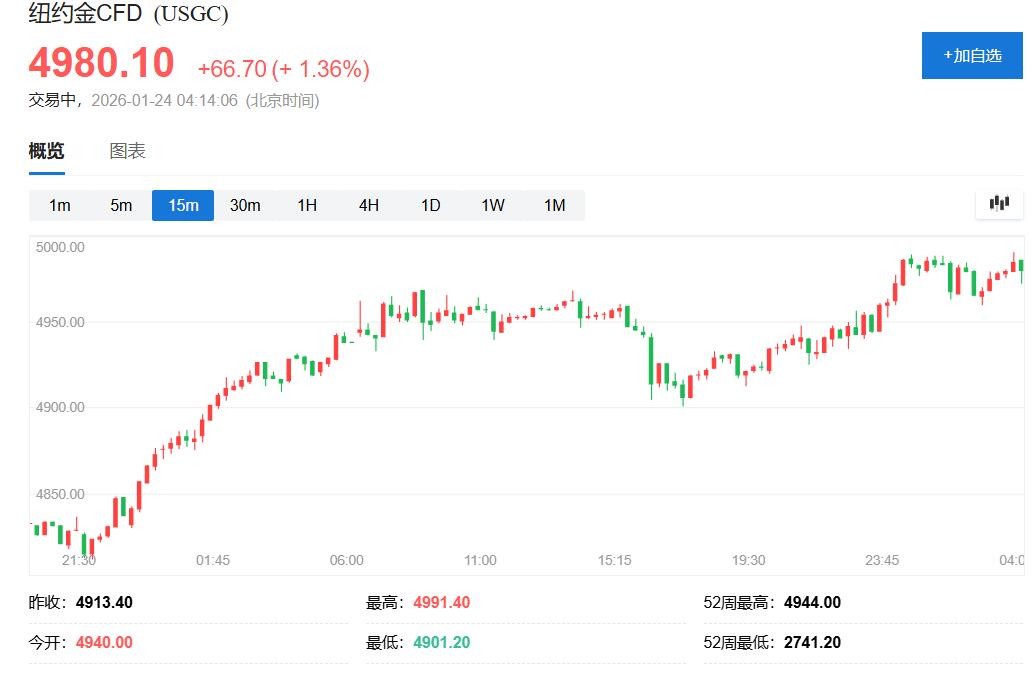
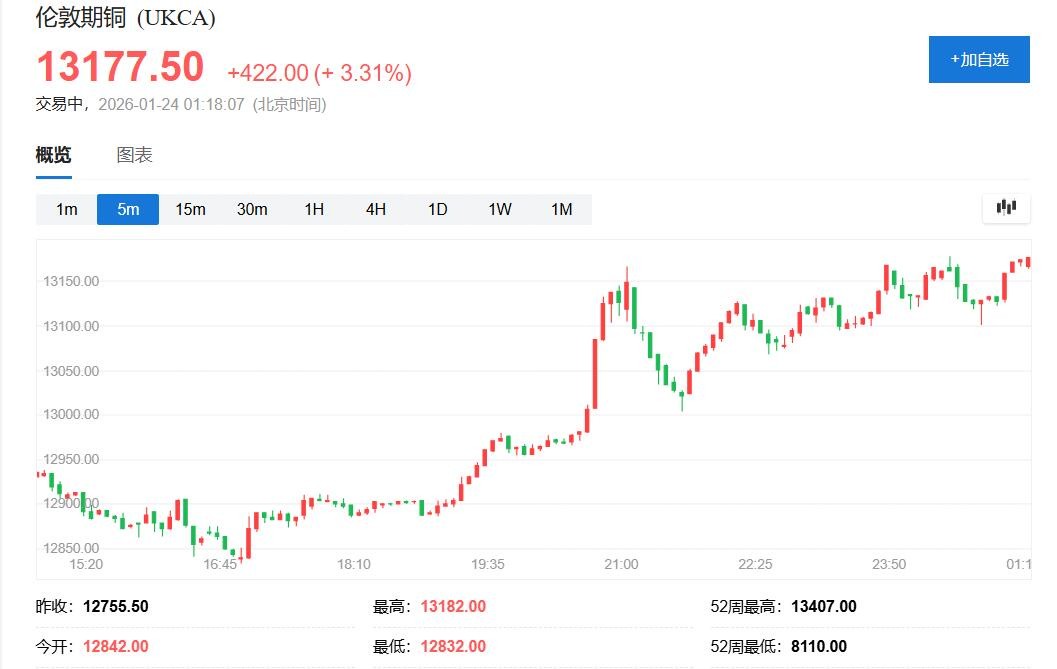
For the first time in history, both New York silver futures and London spot silver broke the $100 mark, while gold hit a new historical high for the fifth consecutive trading day, further approaching the $5,000 threshold. London copper rose back above $13,000, nearing the intraday record set earlier this month. Other precious and industrial metals also saw significant gains. When U.S. stocks hit a daily high in early trading on Friday, New York platinum and palladium futures rose over 6% and about 7%, respectively, while industrial metals London nickel and London tin both rose over 4% during the day.
This round of price increases is driven by multiple factors. The weakening dollar, massive outflows of investor funds from currencies and sovereign bonds, Trump's criticism of the Federal Reserve threatening the independence of the central bank, and geopolitical turmoil have all intensified risk aversion, collectively pushing metals higher.
Commentary mentioned that Trump's remarks about the U.S. "fleet" heading to Iran prompted investors to flock to basic metals such as silver, gold, and copper. The "fleet" refers to the report by Xinhua News Agency that U.S. President Trump stated on Thursday, the 22nd, aboard Air Force One, that the U.S. is mobilizing heavy troops towards Iran, with many vessels heading to Iran.
Wall Street institutions are generally bullish on the future of precious metals. Wall Street Insights mentioned last week that JP Morgan expects gold prices to reach $5,000 by the fourth quarter of 2026, with a long-term outlook even targeting $6,000; Citigroup raised its gold price target to $5,000 and silver target to $100 under a bullish scenario for the next 0-3 months; UBS expects silver to have about a 25% upside from current levels but warns of a potential "roller coaster" trend within the year.
This round of metal frenzy reflects the acceleration of the global de-dollarization trend. Emerging market assets continue to show a strong start, with investors pouring record amounts into emerging market funds, including nearly $6 billion into the iShares Core MSCI Emerging Markets ETF, which has a scale of $135 billion, expected to set a record for the largest single-month inflow since its inception in 2012.
Industrial Demand and Chinese Buying Resonance Push New York Silver Above $100
On Friday, the main contract for New York silver, COMEX March silver futures, broke above $101.10 per ounce towards the end of early U.S. stock trading, rising nearly 5% during the day. Spot silver also rose in tandem, reaching above $100.90, with an intraday increase of nearly 4.9%, and both futures and spot silver set intraday historical highs for two consecutive days. Silver futures are expected to accumulate over 10% for the second consecutive week, having risen over 40% year-to-date.

Silver is expected to outperform gold in 2025, with an annual increase of nearly 150% in silver prices compared to over 60% for gold, marking the strongest annual increase on record. This reflects that some investors have turned to silver after gold became too expensive. Silver also benefits from strong industrial demand, particularly from the solar energy sector, and buying from Chinese retail investors has added upward momentum to silver prices. When silver broke $80 per ounce in the last week of 2025, the queue in front of the trading counters at Shenzhen Shui Bei Market, the largest gold jewelry trading hub in the country, was even longer Analysts believe that $100 is a so-called "psychological price level" for silver. Neil Welsh, head of metals at Britannia Global Markets, stated in a report released on Friday: "The turmoil in the geopolitical order and (Trump's) new attacks on the Federal Reserve are triggering safe-haven demand."
Ole Hansen, head of commodity strategy at Saxo Bank, noted: "Momentum has clearly become an important factor influencing price movements, and as prices break through historical highs, the 'fear of missing out' (FOMO) psychology has also played a significant role. However, it would be a big mistake to attribute this rise solely to speculative behavior."
Activity in the Chinese market is crucial for silver prices. Ole Hansen pointed out that physical silver demand in China remains strong, although rising prices may begin to harm consumption in the long term. Local futures prices continue to trade at a premium of over $12/ounce compared to London prices, indicating regional supply tightness and strong demand. Hansen warned: "If prices accelerate too quickly, the risk of demand destruction cannot be ignored, and this dynamic may ultimately favor a rotation back to gold."
Citigroup aggressively raised its short-term target price in a report released last week. Analysts including Max Layton stated that in a bullish scenario, the silver target price for the next 0-3 months has been significantly raised from $62 per ounce to $100 per ounce.
Citigroup pointed out that due to potential delays in the U.S. Section 232 tariff decision, the ongoing physical shortage of silver may slightly worsen in the short term. However, the bank's baseline scenario assumes a silver target price of $70 per ounce over the next 6-12 months, reflecting a cautious attitude towards market volatility in the second half of the year.
UBS's research report last week projected that silver prices still have about a 25% upside from current levels, but prices are expected to gradually decline before the end of the year, presenting a "two halves" market.
UBS strategist Joni Teves stated that the core driver of this forecast adjustment is the surge in trading activity in the Chinese market. Since the second half of 2025, trading volume in Chinese silver futures has soared, and the unexpectedly high investor participation is amplifying the impact of market tightness on spot prices. UBS specifically noted that trading volume in Chinese silver futures far exceeds that of the New York Mercantile Exchange, but silver inventories on the Shanghai Futures Exchange are less than 10% of those on the New York Mercantile Exchange.
Gold Becomes a Hedge Against Trump's Uncertainty, Up Over 10% This Year
Gold reached an intraday historical high during the early trading hours of U.S. stocks on Friday, with New York gold futures nearing $4,990, up nearly 1.6% for the day, and spot gold breaking $4,988.30, up nearly 1.1% for the day. Gold is on track to record its best weekly performance since March 2020, with a weekly increase of over 7% and a year-to-date rise of 14%.
Yuxuan Tang, head of macro strategy at JPMorgan Private Bank, stated: "As cracks appear in the post-World War II rules-based order, gold is undergoing a continuous re-rating. In the face of risks from systemic changes that are difficult to quantify, investors are increasingly viewing gold as a reliable protection against these risks." Chris Weston, the research director at Pepperstone, pointed out in a report that gold is increasingly seen as a hedge against the "uncertainty" surrounding Trump. Although many traders view gold as a tool to hedge against the risks of the US-EU tariff war, he noted that gold's upward momentum has not retreated even after the threat of tariffs was lifted. Central banks around the world, especially those from emerging markets, are almost daily looking for reasons to rotate their reserves from dollars to gold. He believes that spot gold and futures gold will "eventually" reach the $5,000 level, with the target now clearly visible and attracting buyers.
Analysts at Saxo Bank stated, "This round of increases is driven by FOMO, while continuing to focus on broader drivers supporting hard assets as tensions between the US and Europe ease slightly. Central bank demand remains strong, the dollar continues to weaken, and governments continue to issue debt, but there is almost no clear indication of long-term repayment."
Analysts at Deutsche Bank wrote in a report on Friday, "The search for safe havens remains the most important driving factor. However, in the short term, with the Greenland dispute seemingly resolved for now, the rise may pause."
Major Wall Street investment banks are generally bullish on the long-term outlook for gold. Morgan Stanley has set a price target of $4,800 for gold in the fourth quarter of 2026, a significant upward adjustment from the previous forecast of $4,400 set in October 2025.
JP Morgan expects gold prices to reach $5,000 by the fourth quarter of 2026, with a long-term outlook even towards $6,000. The bank's global commodities strategy head, Natasha Kaneva, emphasized in a report on December 18: "The trends driving gold price revaluation have not yet exhausted." She believes that in the context of ongoing trade uncertainty and geopolitical risks, the diversification demand from central banks and investors will continue to push up gold prices.
Citi raised its gold price target for the next 0-3 months in a bull market scenario from $4,200 per ounce to $5,000. UBS recently reaffirmed its outlook on gold, noting that it may rise further in the first half of this year, with the baseline scenario showing about a 9% increase from current levels.
The Polish central bank approved a plan this week to repurchase an additional 150 tons of gold to address escalating geopolitical instability. Meanwhile, India's holdings of US Treasury bonds have fallen to their lowest level in five years, with gold and other alternatives taking up a larger share, reflecting that some major economies are shifting away from the world's largest bond market.
Supply Disruptions and Dollar Weakness Drive London Copper Rebound
On Friday, the trading price of copper futures on the London Metal Exchange (LME) briefly rose to $13,173.50 per ton, up 3.3% for the day, approaching the intraday record set earlier this month, and is expected to reverse the cumulative decline over the first four days of the week. London nickel and tin rose over 4% during the session. London copper is expected to record an increase of over 1.5% for the week.
The rise in copper prices is attributed to a weaker dollar, ongoing supply disruptions, and easing concerns over trade friction between Washington and Europe. The dollar is expected to record its first weekly decline of the year this week, making it cheaper for buyers holding other currencies to purchase commodities.
Capstone Copper stated on Thursday that operations at the Mantoverde copper-gold mine in Chile have essentially stopped due to a three-week labor strike ANZ analysts stated: "Workers have blocked access to the site, which can produce about 106,000 tons annually. There are currently no plans to resume wage negotiations."
Trump's new attacks on the Federal Reserve and the turmoil in the geopolitical order are triggering safe-haven demand. This typically benefits gold and silver, but recently, such effects have spread to base metals. This adds further momentum to the copper market, which has been rising since mid-last year due to significant mine disruptions, booming demand from electrification, and a surge in goods shipped to the U.S. before potential tariffs.
Although benchmark copper prices have risen, the price differentials between different LME contracts remain small, as goods shipped to U.S. and Asian warehouses have alleviated the pressure on buyers caused by sharp price increases earlier this week. On Friday, spot copper was at a discount of $74.50/ton to the LME three-month copper benchmark contract, and this positive price differential market structure indicates an improvement in supply conditions. This is in stark contrast to Tuesday's situation, when spot prices were at a premium of over $100 to the three-month contract, indicating supply tightness.
Traders noted that the inflow of goods into Asian warehouses was partly driven by deliveries booked by Chinese smelters when arbitrage trades were profitable. Chinese smelters have increased their exports through deliveries to LME warehouses this year, partly due to the rise in the London copper benchmark price exceeding domestic prices, and the slowdown in the real estate sector has also impacted consumption. Traders expect more deliveries in the coming weeks, although the arbitrage window has now closed.
Morgan Stanley is optimistic about aluminum and copper, both facing supply constraints amid rising demand. ING analysts pointed out that the outlook for base metals in 2026 remains constructive, supported by industrial demand from solar panels and battery technologies, as well as ongoing investment inflows