


Kawasaki Sanna voiced on Sunday: We are prepared to respond to market fluctuations, as previous inquiries by the Federal Reserve have sparked speculation about a "joint intervention in the yen" by the US and Japan

Japanese Prime Minister Sanae Takaichi warned that the government "will take all necessary measures to respond to speculative and extremely abnormal fluctuations," without specifically indicating whether it is targeting bond yields or exchange rates. Last Friday, the New York Federal Reserve's rare "inquiry" sparked market discussions, with Wall Street speculating that the U.S. and Japan may intervene together. However, Goldman Sachs believes that mere market intervention cannot solve the fundamental problem, and unless the Bank of Japan adopts a more hawkish stance or conducts QE to stabilize the bond market, the yen and Japanese bonds will continue to face pressure
Japanese Prime Minister Sanae Takaichi issued a stern warning on Sunday regarding speculative behavior in the financial markets, promising to take necessary measures to address abnormal fluctuations. Previously, the yen experienced severe volatility on Friday, recording its largest increase in five months, with the market widely speculating that the New York Federal Reserve's "inquiry" actions suggested that the U.S. and Japan might be preparing to intervene in the foreign exchange market together.
In the party leader television debate on Sunday, Takaichi clearly stated, "Although the Prime Minister should not comment on matters determined by the market, the government will take all necessary measures to address speculative and extremely abnormal fluctuations." While she did not specifically indicate whether this was aimed at bond yields or exchange rates, her statement came at a time when Japanese bond yields were rising and the yen was under continued pressure, reinforcing expectations of official intervention.
This sense of urgency stemmed from the market's dramatic reaction last Friday. Wall Street Journal previously mentioned that after traders reported the New York Fed calling financial institutions to inquire about the exchange rate, the yen experienced a significant reversal, rising twice during the session, with the dollar against the yen plunging about 1.75% to a low of 155.63, the lowest since December 24 of last year. The market interpreted this action by the Federal Reserve, which is typically seen as a precursor to intervention, as a key signal that the U.S. was preparing to assist Japan in supporting the yen.
Although Japanese officials have denied confirming intervention rumors, Japanese Finance Minister Shunichi Suzuki merely emphasized that they are "always keeping a close watch." However, the New York Fed's involvement has sparked heated discussions on Wall Street about "joint intervention." Analysts pointed out that the Fed's actions mean that potential intervention will no longer be unilateral, leading to a rapid covering of short positions in the yen and raising concerns about the potential impact of intervention on the U.S. stock market.
Fed's "Inquiry" Sparks Speculation of Joint Intervention
The reversal in the yen's movement on Friday began in the early European trading session and accelerated during the U.S. stock market's midday period. The dollar against the yen sharply fell from an intraday high of 159.23, erasing the losses since last Christmas.
According to Bloomberg, the yen's surge coincided with the New York Fed's calls to financial institutions inquiring about the yen's exchange rate. Such rate checks have traditionally been viewed as warning signals from the government to traders, typically occurring when volatility increases and verbal interventions fail.
Corpay Chief Market Strategist Karl Schamotta vividly commented, "If a duck looks like, walks like, and quacks like it has been intervened, then it probably has been intervened." He noted that the yen's movement was unusually rapid, indicating that the Japanese government was intervening or that traders were anticipating an action in advance.
BMO Capital Markets Managing Director Bipan Rai believes that the New York Fed's involvement has changed the nature of market speculation. He stated that while past rate checks do not necessarily mean that intervention is imminent, the fact that the Fed made inquiries means that "any potential intervention regarding the dollar against the yen will not be unilateral."
Evercore ISI economist Krishna Guha pointed out that under current circumstances, U.S. participation in foreign exchange intervention is reasonable, with the joint goal not only to prevent excessive weakness of the yen but also to indirectly stabilize the Japanese bond market Even without actual intervention from the U.S. side, such signals could accelerate the short covering of the yen.
Approaching the 160 "Red Line"
Market concerns about intervention peaked as the USD/JPY approached the 160 level. This is the level at which Japanese authorities intervened multiple times in 2024, spending nearly $100 billion to support the yen. Bloomberg Markets Live strategist Brendan Fagan pointed out that 160 has once again formed a psychological barrier, and under fiscal uncertainty and capital outflow pressures, the path for USD/JPY to rise is becoming increasingly narrow.
This market turmoil comes at a highly sensitive time for Japanese politics. The cabinet of Prime Minister Fumio Kishida dissolved the House of Representatives last Friday and will hold a vote on February 8, setting a record for the shortest interval from dissolution to voting since World War II. Since Fumio Kishida took office in October last year, his promised tax reduction policies have raised fiscal concerns, leading to historic highs in Japanese government bond yields, with the yen depreciating more than 4% during this period.
Valentin Marinov, a strategist at Crédit Agricole, stated that when the yen exchange rate is so close to the so-called "red line," the market is like a startled bird, easily leading to the perception that we are currently in the early stages of official intervention.
Last week, the volatility of long-term Japanese government bonds was also unusually severe. On Tuesday, the yield on 30-year Japanese government bonds surged by 25 basis points, indicating a supply-demand imbalance at the long end of the yield curve.
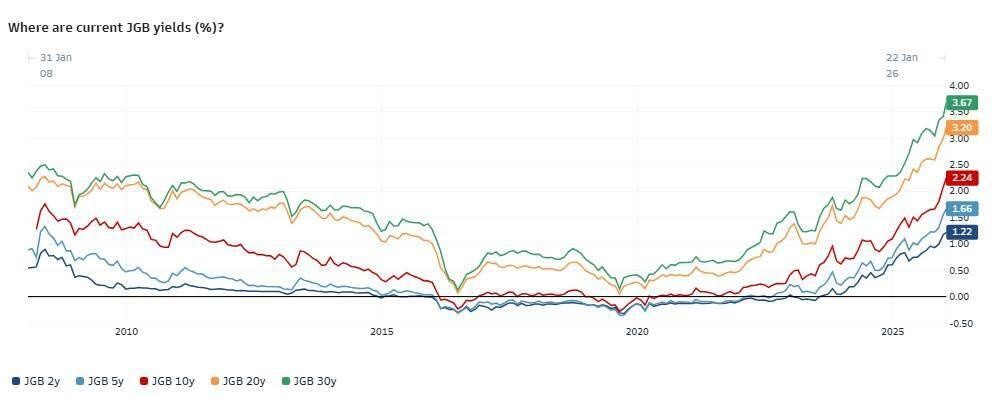
However, Goldman Sachs traders Cosimo Codacci-Pisanelli and Rikin Shah pointed out in a report that mere market intervention cannot solve the fundamental issues. They believe that the supply-demand imbalance in long-term Japanese government bonds is severe, and the loose fiscal policy has exacerbated this problem. Unless the Bank of Japan adopts a more hawkish stance or implements quantitative easing (QE) to stabilize the bond market, the yen and Japanese government bonds will continue to face pressure:
What can stop this situation? The Japanese Ministry of Finance should also reduce the issuance of long-term government bonds, but that is not enough. With demand so weak, the absolute supply of long-term Japanese government bonds remains high. Implementing offsetting quantitative easing could stabilize the market more quickly, but ultimately, interventions in interest rates or the foreign exchange market do not address the root causes of the problem. Of course, adjusting the direction of fiscal policy could change the situation, but it seems almost impossible at present. Therefore, the path of monetary policy remains. Does Ueda Kazuo have the ability to take unexpected hawkish measures to respond to the market? This week's meeting still indicates he is hesitant, but we believe the Bank of Japan may ultimately be forced to take action.
For long-term government bonds, it remains unclear whether these measures will be sufficient to provide support. Although current levels are already high, we believe the risks still lean towards prices continuing to rise until the supply-demand relationship stabilizes further
Why the U.S. May "Green Light"
Since 1996, the Federal Reserve has only intervened in the foreign exchange market on three occasions, the most recent being after the 2011 Japan earthquake. However, analysts believe that the current market environment may prompt the U.S. to change its stance. Ed Al-Hussainy, global interest rate strategist at Columbia Threadneedle Investment, points out that the U.S. Treasury may be concerned about the spillover effects of fluctuations in Japanese government bonds on the U.S. Treasury market and is considering using currency intervention as a stabilizing tool.
Leah Traub, portfolio manager at Lord Abbett & Co., believes that given the government's past concerns about currency intervention, if Japan indeed needs to intervene more forcefully, "the U.S. seems to be giving the green light."
Jason Furman, a Harvard University professor and former chairman of the White House Council of Economic Advisers, commented that both the U.S. and Japanese governments seem dissatisfied with the value of the yen, and everyone is highly vigilant. However, he also warned that historically, exchange rate checks and even actual interventions have not produced lasting effects, and real policy changes are needed to achieve that
