


The increase far exceeds that of chips and Mag 7, global mining stocks have become the "top allocation target" for fund managers

Global mining stocks are becoming a new favorite for fund managers, driven by AI prosperity and tight supply of key minerals, pushing the industry into a new "super cycle." Metal and mining indices have significantly outperformed tech giants. As investment logic shifts from cyclical drivers to structural demand, while mining stock valuations have risen sharply, they still remain at historical lows. The industry is active in mergers and acquisitions, with institutions having differing views on price prospects, but a long-term bullish sentiment prevails
Global mining stocks are rapidly rising to the top of fund managers' allocation lists, driven by a surge in metal demand triggered by the boom in artificial intelligence and tight supply of key minerals, indicating that the industry is entering a new "super cycle."
Since the beginning of 2025, the MSCI Metals and Mining Index has risen nearly 90%, significantly outperforming the semiconductor sector, global banking, and the "Big Seven" tech stocks. This upward trend shows no signs of slowing down, as the booming development of robots, electric vehicles, and AI data centers continues to push metal prices higher.
Among them, copper, as a key raw material for energy transition, has soared 50% during the same period. Besides copper, analysts are also bullish on the prospects of a range of minerals including aluminum, silver, nickel, and platinum. Meanwhile, influenced by concerns over U.S. monetary and fiscal policy and geopolitical risks, gold, after continuously hitting historical highs, is expected to continue benefiting.
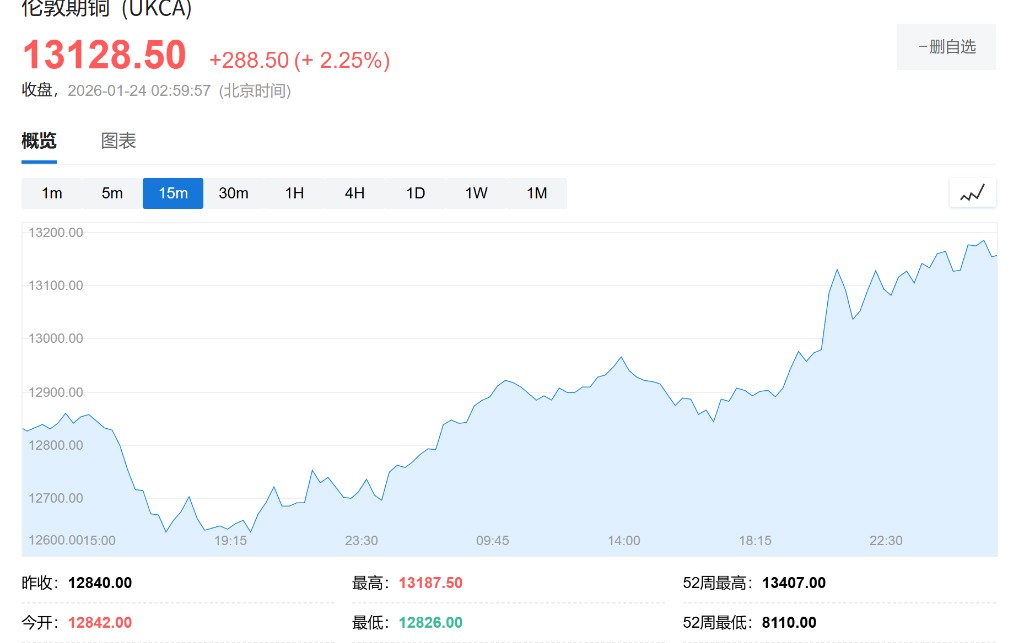
This outstanding performance marks a significant reversal in market sentiment. Previously, the sector was somewhat neglected due to commodity price fluctuations and concerns over slowing growth in China, the largest metal consumer. Now, with Beijing promising to support the economy through measures such as interest rate cuts, fund managers who previously flocked to tech and financial stocks are beginning to reassess the value of mining stocks, viewing them as core assets in their portfolios.
Shift in Capital Allocation and Structural Changes
The investment logic for commodities is undergoing a fundamental transformation. The correlation of commodities like copper and aluminum with the economic cycle is decreasing, gradually evolving from historically short-cycle trades dominated by global economic growth rates to structural investment targets. Dilin Wu, a research strategist at Pepperstone Group Ltd., points out that mining stocks have quietly transformed from a "boring defensive sector" to a "necessary portfolio anchor," becoming one of the few sectors that can capture changes in monetary policy dynamics while responding to increasingly volatile geopolitical landscapes.
Additionally, investors are gaining exposure to the AI theme by purchasing metal assets, which has also driven the trend of buying on dips. A monthly survey by Bank of America shows that European fund managers currently have a net increase of 26% in this sector, reaching a four-year high, although still below the 38% peak in 2008.
Valuation Discount Provides a Margin of Safety
Despite the recent surge, the valuation of the mining sector remains low. The forward price-to-book ratio of the Stoxx 600 Basic Resources Index relative to the MSCI Global Benchmark Index is about 0.47 times. This level is approximately 20% below the long-term average of 0.59 times and significantly lower than the previous cycle peak of over 0.7 times.
The analyst team at Morgan Stanley, led by Alain Gabriel, believes that despite the significant increase in the strategic importance of natural resources, this valuation gap still exists. Given that we are currently in a period of supply shortages, this backdrop should support higher commodity prices and valuation multiples.
Mergers and Acquisitions Wave and "Buy Over Build"
The capital-intensive nature of the industry prompts mining companies to prefer expanding capacity through mergers and acquisitions rather than new projects. Morgan Stanley points out that miners are striving for economies of scale and portfolio optimization, especially in the copper mining sector. Currently, several merger and acquisition deals are underway, including Anglo American Plc's acquisition of Teck Resources Ltd., and the potential merger between Rio Tinto Plc and Glencore Plc. This trend of "buy over build" is becoming the main theme of the industry.
However, top miners, including BHP Group and Rio Tinto, still primarily rely on iron ore profits, which are still affected by the end of the previous supercycle led by China. This further fuels the motivation for companies to shift towards mergers and acquisitions in the copper mining sector. Currently, Freeport-McMoRan Inc. and Antofagasta Plc are among the few companies providing pure copper mining exposure.
Divergent Institutional Views and Price Outlook
Despite the bullish market sentiment, some institutions remain cautious. Bank of America recently downgraded the European mining sector rating to "underweight," citing the risk of negative economic surprises. Nick Ferres, Chief Investment Officer of Vantage Point Asset Management, expressed concerns about the non-linear or parabolic rise in asset prices and has reduced gold exposure, but will consider re-entering during price corrections, as mining stocks remain very cheap.
Regarding future price trends, Bloomberg Industry Research (BI) expects the copper supply shortage to persist this year, with the gap potentially becoming more severe than in 2025. In terms of gold, BI analysts believe that gold prices could approach $5,000 per ounce, while Goldman Sachs predicts that gold prices will reach $5,400 by the end of 2026, about 8% higher than current levels. Gerald Gan, Chief Investment Officer of Reed Capital Partners Ltd. in Singapore, stated that the upward momentum for commodities is now stronger and more diversified, planning to gradually increase exposure to mining stocks in the coming months
