


Extremely rare! What does the US-Japan joint intervention mean for the market?

The New York Fed's rare "inquiry" into the yen is seen as a key signal that the U.S. is preparing to "step in" personally to stabilize the market. If a joint intervention by the U.S. and Japan materializes, it would not only mean a bloodbath for yen shorts but could also evoke associations with "Plaza Accord 2.0," fundamentally reshaping the pricing logic of the global foreign exchange market and risk assets
Japan is currently caught in a severe financial dilemma: between the collapse of the yen and the disintegration of the bond market, policymakers seem to have no way out. As Japanese bond yields soar and the currency remains under pressure, the market is closely watching for a signal that could change the global currency market landscape—whether the United States is preparing to "step in" to assist Japan.
Wallstreetcn previously mentioned that Japanese Prime Minister Fumio Kishida issued a stern warning on Sunday, promising that the government would take "all necessary measures" to address the market's speculative and extremely abnormal volatility. This statement followed last Friday's sharp market fluctuations, during which the USD/JPY exchange rate plummeted by about 1.75%, marking the largest single-day increase in five months. The market generally speculates that the catalyst for this reversal came from the New York Federal Reserve's extremely rare "rate check" action.
According to media reports citing informed sources, the New York Federal Reserve, at the direction of the U.S. Treasury, called major financial institutions last Friday to inquire about the USD/JPY exchange rate quotes. This action is typically seen as a precursor to direct intervention in the currency market and even a key signal that the U.S. is preparing to assist Japan in supporting the yen. The market interpreted this as a readiness of U.S. and Japanese authorities to work together to curb the yen's decline, triggering a massive short covering of the yen.
This potential expectation of "joint intervention" is reshaping investors' risk appetite. Analysts point out that if the Federal Reserve intervenes, it means that the intervention will no longer be a solo effort by Japan, and it may even evoke associations with "Plaza Accord 2.0." As the Bank of Japan faces dual pressures of maintaining bond market stability and curbing inflation, this exchange rate defense battle involving the U.S. could have far-reaching impacts on the dollar, U.S. bonds, and global risk assets.
Rare "Rate Check" by the New York Fed Sends Signals
Last Friday, after a neutral performance from the Bank of Japan meeting, the yen was initially sold off. However, just after 11 a.m. Eastern Time—typically the time of highest liquidity in the foreign exchange market—the Federal Reserve intervened and inquired with banks about the USD/JPY quotes.
The New York Fed represents the Treasury in financial transactions, and its "rate check" is usually a signal of concern from authorities regarding the trading situation of a certain currency, often occurring before direct intervention. According to The Wall Street Journal, this is a clear signal that U.S. and Japanese authorities are preparing to intervene to stop the yen's decline. As a result, the USD/JPY exchange rate plummeted and closed around 155.80.
It is noteworthy that this action is extremely rare. According to data from the New York Fed's website, the U.S. has only intervened in the currency market on three different occasions since 1996, with the most recent instance occurring after the 2011 Japan earthquake, when it collaborated with G7 countries to sell yen to stabilize the market.
According to Morning Forex analysis, due to time zone differences, during late-night hours in Tokyo, the Japanese Ministry of Finance can request the New York Fed to "take over" the intervention work, using the Japanese Ministry of Finance's foreign exchange reserves. The recent rate check by the New York Fed represents the will of the U.S. Treasury, requiring confirmation from U.S. Treasury Secretary Janet Yellen (and possibly even Trump), thus elevating it to the level of a multinational joint intervention action. The recent rate check by the New York Fed represents the will of the U.S. Treasury, requiring confirmation from U.S. Treasury Secretary Janet Yellen (and possibly even Trump), thus elevating it to the level of a multinational joint intervention action Past multinational joint intervention actions typically involved broader collaboration across multiple currencies (such as the Plaza Accord and the Louvre Accord), either in response to significant shocks (Asian financial crisis, euro instability, Great East Japan Earthquake). However, this joint action occurs in the absence of major shocks and does not involve broader currency collaboration, making it a rather rare occurrence.
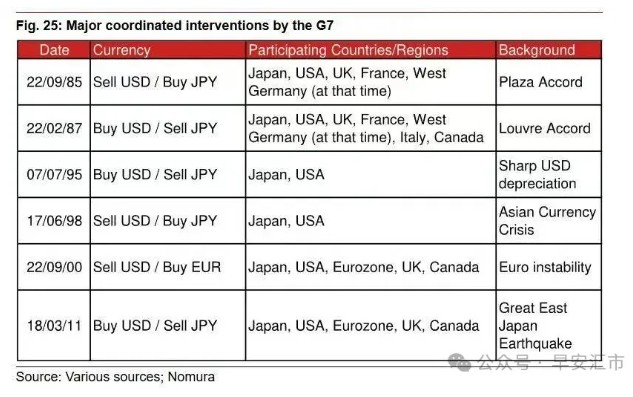
The urgency of the Japanese authorities stems from the sharp decline of the yen over the past two weeks and the ensuing shadow of a "Japanese bond crisis." Previously, Prime Minister Kishi Nobuo promised to exempt food sales tax for two years, a electoral commitment that raised market concerns about Japan's fiscal financing capacity, even drawing comparisons to the turmoil in UK government bonds triggered by former Prime Minister Liz Truss.
The Bank of Japan currently finds itself in an extremely passive position. On one hand, officials have warned for months that a weak yen will lead to high inflation; on the other hand, the Bank of Japan is reluctant to raise interest rates. This is because raising rates could accelerate the collapse of an already fragile bond market, which would in turn impact the stock market and the broader Japanese economy.
It is this dilemma of "protecting the exchange rate leads to a collapse of the bond market, while protecting the bond market leads to a collapse of the exchange rate" that may force Japan to seek external assistance. Market views suggest that the Bank of Japan is effectively asking the Federal Reserve to rescue it from this predicament: either the yen collapses, or the Japanese bond market disintegrates.
The Ghost of "Plaza Accord 2.0" and Market Games
The expectation of this "coordinated intervention" by the US and Japan has led Wall Street to reassess the outlook for the dollar. Last Friday, the dollar not only fell 1.7% against the yen but also weakened against other Asian currencies such as the Korean won and the New Taiwan dollar.
Stephen Miller of GSFM pointed out, "You cannot rule out the possibility of this government initiating a 'Plaza Accord 2.0'." He believes this action bears the shadow of the 1985 Plaza Accord, when major global economies worked together to lower the dollar. Miller emphasized that the Trump administration does not view the dollar as an "exorbitant privilege," but rather sees it as a "curse" as a reserve currency.
Anthony Doyle, Chief Investment Strategist at Pinnacle Investment Management, also stated that Japan cannot repair the yen alone without triggering domestic pressure or global spillover, thus a "Plaza Accord 2.0"-style coordinated outcome is no longer a crazy idea for some. When the U.S. Treasury starts making calls, it usually signifies that the situation has exceeded ordinary foreign exchange boundaries.
However, Homin Lee, Senior Macro Strategist at Lombard Odier, warned that if this is a genuine attempt to anchor the dollar against the yen, Tokyo must subsequently take actual intervention actions. He noted that 160 is a simple integer threshold, and for many Japanese voters and market commentators, it is a major crisis indicator ahead of the early elections in the lower house in February
What Will Happen Next?
For market participants, the most critical question is "What will happen next?" Nick Twidale, Chief Analyst at AT Global Markets, warns that given the comments from high-ranking officials and potential U.S. intervention, traders should be very vigilant at the market open on Monday, as yen shorts may be squeezed.
Brent Donnelly from Spectra proposed three possible paths:
- Most Likely Path (Probability 45%): This inquiry is aimed at stabilizing the situation in a market with low liquidity on Friday afternoon, and the Japanese Ministry of Finance (MOF) will likely take actual action on Sunday evening or during the New York session on Monday.
- Secondary Path (Probability 20%): This is merely an attempt to stabilize the exchange rate at zero cost; if there is no actual intervention following this, once the market realizes this, the USD/JPY will trigger massive short covering, forcing the MOF to eventually intervene physically at the 159/160 level.
- Macro Agreement (Probability 20%): The U.S., Japan, and South Korea may have reached some sort of agreement (similar to rumors of the Mar-a-Lago agreement) to jointly stabilize the exchange rate due to excessive depreciation of the yen and won.
Donnelly believes that based on these probabilities, the downward trend of USD/JPY may continue. However, he also points out that this does not necessarily mean the beginning of a comprehensive weakening policy for the dollar. His suggested strategy is to "sell EUR/JPY" and "buy AUD/USD," believing that this logic will become clearer over time.
Stephen Miller summarized: "Japan has been sleepwalking into chaos for a long time... The question is, you always have to pay the price one day, and I suspect that day is now, and we are witnessing something unprecedented—America has taken action."
