


When AI starts "selling goods," JPMorgan Chase explains the monetization logic behind ChatGPT's advertising testing

JPMorgan analyzes OpenAI's advertising monetization strategy, believing that its testing of advertisements in ChatGPT marks a shift from a subscription model to diversified commercial monetization. With nearly 1 billion users, 95% of whom are free users, advertising revenue has become essential. ChatGPT's advertising model will achieve higher cost per thousand impressions by capturing users' commercial intentions. This move may affect user growth rates and competitive positioning, but OpenAI's management discipline and brand recognition will support it through the testing period
Officially bidding farewell to the "free lunch" era, OpenAI has finally pressed the button for advertising monetization. JPMorgan Chase believes that with ChatGPT announcing it will begin testing ads in the free and Go versions (lightweight subscription version) in the coming weeks, this AI giant has officially taken a key step in transitioning from solely relying on a subscription model to diversified commercial monetization.
On January 24, JPMorgan Chase stated in its latest research report that on January 16, OpenAI announced it would start testing ads in the free and Go versions of ChatGPT in the coming weeks, marking a substantial shift in its monetization strategy.
The report noted that this shift is not coincidental—faced with the reality that 95% of nearly 1 billion weekly active users are free users, and a commitment to infrastructure investment of up to $1.4 trillion over the next eight years, advertising revenue has shifted from an option to a business necessity.
JPMorgan Chase's analysis pointed out that ChatGPT's advertising model will differ from the "attention economy" of traditional social platforms, instead capturing users' high commercial intent to achieve higher effective cost per mille (eCPM). Currently, about 12% of ChatGPT's queries are search-related, and users have a strong purchasing intent.
The firm believes that this strategy aims not only to open up new revenue streams, but also to build a clear value ladder encompassing free, Go ($8/month), Plus ($20/month), and Pro ($200/month) tiers, compelling users to convert to paid tiers through the advertising experience.
At the same time, JPMorgan Chase believes that as the first mainstream large language model provider to test ads in consumer applications, OpenAI's move may impact its user growth rate and competitive position, but the company's management discipline, brand recognition, and user stickiness will support it through the testing period.
The "Three Driving Forces" of Commercialization: Advertising is an Inevitable Choice
JPMorgan Chase believes that OpenAI's deployment of ads is a commercial inevitability based on three key factors:
- First is the large base of free users. Among ChatGPT's approximately 900 million weekly active users (WAUs), about 95% are free users, and maintaining such a large user base is costly without a "freemium" conversion model.
- Second is the astonishing capital expenditure pressure. OpenAI has committed to investing $1.4 trillion in AI infrastructure over the next eight years, and relying solely on subscription and API revenue is insufficient to cover this massive expenditure.
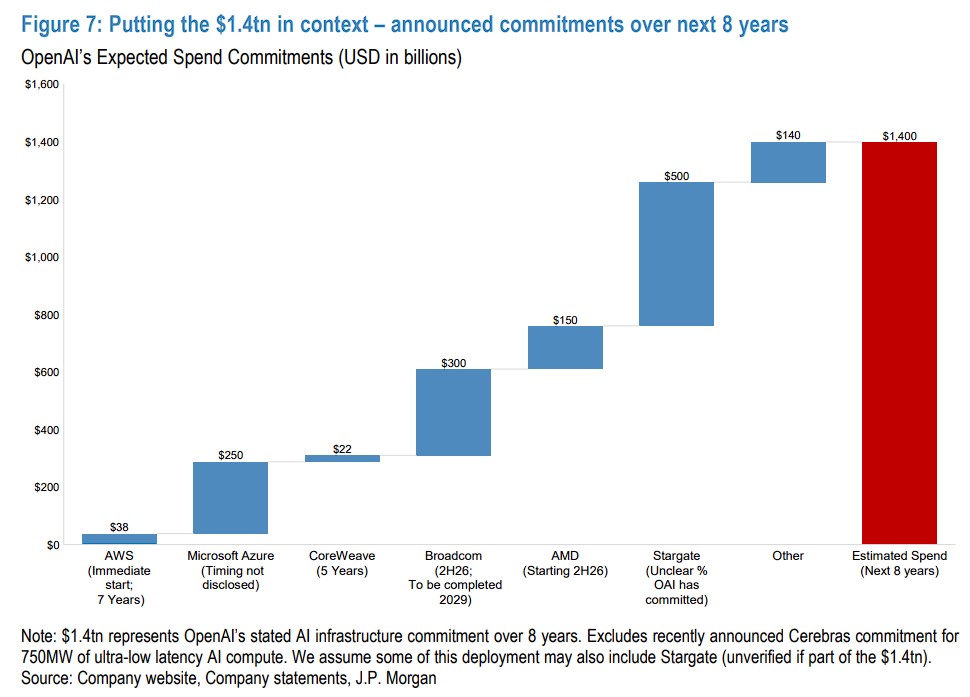
Additionally, according to data from The Information, the company urgently needs to generate over $10 billion in additional revenue through advertising and shopping businesses by 2027
- Finally, there is the growing commercial intent. Data shows that ChatGPT has handled about 12% of search queries, with users increasingly relying on AI for product research and seeking recommendations, providing a natural scenario for ad placements.
Monetization Logic Reconstruction: From Competing for "Attention" to Capturing "Intent"
JP Morgan believes that OpenAI's advertising strategy will focus on "user intent" rather than "user attention." Unlike social platforms that monetize by maximizing user dwell time, OpenAI's principle is "not to optimize the usage duration of ChatGPT."
This means that ads will be prioritized for queries with clear purchase signals (such as product inquiries and comparison requests). If executed properly, this precise high-intent matching will generate higher conversion rates and eCPM than traditional display ads while maintaining user trust.
JP Morgan expects this model to attract advertisers seeking high return on investment (ROI), especially those looking to drive brands through the "purchase funnel" via AI conversational interactions.
Implementation Path: From Experimental Budgets to Industry-Wide Penetration
The research report indicates that, according to media reports, testing will begin in early February, initially targeting a small number of advertisers, each committing less than $1 million and adopting a per-view payment model rather than a pay-per-click model.
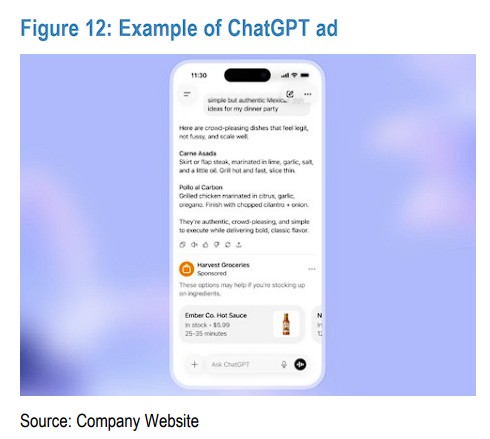
JP Morgan predicts that in the initial phase, OpenAI will primarily attract "experimental budgets" to establish proof of concept. The main targets include advertisers from social and emerging platforms like TikTok, X, and SNAP, which account for about 13% of U.S. digital ad spending.
If OpenAI can prove its conversion rate advantage, it is expected to compete for budgets in core verticals such as retail (approximately $115 billion), fast-moving consumer goods (approximately $65 billion), automotive, and financial services from giants like Google, Meta, and Amazon in the future.
Additionally, OpenAI faces the choice of "build or buy" regarding advertising infrastructure.
The report states that while building proprietary advertising technology (DSP/SSP, attribution measurement) is more economically beneficial in the long run, it takes longer; collaborating with existing giants like The Trade Desk or Google Ad Manager can accelerate implementation but sacrifices profit margins and control. Based on management's background, JP Morgan tends to believe that OpenAI will choose to build internally.
Tiered Pricing Strategy: Using Ads to Drive Paid Conversions
Another major strategic intent of introducing ads is to reshape user segmentation. JP Morgan analyzes that an important goal of testing ads in 2026 is to push free users towards the $8 per month "Go" tier JPMorgan Chase believes that by displaying ads in the free and Go versions while maintaining an ad-free experience for Plus, Pro, and enterprise versions, OpenAI has established a clear value ladder.
This move aims to increase the conversion rate from free to paid users from the current approximately 5% to 7-8% (upper single digits). This not only increases subscription revenue but also filters out high-value users, optimizing the overall revenue structure.
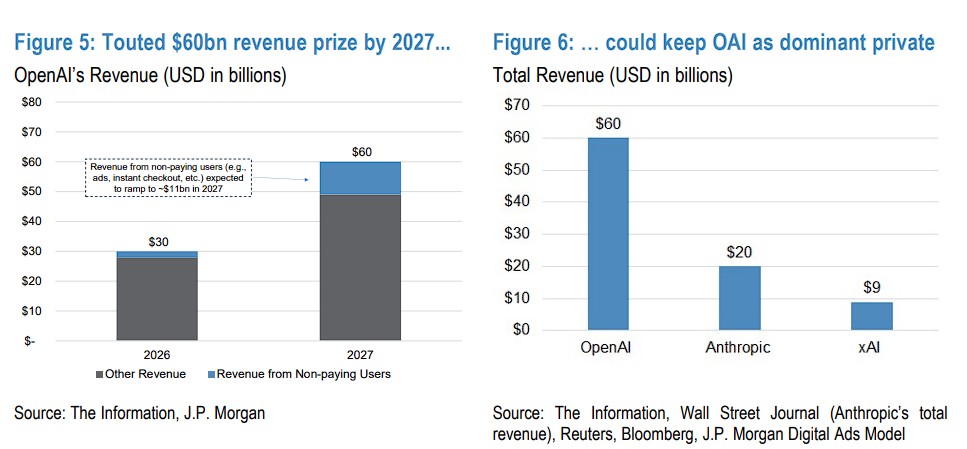
According to the research report, based on data reported by The Information, OpenAI's revenue targets are highly ambitious, with a total revenue target of $30 billion by 2026, of which about $2 billion will come from non-paying users (advertising, shopping, etc.). The total revenue target for 2027 doubles to $60 billion, with non-paying user revenue surging to about $11 billion.
Competitive Landscape: Breaking Through Under the Shadow of Google Gemini
Although OpenAI currently holds about 60% of the mobile AI application download market, competitive risks still exist.
The research report points out that Google Gemini, with its strong position in the search field, mature advertising model, and vast data advantages, remains a major threat. Moreover, Gemini has not yet introduced advertising, which puts some pressure on OpenAI's user experience.
However, JPMorgan Chase notes that OpenAI's management has consistently emphasized that "trust comes before short-term monetization," and Altman has stated that they will handle advertising very carefully. The company has released a series of advertising principles, including content independence, privacy protection, and user control, which help protect the core experience during the testing phase.
Given OpenAI's significant lead in brand recognition and user engagement, JPMorgan Chase believes that the risk of users flowing to competitors like Claude or Grok is relatively controllable.
The above exciting content comes from the Wind Trading Platform.
For more detailed interpretations, including real-time analysis and frontline research, please join the【 **Wind Trading Platform ▪ Annual Membership**】

Risk Warning and Disclaimer
The market has risks, and investment should be cautious. This article does not constitute personal investment advice and does not take into account individual users' specific investment goals, financial conditions, or needs. Users should consider whether any opinions, views, or conclusions in this article align with their specific circumstances. Investment based on this is at one's own risk.
