


AI empowerment + patent expirations, 2026 will be an exciting year for healthcare private equity!

UBS stated that if interest rates continue to stabilize and policy uncertainties are gradually digested, the recovery momentum in the healthcare market is expected to continue until 2026. One of the variables driving the rebound is the pressure from patent expirations faced by large pharmaceutical companies in the coming years, and the role of AI in the medical field is shifting from "concept-driven valuation" to "directly impacting cost structures."
After experiencing multiple uncertainties from policies, interest rates, and regulations, the U.S. healthcare private equity market is at a critical turning point.
According to the Wind Trading Desk, UBS pointed out in its latest release that as the macro environment gradually clarifies, AI technology accelerates its implementation, and the pressure from patent expirations (LOE) in the pharmaceutical industry approaches in the coming years, 2026 is expected to be an important year for the healthcare private equity and venture capital markets to become active again and improve exit paths.
From "Suppression" to "Repair": Market Sentiment is Warming Up
Looking back at 2025, the healthcare sector faced overall pressure in the public and private equity markets. Drug price reforms, adjustments in healthcare policies, uncertainties in FDA approvals, and a high-interest-rate environment collectively suppressed risk appetite, causing most sub-sectors to underperform the market.
UBS stated that signs of recovery began to emerge in the second half of 2025:
- IPO window showed signs of loosening: In the fourth quarter of 2025, Medtronic's MDLN completed an IPO of approximately $7.2 billion, becoming the largest listing transaction of the year, releasing a key emotional signal;
- Secondary market rebounded first: The biotechnology index XBI rebounded nearly 50% in the second half of 2025, laying the foundation for the recovery of primary and private equity valuations;
- Private equity funds continued to flow in: VC investment in the healthcare sector grew by 13% year-on-year in 2025, with biopharmaceutical-related financing increasing by about 20% year-on-year, indicating that long-term capital has not exited the market.
UBS believes that if interest rates continue to stabilize and policy uncertainties are gradually digested, this momentum for recovery is expected to continue into 2026.
Approaching Patent Expirations (LOE) Reinforces Strategic M&A Logic
One of the structural variables driving the recovery of private equity in healthcare in 2026 is the pressure from concentrated patent expirations faced by large pharmaceutical companies in the coming years.
UBS estimates that 2026-2033 will be a period of intensive LOE releases in the pharmaceutical industry. Against this backdrop, multinational pharmaceutical companies' reliance on external innovation has significantly increased, directly boosting the strategic M&A demand for high-quality private biopharmaceutical assets.
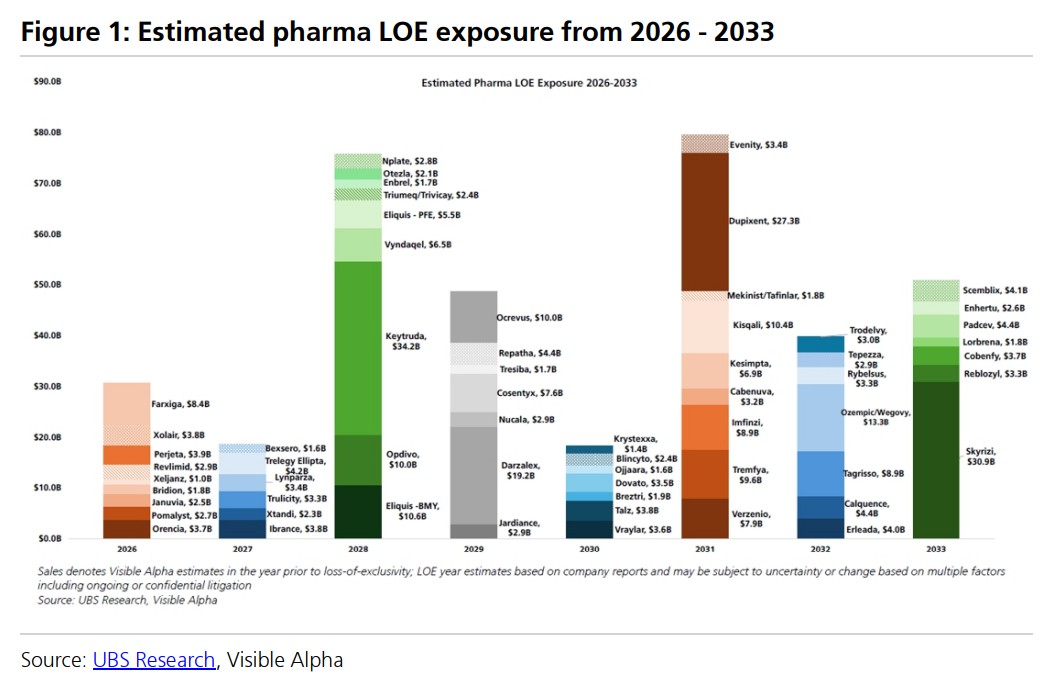
This trend began to emerge in 2025:
The acquisition amount of private biopharmaceutical companies reached $16.4 billion, a year-on-year surge of about 150%; compared to IPOs, M&A has become a more significant exit path, providing private equity funds with more certain liquidity expectations.
UBS predicts that as the patent cliff approaches, competitive mergers and acquisitions around "differentiated mechanisms (MoA) + late-stage clinical assets" may further heat up in 2026.
Three Major Therapeutic Areas May Become the "Main Battlefield" for Private Capital
In the therapeutic area, UBS highlighted three potential "catalysts" that may form in 2026:
First, psychedelic drugs are entering a critical validation period. Multiple Phase III clinical data will be disclosed intensively in 2026. UBS believes that this field has already reduced risks at the mechanism level, and the ability to execute commercialization will become the key to valuation differentiation, making it more suitable for defensive capital allocation
Second, the KRAS target may welcome "paradigm validation." If RVMD's Phase III data in pancreatic cancer is positive, it could reshape the market's perception of the overall commercial potential of the KRAS pathway, thereby driving a revaluation of several private companies.
Third, weight loss and metabolic diseases remain a high ground for mergers and acquisitions. With the advancement of new generation solutions such as oral GLP-1 and long-acting weight loss drugs, UBS expects to see more merger and acquisition transactions related to pharmacokinetics or new mechanisms continuing in 2026.
AI is no longer just a "story," but a tool for cost and efficiency
Unlike before, AI's role in the medical field is shifting from "concept-driven valuation" to "directly impacting cost structures."
In the healthcare IT and managed care sectors, UBS is particularly focused on two changes:
- Intensified competition in AI medical documentation (AI Scribe): Against the backdrop of hospital budget pressures, automated coding and documentation tools are seen as breakthroughs in efficiency. Some systems have observed an 11%-14% increase in clinical workload metrics (wRVU), but this may also exert reverse pressure on the healthcare payment system;
- Entry of major companies changing industry structure: Tech giants like Anthropic, OpenAI, and NVIDIA are accelerating their layout in medical AI applications, coupled with a rapid increase in AI usage among doctors, leading to a significantly faster pace of technology diffusion in the industry compared to the overall economic level.
UBS believes that AI at this stage is more likely to benefit private equity and growth assets, rather than forming a unified valuation premium in the secondary market in the short term.
PE and VC: Exit repair is the "core variable" for 2026
From a funding perspective, healthcare VC investment in 2025 shows a structural characteristic of "early-stage flat, late-stage warming," while PE-supported exit activities have clearly rebounded:
Mergers and acquisitions dominate exits, while IPOs are still in the early stages of recovery; several healthcare unicorns are expected to go public or be acquired in 2025, providing a reference point for private asset pricing.
UBS judges that if the macro environment does not experience new severe shocks, the quantity and quality of healthcare IPOs in 2026 are expected to marginally improve, thereby enhancing risk appetite in the primary and private markets.
UBS does not depict 2026 as a year of comprehensive prosperity for healthcare. On the contrary, its core judgment leans more towards: this is a year of "clear differentiation and rich structural opportunities."
The efficiency revolution brought by AI, the merger demand generated by patent expirations, and the marginal repair of exit channels together constitute the three main lines of the healthcare private market. For capital that can make precise choices between technology, clinical, and commercialization, 2026 may indeed be worth getting excited about again
