"Go long on Detroit"! Bank of America Hartnett: Learn from history, the best strategy to take over gold

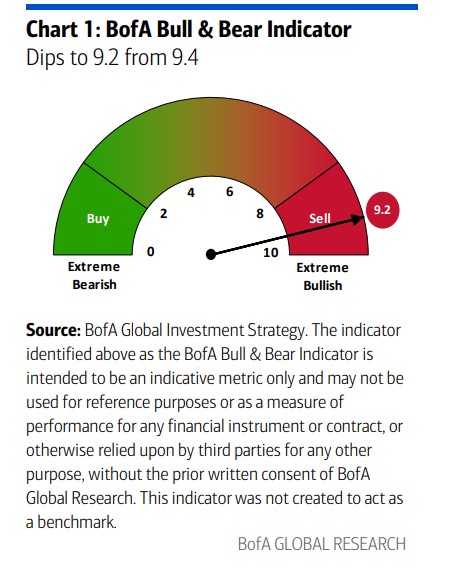
Bank of America pointed out that the current bull-bear indicator has risen to 9.2, which triggers a short-term sell signal. However, investors should grasp the rotation logic of "going long on Detroit and shorting Davos," shifting from large-cap tech stocks to small and mid-cap stocks and the real economy sector. This strategy draws lessons from the 1970s: just as small-cap stocks took over from gold to become the winners of the new cycle, small and mid-cap stocks are also expected to become core assets replacing the first-half winners like gold under the bond bear market and policy support
Bank of America has sent a clear signal: although the "Bull-Bear Indicator" is in the extremely bullish zone (9.2) and has issued a tactical sell signal, strategically, investors should not retreat but should rotate. The core logic is "long Detroit, short Davos," that is, shifting from crowded large-cap and tech stocks to small and mid-cap stocks and real industries.
According to the Wind Trading Desk, on January 22, Bank of America's star strategist Michael Hartnett pointed out in the latest research report that the winners of the first half of the 2020s (U.S. tech stocks, gold) are giving way to the winners of the second half (emerging markets, small and mid-cap stocks). Against the backdrop of soaring U.S. Treasury yields and a "big bear market" in bonds, funds are seeking "any assets outside of bonds." For investors, this means focusing on previously extremely undervalued asset classes, especially small and medium-sized enterprises that benefit from government intervention in cost control and re-industrialization.
Capital Flow Monitoring: Soaring U.S. Treasury Yields
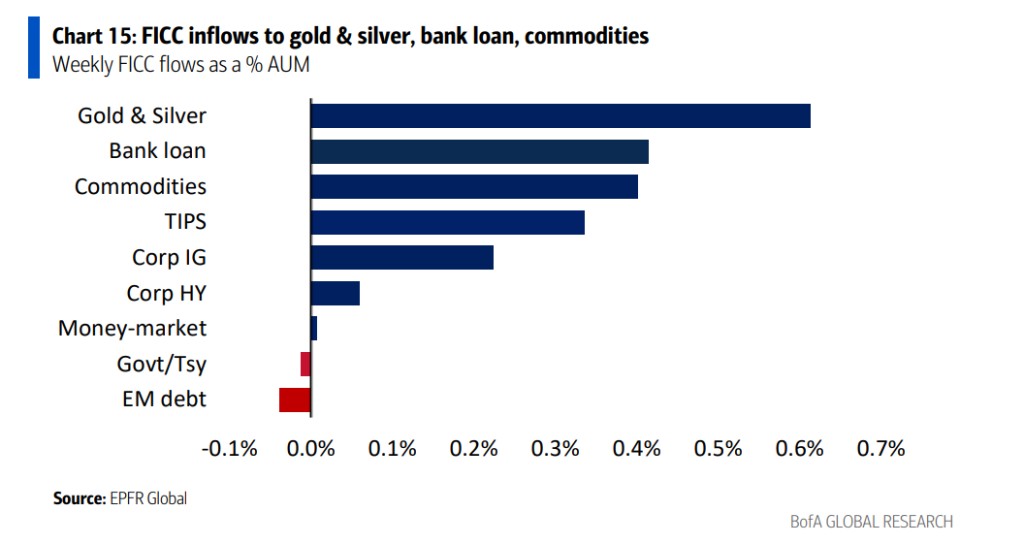
In the week ending January 22, 2026, global market capital flows showed significant volatility:
Bond Market: Despite rising yields, recorded an inflow of $15.4 billion.
Gold: Continues to be in demand, with an inflow of $4.9 billion.
U.S. Stocks: Experienced an outflow of $16.8 billion, the first in two weeks.
The current "spirit of the times" in the market is that although the selection of the Federal Reserve Chair usually brings yield volatility (since 1970, yields have risen within three months of seven nominations), the market believes that the new chair in 2026 will not allow the 30-year U.S. Treasury yield to break the "safe" level of 5%, as quantitative easing (QE) and yield curve control (YCC) will intervene to "repair" prices.
Theme of the Second Half of the 2020s: ABB (Anything But Bonds)
Bank of America points out that the bear market in bonds is extremely severe. Since the beginning of the 2020s, the price of 30-year U.S. Treasuries has fallen by 50% from its peak, and Japanese government bonds (JGB) have fallen by 45%.
First Half Script: The bond bear market has spawned bull markets in U.S. tech stocks (the seven giants), European/Japanese bank stocks, and gold.
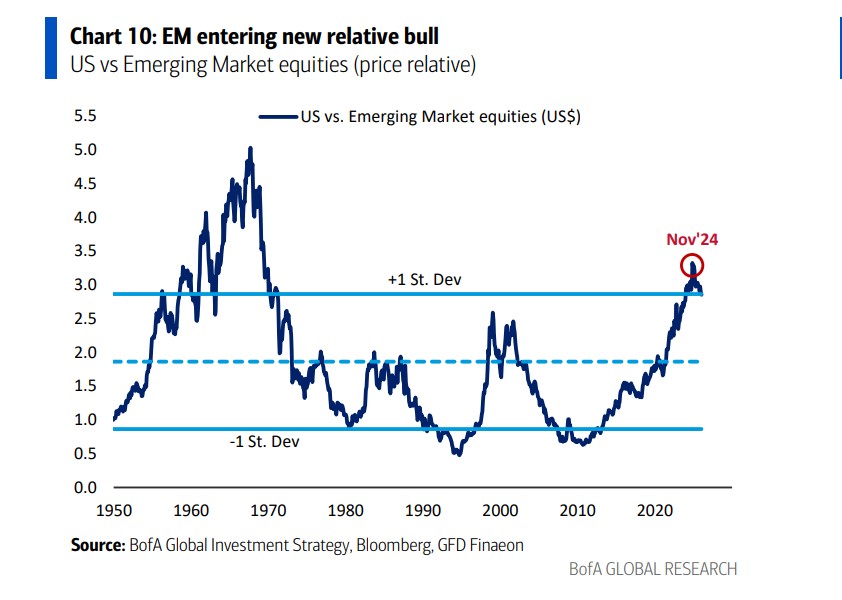
Second Half Script: Bank of America believes that emerging markets (EM) and small and mid-cap stocks will become the new beneficiaries of the "ABB" strategy.
- Historical Resonance: This is similar to the 1970s when the end of the Bretton Woods system led to the depreciation of the dollar, initially with gold reigning supreme (1971-74), followed by small-cap stocks replacing gold as the best asset from 1975-77. Bank of America strongly recommends GLD (gold), GNR (resources), EEM (emerging markets), MDY (mid-cap stocks), and IJR (small-cap stocks) as beneficiaries for 2026
Core Strategy: "Long Detroit, Short Davos"
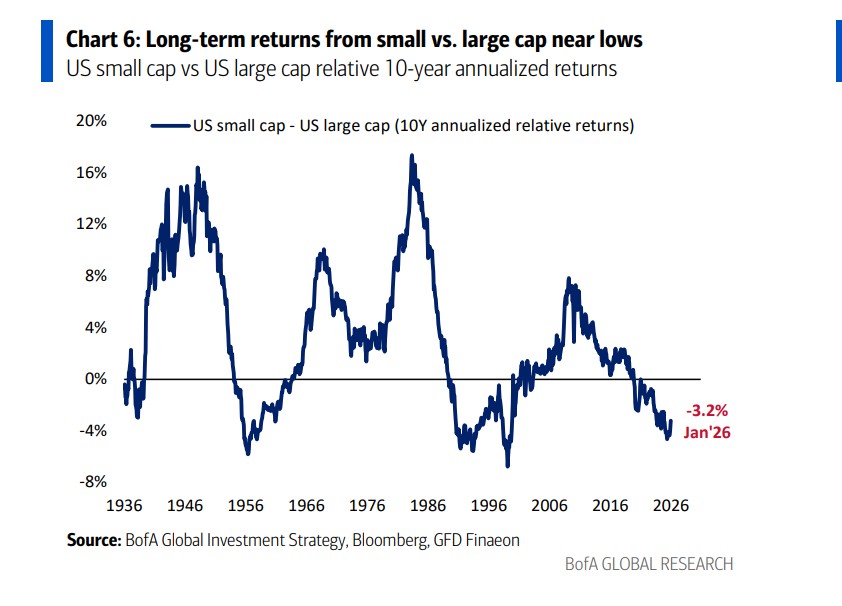
Bank of America is firmly optimistic about the performance of U.S. small and mid-cap stocks until 2027, a strategy referred to as "Long Detroit (representing the real economy/small and medium-sized enterprises), Short Davos (representing global elites/large enterprises)." The four pillars supporting this view include:
Extreme Position Disparity: Since the 2020s, U.S. large-cap stocks have received $1.6 trillion in capital inflows, while small-cap stocks have faced $6.1 billion in capital outflows. This significant divergence indicates extreme reverse trading opportunities.
Extreme Price Undervaluation: Over the past century, only in 1956 and 1999 did small-cap stocks have a worse long-term return relative to large-cap stocks than they do now.
Policy Shift: The goal of the Trump administration was to lower "funding costs" through QE/YCC, eliminating the tail risk of a significant rise in bond yields.
Political Intervention (from invisible hand to visible fist): The government is actively intervening in the corporate sector to control prices. In 2025, tariffs will be used to lower healthcare costs, in 2026, banks will be pushed to reduce credit card rates, limit private equity from purchasing homes, and tech companies will be made to pay for power generation for data centers. This suppression of energy, healthcare, and credit costs effectively compresses the profit margins of "large enterprises," benefiting the prosperity of "Main Street," the return of manufacturing, and small and medium-sized enterprises.
Global Macro: Yen Depreciation and the Rise of Emerging Markets
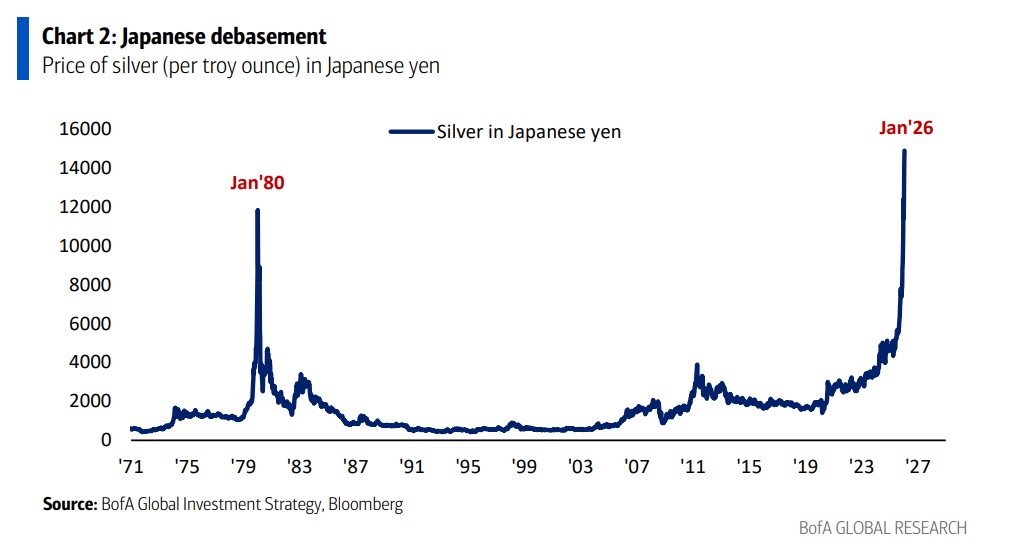
On a macro level, Japan's currency depreciation is triggering significant capital outflows.
- Yen-Denominated Silver: Prices have reached an all-time high, surpassing the peak in 1980, marking the impact of currency depreciation.
Capital Outflow: Weak Asian currencies are stimulating capital flows into U.S. and European assets; for instance, South Korean retail investors have cumulatively invested nearly $100 billion in U.S. stocks since 2019.
Emerging Market Bull Market: The long-term bull market in international stocks has entered its second year. The strengthening of emerging market currencies driven by strong commodity prices (boosted by AI construction) will lower emerging market bond yields, thereby pushing emerging market stocks into a new relative bull market. Bank of America is particularly optimistic about China, believing that its 3% weight in the MSCI ACWI index is too low compared to the 64% weight of the U.S., and that consumption's share of GDP is expected to rebound from a low of 40%.
Gold and Market Signals
In the context of a new world order, currency devaluation, populism, and excessive fiscal spending, gold remains an attractive hedging tool. Historically, the average increase in the four gold bull markets over the past 60 years has been about 300%, which suggests that gold prices could peak above $6,000.
The current reading of the bull-bear indicator is 9.2, which is in the "extremely bullish" range (a reading above 8.0 indicates a sell signal). This is mainly influenced by significant outflows from the stock market and emerging market ETFs, offsetting the positive aspect of cash levels being at a historical low (3.2%). This indicates that short-term market sentiment is overheated, and caution is needed regarding the risk of a pullback, but this is more of a rotational opportunity rather than a signal to exit completely.