


ILUVATAR COREX announced the fourth-generation chip architecture roadmap, expecting to surpass NVIDIA's Rubin architecture next year

ILUVATAR COREX released its fourth-generation architecture roadmap on January 26, planning to surpass NVIDIA's Rubin architecture by 2027. The new architecture focuses on "high efficiency, predictability, and sustainability," aiming to enhance the performance of AI++ computing systems. It is expected to surpass Hopper in 2025, benchmark against Blackwell in 2026, and exceed Rubin in 2027. ILUVATAR COREX will continue to launch new products to address issues such as low energy efficiency and insufficient creativity in the industry
On January 26, the general GPU company TianShuZhiXin (09903.HK) released its fourth-generation architecture roadmap, proposing a design goal of "high-quality computing power" centered on "high efficiency, predictability, and sustainability," aiming to create a new paradigm for AI++ computing systems, with expectations to surpass NVIDIA's Rubin architecture by 2027 and move towards more innovative breakthrough architecture designs.
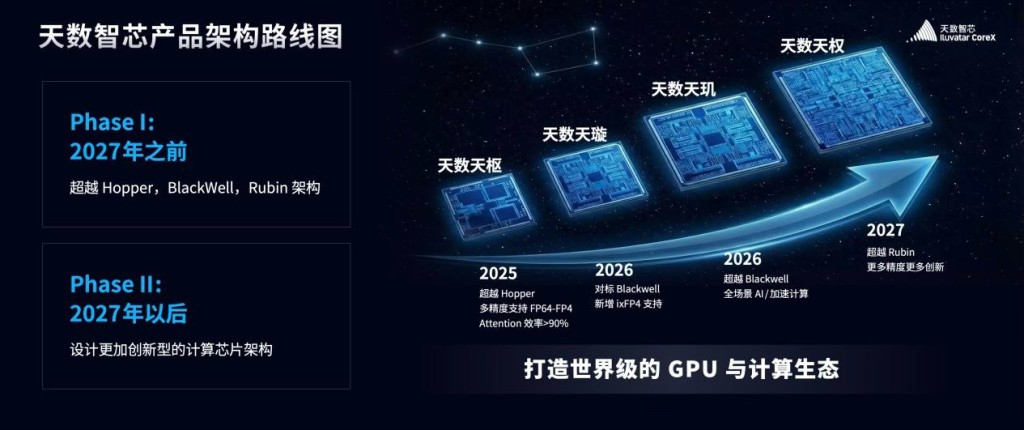
TianShuZhiXin's head of AI and accelerated computing technology, Shan Tianyi, announced the fourth-generation architecture roadmap. Among them, in 2025, the TianShu TianShu architecture will surpass Hopper; in 2026, the TianShu TianXuan architecture will benchmark against Blackwell; in 2026, the TianShu TianJi architecture will surpass Blackwell; in 2027, the TianShu TianQuan architecture will surpass Rubin; and after 2027, it will shift towards breakthrough computing chip architecture design. In the next three years, TianShuZhiXin will release multiple products based on this fourth-generation architecture, continuously enhancing computing performance.
Earlier this January, NVIDIA CEO Jensen Huang announced at CES that the company's latest AI super chip platform, Vera Rubin, has begun full-scale production, integrating NVIDIA's Vera CPU and Rubin GPU. Jensen Huang pointed out that the capabilities of the Vera Rubin platform are twice that of the previous generation Grace Blackwell, with assembly time reduced from 2 hours to 5 minutes. Despite the significant performance improvement, the cooling requirements of Vera Rubin have not increased, eliminating the need for water cooling equipment.
In response to industry challenges such as low energy efficiency ratios, insufficient creativity, and practical usage difficulties, TianShuZhiXin proposed a solution for "high-quality computing power," defining it by three core characteristics: high efficiency, creating optimal TCO (total cost of ownership) for customers through optimized design, and effectively handling complex application scenarios; predictability, allowing customers to anticipate performance before deployment through precise simulation; and sustainability, seamlessly adapting to the evolution from traditional algorithms to future unknown algorithms, ensuring long-term usage value.
Shan Tianyi introduced key details of the fourth-generation architecture, including the TianShu TianShu architecture, which supports high-precision scientific computing to AI precision computing, achieving over 90% effective utilization efficiency of computing power when executing attention mechanism-related calculations; the TianShu TianXuan architecture, which adds ixFP4 precision support; the TianShu TianJi architecture, which achieves full-scene AI and accelerated computing coverage; and the TianShu TianQuan architecture, which incorporates more precision support and innovative design.
Additionally, in the edge computing field, TianShuZhiXin Vice President Guo Wei officially launched the "Tongyang" series products, completing the "cloud + edge + end" full-scene computing layout. The four products released include the Tongyang TY1000 computing module, which uses a 699-pin interface, integrating industry-level computing power and an open ecosystem in a pocket-sized form for portable deployment; Tongyang TY1100 computing power module integrates ARM v9 12-core CPU and self-developed GPU module, providing abundant computing power for diverse choices; Tongyang TY1100_NX computing terminal, with larger video memory, becomes a high cost-performance option, known as the "small cannon" of edge computing power; Tongyang TY1200 computing terminal, with an extreme performance of 300 TOPs and compact size, provides core support for cutting-edge scenarios such as AIPC and embodied intelligence.
It is worth noting that the nominal computing power of the entire Tongyang product line is based on measured dense computing power, covering a range from 100T to 300T. In multiple scenarios including computer vision, natural language processing, DeepSeek 32B large language model, embodied intelligence VLA model, and world model, the performance of Tongyang TY1000 significantly outperforms NVIDIA AGX Orin. Guo Wei stated that the goal of the Tongyang series products is to achieve the highest computing power at the edge in China, providing the optimal carrier for physical AI to connect with the physical world and promoting the transformation of generative AI into "doing things" physical AI.
As of the close on January 26, TianShuZhiXin fell 7.65%, closing at HKD 188.2.
The Paper
Risk Warning and Disclaimer
The market has risks, and investment requires caution. This article does not constitute personal investment advice and does not take into account the specific investment objectives, financial conditions, or needs of individual users. Users should consider whether any opinions, views, or conclusions in this article are suitable for their specific circumstances. Investment based on this is at one's own risk.
