


The "big short" continues to buy, triggering GameStop, with the stock price temporarily rising by 8.8%

Investor Michael Burry, known for successfully shorting the U.S. real estate market before the financial crisis, disclosed that he has been continuously buying GameStop stock recently. The stock rose as much as 8.8% during intraday trading on Monday, marking the largest intraday increase since May and reaching a high not seen since October 8, with significantly increased trading volume. Burry stated that this investment is a long-term value bet, rather than a speculative bet on meme stocks again
Michael Burry, the investor who gained fame for betting against the U.S. housing market before the financial crisis, stated on Monday that he is buying GameStop, causing the company's stock price to surge by as much as 8.8% during intraday trading.
Burry wrote on Substack that he is confident in the company's chairman and CEO Ryan Cohen. As online gaming becomes increasingly popular, GameStop's primarily brick-and-mortar business network is facing challenges, and Cohen has been trying various strategies to address these issues.
Burry wrote:
“I hold GME, and I have been buying recently. I expect that the price I bought in at may soon approach 1 times tangible book value and 1 times net asset value. Furthermore, the company is led by young CEO Ryan Cohen, who is directing capital allocation and cash flow utilization, with a strategic vision focused on long-term development over the next 50 years.”
“I do not expect to achieve long-term value through a short squeeze. I believe in Ryan, I like what I see in the overall layout, corporate governance, and strategy. I am willing to hold long-term and look forward to seeing where things go. I am 15 years older than him, but not old enough to be impatient.”
GameStop's stock price skyrocketed in 2021, becoming the most representative "meme stock," largely due to Cohen's initial significant investment in the company. Burry was also one of the investors at that time, but he later stated that he had sold his shares before the stock price surged dramatically. Over the past year, GameStop's stock performance has lagged behind the overall market and is currently well below its historical highs during the pandemic.
On Monday, the stock rose by as much as 8.8%, marking the largest intraday gain since May, with the stock price reaching its highest level since October 8, and trading volume also significantly increased. Ultimately, GameStop closed up 4.44% at $24.01.
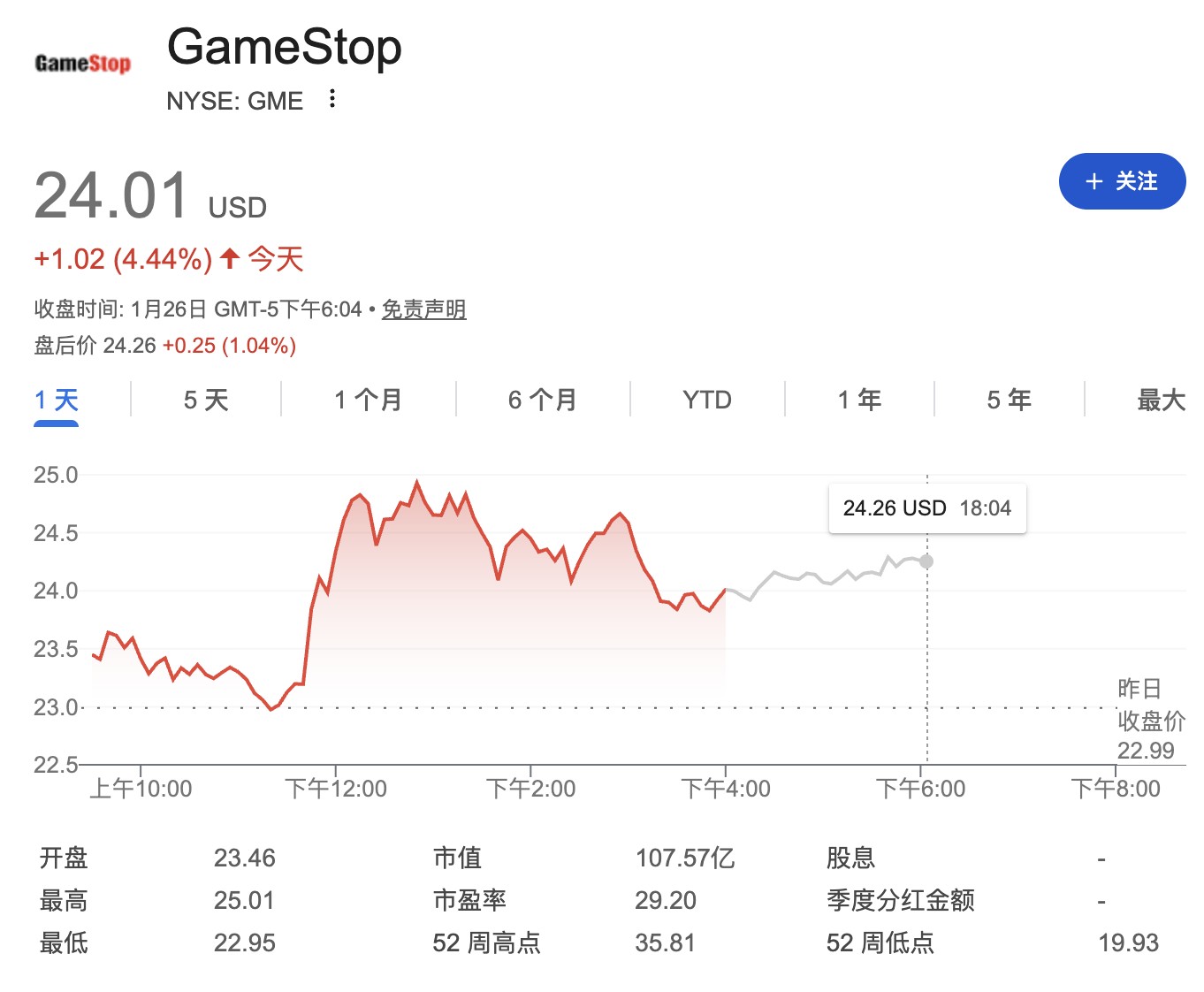
Options traders flocked to buy call options for GameStop, causing the one-month implied volatility to rise to its highest level since early December, while the premium of call options relative to put options (i.e., call skew) significantly widened. The total volume of call options on Monday reached its highest level since June 12.
Since the beginning of this year, GameStop's stock price has risen by about 21%, but compared to its peak five years ago, the stock price is still down about 72%.
“Willing to Hold Long-Term”
Media reports indicate that since the frenzy in 2021, GameStop's stock price has experienced sharp increases at various points in time, often driven by financial influencers posting on social media. However, after each rise, the stock price would fall again. Investors have consistently questioned whether the company can successfully transition from brick-and-mortar retail to an online model.
Nevertheless, GameStop has managed to raise billions of dollars through stock offerings during periods of heightened investor attention, allowing the company to retain a considerable cash reserve Barry recently closed his hedge fund Scion Asset Management. He stated that this investment is a long-term value investment, not a bet on the return of meme stock speculation.
In his latest article, Barry reviewed the company's development history and mentioned GameStop's layout in Bitcoin and collectibles, as well as the store closure measures implemented under Cohen's leadership. GameStop began buying Bitcoin last year, a similar move that was previously well-known due to MicroStrategy (now known as Strategy). Cohen stated at the time that the decision to buy Bitcoin stemmed from macro-level concerns, as Bitcoin's fixed supply and decentralization could help hedge against certain risks.
He also emphasized GameStop's "strong cash flow," its considerable net operating loss scale—"in the foreseeable future, these losses will serve as tax deductions, protecting income," and the company's minimal capital expenditure.
Barry wrote:
"Ryan is making lemonade out of lemons. He is running a bad business, but he is extracting value from it as much as he can, while using the meme stock phenomenon to raise cash, waiting for the opportunity to make a real big acquisition, buying a high-quality business with continuously growing cash flow."
"With tangible asset value providing protection against downside risk, going long on GameStop is almost one of the most asymmetric opportunities in the current U.S. common stock market."
"I am willing to hold long-term."
Barry also speculated that Cohen may seek merger and acquisition deals in the future, which could become a catalyst for driving up the stock price; he also noted that Cohen had further increased his stake in GameStop earlier this month.
Last week, according to disclosure documents submitted to the U.S. Securities and Exchange Commission (SEC), Cohen himself bought 1 million shares of GameStop stock. In an SEC filing submitted on January 21, he pointed out that it is "crucial" for the CEO of a publicly traded company to buy company stock with personal funds, as this helps further align the interests of management and shareholders
