Will AI accounting be the next "killer" application?

The financial accounting processes in the back office are becoming a potential area for AI monetization. AI can significantly reduce the manual task time for accountants, allowing them to shift to higher-value work and significantly enhance client return on investment. Software vendors such as Intuit (focusing on small and medium-sized enterprises) and Workday (targeting large enterprises) are accelerating value capture through product upgrades, with Intuit expected to realize revenue growth more quickly
Morgan Stanley released a report indicating that financial accounting processes are becoming a fertile ground for AI monetization potential, which is generally underestimated by investors.
According to Chasing Wind Trading Desk, on January 27, Morgan Stanley published a report stating that leading software providers, such as Intuit (INTU) and Workday (WDAY), can not only significantly enhance customers' return on investment (ROI) through AI but also leverage this to unlock new market space (TAM) and achieve value capture.
For investors, this signifies a clear path for product upgrades and revenue growth, with Intuit, aimed at small and medium-sized enterprises, likely to be the first to realize this potential.
Productivity Revolution: Automation Reshaping the Foundation of the Accounting Industry
Financial accounting work, due to its clear rules, large data volume, and high repetition, has become an ideal candidate for AI automation. The seminar cited research from a professor at the Massachusetts Institute of Technology, indicating that accountants currently spend 50%-65% of their time on data processing (such as entering receipts and processing bank statements) and account classification (matching transactions to general ledger accounts). These are all labor-intensive manual tasks.

The intervention of AI is disrupting this status quo. Research shows that the application of AI can reduce tasks that originally took about 3 hours to complete to about 8 minutes. More critically, this efficiency improvement is not merely a time-saving measure but brings about a fundamental role transformation: accountants can redirect the time freed up to higher-value consulting and strategic work, which has a more direct positive impact on corporate revenue and growth. Each significant improvement in AI application can save about 20% of processing time for each client task on average; fully utilizing AI can more than double the number of clients served by accountants.
Market Misjudgment: It's Workforce Augmentation, Not Job Replacement
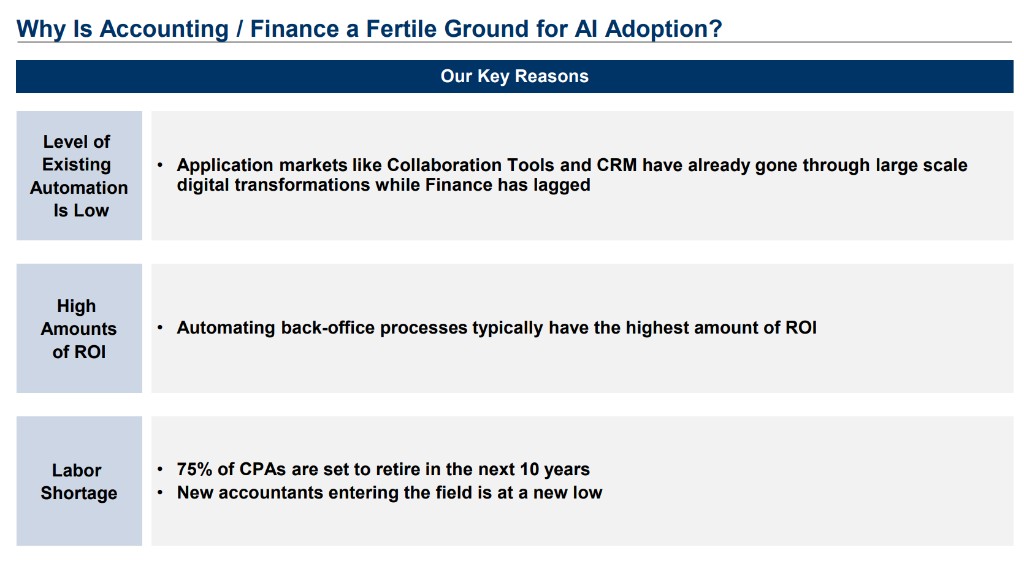
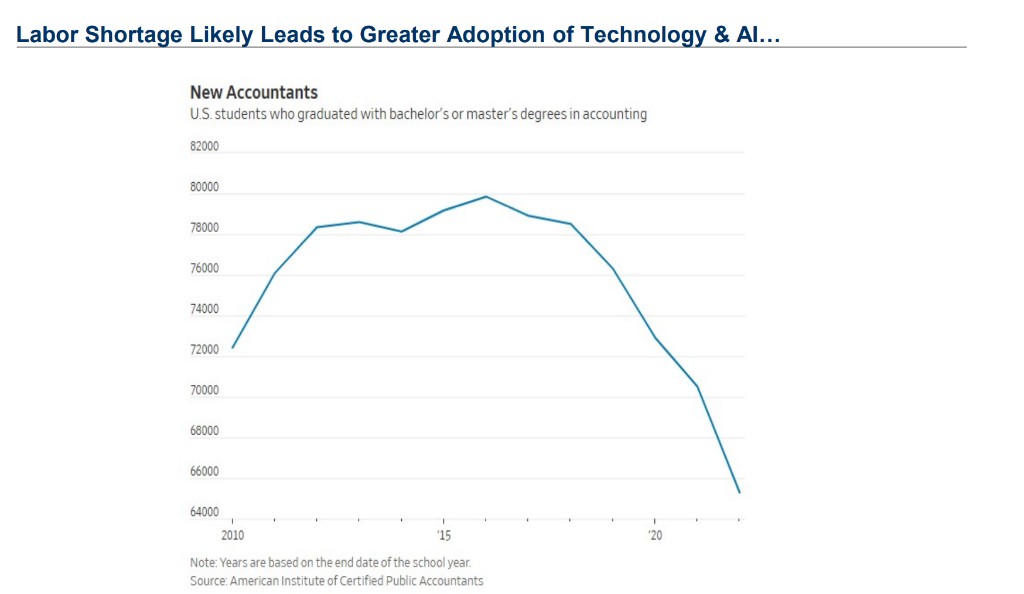
The market generally worries that AI will lead to a reduction in accounting positions, but experts at the seminar believe this risk has been overstated. The reason lies in the fact that the accounting industry has long been constrained by labor shortages (data shows that 75% of certified public accountants will retire in the next decade, with new entrants at a historical low), making it a market limited by supply (capability) rather than demand.

Therefore, the short-term return on investment brought by AI is primarily used to enhance the capabilities of existing accountants, rather than leading to layoffs. Companies can handle more business, absorb more growth, and take on more clients with the same-sized team. AI reveals previously unobserved "hidden" work capabilities, and this incremental part precisely brings untapped monetization potential to financial/accounting software providers
Monetization Path: The Value Capture Race of Software Giants
Such a significant ROI means that software vendors have the capability and should capture a portion of that value. For leading companies like Intuit and Workday, their monetization paths are already clear: Intuit: It is expected to monetize by encouraging customers to upgrade to higher-tier QuickBooks plans (to access additional AI features). At the same time, AI will drive customers to adopt more online services (such as payroll, payments, bill payments, human capital management, etc.). Workday: Monetization may occur through customers purchasing additional Agent products and accelerating the use of Flex Credits.

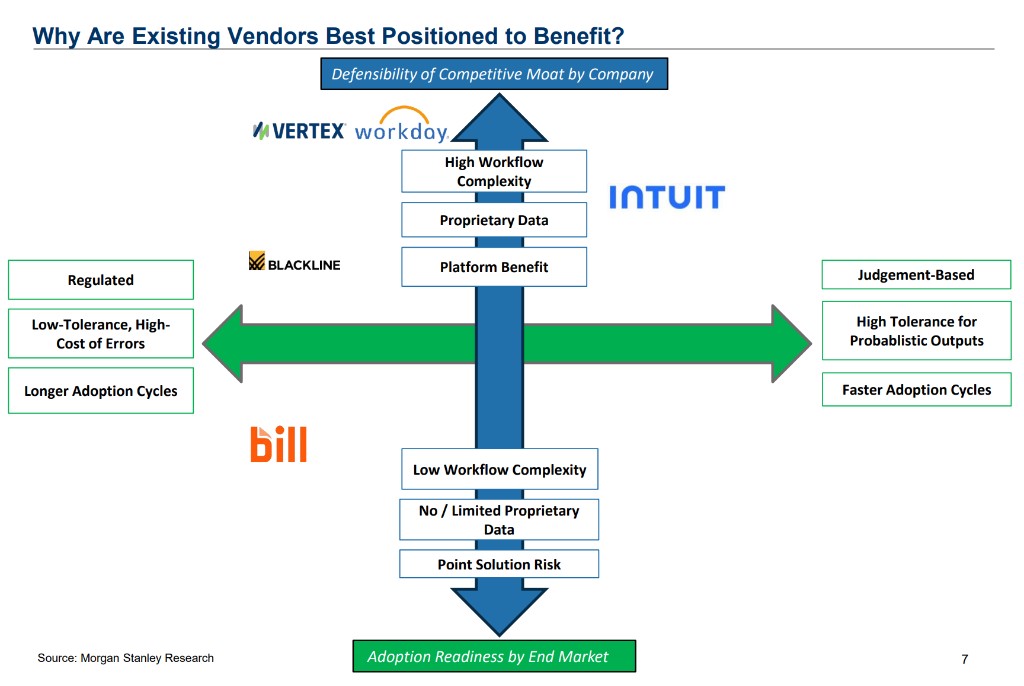
A key difference lies in the speed of adoption. Due to the more complex data structures and stricter governance requirements of enterprise customers, their readiness for large-scale AI deployment takes longer. In contrast, the Small and Medium-sized Business (SMB) market, with simpler infrastructures and higher risk tolerance, will adopt more quickly. Therefore, Intuit is expected to see the revenue impact of AI monetization earlier than Workday.
Accounting work requires a high level of trust and risk control, leading to a more cautious initial adoption of AI. Thus, recent AI use cases are likely to first target low-risk tasks. However, as enterprise data readiness and governance structures improve, AI adoption will accelerate towards more complex, higher ROI tasks. Experts predict this will be a convex growth curve—slow at first, then accelerating.
Structural Opportunities: Why Financial Accounting? Why Now?
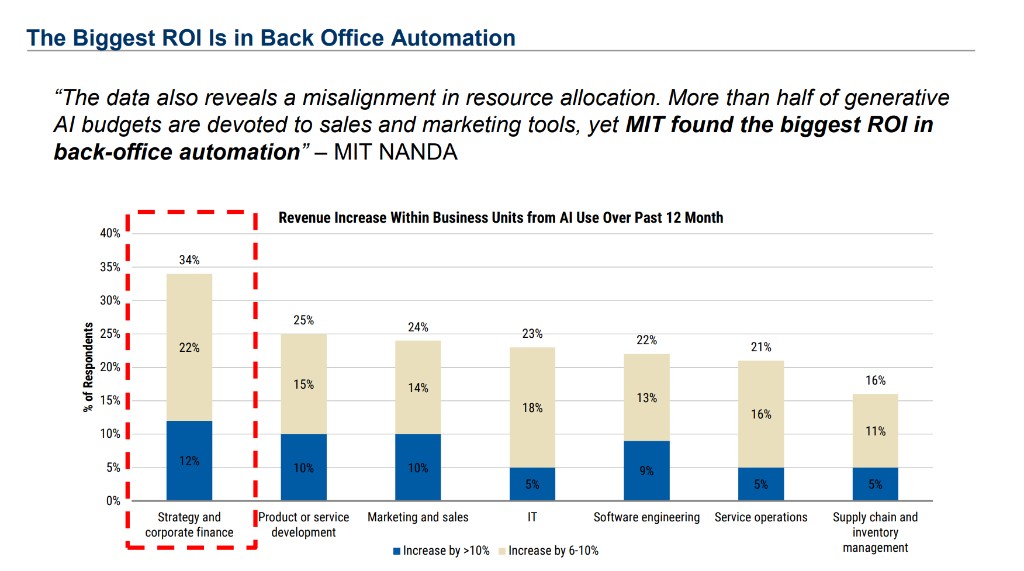
The seminar pointed out several structural reasons why the financial accounting field has become "fertile ground" for AI: 1) Back-end process automation often yields the highest ROI; 2) Compared to markets like collaboration tools and CRM that have undergone large-scale digital transformation, the current level of automation in finance is relatively low (with cloud deployment rates at the bottom among major enterprise software categories); 3) The increasingly severe accounting labor shortage is forcing companies to seek technological and AI solutions.

In summary, evidence suggests that the application of AI in financial accounting is far from mere conceptual hype. It is driving a quantifiable, high-return efficiency revolution and will reshape the business models and revenue growth trajectories of software vendors. For investors focused on the enterprise software track, this may be the next "killer" application scenario worth exploring in depth