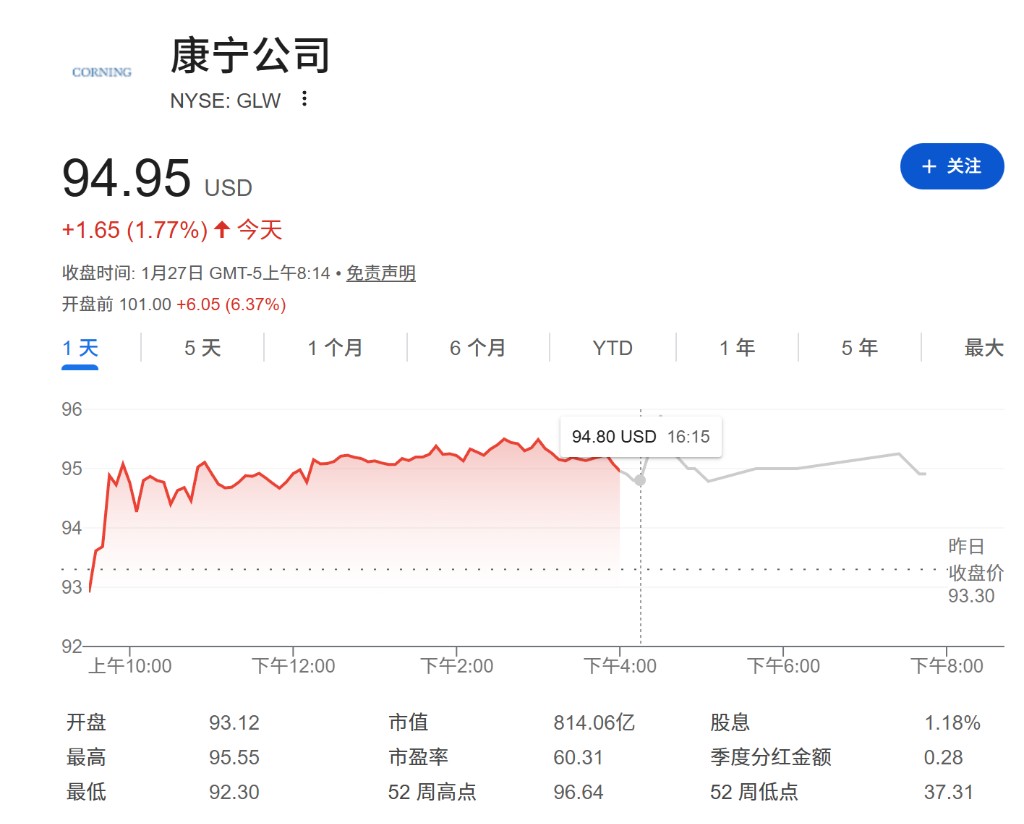
Corning's U.S. stock soared over 7% in pre-market trading! Report: Meta plans to spend $6 billion on fiber optic orders, focusing on AI data centers

Wallstreetcn
2026.01.27 13:28
portai
I'm PortAI, I can summarize articles.

Meta has signed a long-term optical fiber supply agreement with Corning worth up to $6 billion to secure critical transmission channels for its global AI data center construction. These optical fibers are the cornerstone of AI computing, responsible for transmitting massive amounts of data at nearly the speed of light between thousands of GPUs. The two largest data centers under construction by Meta—1 gigawatt "Prometheus" in Ohio and 5 gigawatts "Hyperion" in Louisiana—will fully adopt Corning's optical fiber products

Tech giant Meta has reached a long-term supply agreement worth up to $6 billion with established glass manufacturer Corning to obtain the fiber optic cables needed for its data centers. This deal highlights how the AI race is rapidly expanding from algorithmic models to an arms race in underlying hardware infrastructure.

Under the agreement, Meta will pay Corning this amount by 2030 to ensure that its ambitious global data center construction plans, particularly for its AI business, can secure sufficient critical data transmission "veins." This move directly echoes Meta's announcement last November of a massive plan to invest $600 billion in data centers and infrastructure in the U.S. by 2028.

This huge order drove Corning's stock price up more than 7% in pre-market trading following the announcement. Corning CEO Wendell Weeks told CNBC that he expects "hyperscale data centers to become our largest customers next year." This represents a historic shift for the company, known for iPhone screen glass, as its business focus changes due to the AI wave.

For Meta, this deal is one of its concrete actions to address Wall Street's skepticism about its unclear AI profit model. Although the company's stock has underperformed the market in 2025 and has experienced significant volatility due to massive AI investment plans, Meta is solidifying the physical foundation of its AI strategy by locking in key supply chains. Its Chief Global Affairs Officer Joel Kaplan emphasized that building a strong domestic supply chain is crucial to supporting AI goals.

Core of the Deal: $6 Billion Secures AI Data "Highway"

This $6 billion deal is a rare public and long-term bundling agreement between Meta and a key supplier. Its core objective is to ensure that the numerous AI data centers Meta plans to build in the coming years can obtain ample and advanced fiber optic connections.

According to exclusive reports from CNBC, the agreement will last until 2030. Corning will primarily provide fiber optic cables for connections within and between data centers. These fibers are the cornerstone of AI computing, responsible for transmitting massive amounts of data at nearly the speed of light between thousands of graphics processing units (GPUs). The two largest data centers currently under construction by Meta—the 1-gigawatt "Prometheus" data center in New Albany, Ohio, and the 5-gigawatt "Hyperion" data center in Richland Parish, Louisiana—will both utilize Corning's fiber products.

Corning CEO Wendell Weeks confirmed the deal during an interview at the company's factory in Hickory, North Carolina. He stated that to meet the surging demand from customers like Meta, NVIDIA, OpenAI, Google, AWS, and Microsoft, Corning is expanding its fiber optic factory, which will become the largest fiber optic cable factory in the world upon completion "Almost every customer call is asking, how can we attract more customers?" Weeks said.

Corning Turns: From Consumer Electronics Glass to AI Infrastructure Core

This deal marks a decisive shift in the growth engine of Corning, a company with a 175-year history. Over the past year, Corning's stock price has risen more than 75% due to a surge in demand for optical fibers from AI data centers. Its optical communications business (including optical fibers) has become the largest and fastest-growing segment of the company, with third-quarter revenue increasing by 33% year-on-year to $1.65 billion.

Corning's transformation has not happened overnight. The company was founded during the Gold Rush and has undergone multiple innovations throughout its history: manufacturing glass for Edison light bulbs, producing Pyrex cookware, automotive filters, and even glass vials for COVID-19 vaccines. Since the release of the iPhone in 2007, Apple has been an important customer, recently renewing a $2.5 billion glass supply agreement.

However, the explosion of AI has brought historic opportunities for Corning. In 1970, Corning invented the first glass optical fiber suitable for long-distance communication. Today, to meet the unique demands of AI data centers, Corning has specifically invented a new type of optical fiber called "Contour." Weeks demonstrated to CNBC that this patented product can accommodate twice the number of optical fibers within standard conduits and significantly simplifies connectors. He revealed that Meta alone requires 8 million miles of optical fiber for its Hyperion data center in Louisiana.

Weeks likened the AI data center network to "a completely independent network," attempting to establish connections "like neurons in a brain." The demand for such connections far exceeds traditional cloud computing, directly driving Corning's performance growth.

Meta's Bet: Heavy Asset Investment in an Uncertain Future

For Meta, this $6 billion expenditure is a key step in responding to the pressures of the AI race and skepticism from Wall Street. Despite the massive investment, Meta's path to AI profitability remains unclear, leading to pressure on its stock price in 2025, and it experienced its worst single-day performance in three years last October after announcing ambitious AI investment plans.

Meta is trying to build a moat by locking in infrastructure. The company plans to build 26 data centers in the U.S. and a total of 30 globally. Chief Global Affairs Officer Joel Kaplan expressed strategic considerations for establishing a domestic supply chain and mentioned concerns about falling behind in the AI race: "If our country does not make the right policy choices and investments, that will be a real risk."

This deal with Corning is part of Meta's broader "Meta Compute" initiative. The initiative aims to expand its AI infrastructure and manage its global data center fleet and supplier partnerships. Essentially, Meta is betting its future on winning the AI competition through scaled physical computing capabilities.

Industry Insight: A Feast of Demand and Cyclical Concerns

The data center construction frenzy driven by AI is bringing unprecedented demand across the entire supply chain. According to industry statistics, the transaction volume in the computing sector is expected to exceed $1 trillion by 2025 This puts key component suppliers like Corning in a favorable position, but also raises market concerns about potential bubbles or a slowdown in the cycle.

Corning is no stranger to this history. During the internet bubble, its fiber optic business achieved great success due to strong demand for communication equipment, with its stock price rising about eightfold from 1997 to 2000, but its market value shrank by more than 90% in the subsequent market crash. Weeks admitted that he learned at that time: "It's not enough to just make great innovations."

Regarding the current construction boom, Weeks expressed cautious optimism. He believes that fiber optic demand grows at an average rate of about 7% per year, so there will always be applications for it. He is "not worried about whether Meta can succeed in this field," as it ultimately depends on "technological excellence, willingness to invest in infrastructure, and computing power."

Morgan Stanley analyst Meta Marshall pointed out that "there is volatility in fiber optics," but Corning's diversified business portfolio (including more stable businesses like television screens and automotive glass) allows it to withstand industry fluctuations. Her rating on Corning stock is equivalent to holding.

A more long-term trend may be that fiber optics will further penetrate into data centers. Weeks predicts that as the number of GPUs in each server rack reaches hundreds, replacing the currently dominant copper cable connections with fiber optics inside the racks will become "inevitable" and "more cost-effective," as "the energy required to transmit photons is 5 to 20 times lower than that for transmitting electrons."

Both Corning and Meta will announce their latest quarterly financial reports soon, and the market will closely monitor their capital expenditure plans and performance guidance to assess the intensity and sustainability of this AI infrastructure race