


ANTA's Acquisition of PUMA: An Atypical Move in Globalization

Testing the waters
Rumors have materialized, and ANTA has officially taken action, acquiring nearly 30% of PUMA's shares.
On January 27, ANTA announced the acquisition of 29.06% of the sports brand PUMA SE for a cash consideration of €1.5 billion.
After the transaction is completed, ANTA will officially become PUMA's largest single shareholder.
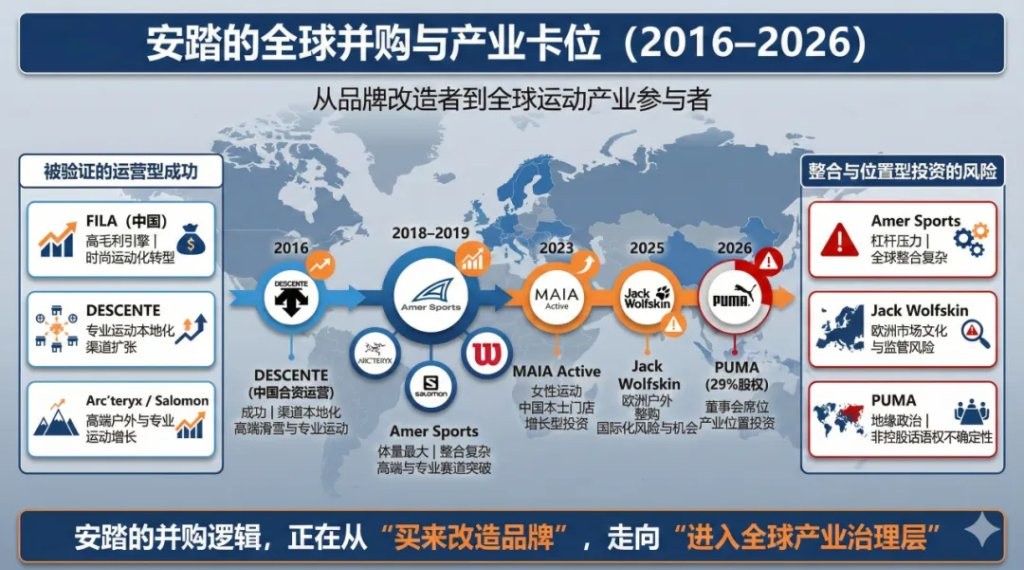
However, unlike the key aspects of past deep integration models, ANTA has adopted a strategic financial investment stance this time, not seeking further operational control, but only planning to appoint representatives to the supervisory board.
Ding Shizhong, Chairman of ANTA Group, stated that ANTA values the long-term value and potential of the PUMA brand and believes that its recent stock price has not fully reflected this.
ANTA currently has no plans to launch a full takeover bid for PUMA, fully respecting PUMA's management culture and its independent governance structure as a publicly listed company in Germany.
This stands in stark contrast to the era of mergers and acquisitions involving Amer Sports and The North Face, shifting ANTA's acquisition model from the previous "buy and transform brands" integration to a strategic collaboration linked by capital, entering the global industrial governance layer.
Ding Shizhong stated: "In the future, both parties will collaborate in areas of high consensus, achieving complementary advantages while strictly maintaining the independence, discipline, and strategic clarity of their respective business operations, jointly supporting the brand's revival."
The funds for this acquisition of PUMA all come from the group's internal cash reserves, and it is particularly emphasized that it will not affect the dividend policy for 2025.
Is this move by ANTA to acquire PUMA a safety card for "bottom-fishing quality assets," or is it another new impact of its globalization ambitions?
Atypical Acquisition
ANTA's investment in PUMA seems to once again follow its familiar strategic script: acquiring targets with deep brand value and genes during industry or brand cycle lows.
Although PUMA's revenue is expected to grow from €6.805 billion in 2021 to €8.817 billion in 2024, its recent performance has clearly come under pressure.
In the first three quarters of 2025, its sales fell by 4.3% year-on-year to €5.974 billion, with a cumulative loss of €309 million, and its stock price plummeted nearly 65% during the year.
The company expects a low double-digit decline in sales in 2025.
Currently, PUMA faces challenges such as high inventory, weak wholesale channels, and diminished brand momentum, which are quite similar to the situation ANTA encountered when it took over FILA more than a decade ago.
This also means that PUMA is likely to rejuvenate, just like FILA and Arc'teryx, leveraging ANTA Group's channels and operational capabilities.
From ANTA's perspective, the reason for not adopting a "comprehensive takeover" approach this time is primarily due to objective constraints.
As a brand that once firmly held the position of the third-largest sports brand globally, PUMA's brand assets and influence have long been on par with Nike and Adidas, and its scale is far beyond that of the brands ANTA has previously acquired In 2024, PUMA's global revenue reached €8.817 billion, comparable to the overall scale of ANTA Group.
For this reason, fashion industry analyst Tang Xiaotang from No Agency pointed out: "As a comprehensive sports brand, ANTA and PUMA are actually in a competitive relationship. This is also the most important reason why ANTA emphasized in the announcement that there is 'no comprehensive takeover plan' and continues to release goodwill for cooperation."
The reality of transaction structure and control considerations may be more critical factors.
Tang Xiaotang analyzed that seeking a minority stake rather than a full acquisition may be to expedite the transaction process. "If a full acquisition is initiated, it would require complex board approvals, and the final price is likely to be much higher than the current level."
The transaction is priced at €35 per share, representing a premium of about 60% over the previous trading day. However, looking at it over a longer period, the current seller, the Pino family, has already discounted several hundred million euros compared to when they acquired it twenty years ago due to debt pressure and other factors.
"Since this 29% stake belongs to the personal ownership of the Kering Group owner, it does not require complex internal decision-making processes," Tang Xiaotang stated. "This price is actually cheap."
A senior consultant in the footwear and apparel industry pointed out to Xinfeng that ANTA's current product tier still struggles to directly compete with Nike in consumer perception, especially in the mid-to-high-end sports sector where there is a significant gap.
"This is also why the market previously generally expected ANTA to choose one acquisition between Reebok and PUMA," the person said.
"Although it is not a complete acquisition at once, a 29% stake is sufficient for ANTA to drive business transformation and achieve synergies," the person further stated. "If ANTA continues to tilt resources towards a globalization strategy in the future, further increasing its stake cannot be ruled out."
Different Needs
If we place the investment in PUMA within the context of ANTA's globalization strategy, it resembles a new attempt to "test the waters."
ANTA has planned to become the number one market share holder in China by 2025 and achieve global leadership by 2030.
To this end, it has formulated a "three-step" strategy: "Do well with international brands in China," "Go out to operate global brands," and "Let China's ANTA brand go out," making ANTA a global brand.
At this stage, ANTA's globalization is a dual-track approach of "self-owned brands going abroad" and "operating global brands through acquisitions."
In April 2025, when announcing the acquisition of the German outdoor brand Jack Wolfskin, ANTA pointed out that the brand has a very high channel and community penetration rate in Europe, especially in German-speaking regions, which will significantly enhance the group's market influence in that area.
Founded in 1948, PUMA shares similarities in this regard.
However, some viewpoints indicate that PUMA's main markets are in Europe and North America, which highly overlap with Amer Sports' core markets. In other words, ANTA does not lack "gateways" to enter these markets.
Another potential route may be the emerging "management model going abroad."
Guangfa Securities analyst Jiang Hao believes that ANTA is expected to leverage its successful cases of multiple investments and acquisitions to increase exchanges with international sports outdoor brands and become their preferred partner, enhancing the company's voice and influence in the global sports market In the view of Tang Xiaotang, although Anta has achieved a global business layout through acquisitions such as Amer Sports, this does not mean that these acquisitions can directly translate into empowerment for the main brand "Anta."
In 2025, Anta launched the "Thousand Store Plan" targeting Southeast Asia and opened its first North American store in Beverly Hills, Los Angeles, but has not yet generated performance growth.
Anta may currently have a certain degree of growth anxiety.
In the fourth quarter of 2025, the retail amount of Anta's main brand recorded low single-digit negative growth compared to the same period in 2024. FILA is also in a stage of operational optimization and cultivation for rebranding.
In the Chinese market, PUMA still has significant potential for growth.
Its revenue share in the Greater China region is in the high single digits, significantly lower than Nike and Adidas's approximately 15% level.
Currently, PUMA is advancing its strategic transformation, actively shrinking some wholesale business to improve brand health, while its DTC (direct-to-consumer) business is on the rise.
If coordinated with Anta, the latter's vast retail network in the Chinese market, mature digital operation capabilities, and keen insights into emerging consumer trends will strongly support PUMA in consolidating and expanding its business in China.
On the supply chain level, Anta's middle and back office system is expected to optimize PUMA's cost structure in the Asia region.
PUMA can also form effective complements with Anta in product portfolio and segmented sports fields.
Both following a sports fashion route, FILA focuses on high-end tennis and golf, while PUMA excels in football, running, basketball, and motorsports. The two can synergize in the diversity of sports events, fashion styles, and major product management.
From a timing perspective, PUMA started with football, and with the 2026 World Cup in the US, Canada, and Mexico approaching, it provides a key marketing window for the brand to restart growth.
Jiang Hao expects that 2025 will be a year of strategic adjustment for PUMA, 2026 will be a transitional year, with the goal of restoring inventory to normal levels by the end of 2026 and returning to a growth track in 2027.
What kind of synergy and transformation PUMA's joining of Anta's globalization layout will bring remains to be continuously observed and anticipated by the market
