


Seagate Tech conference call: "Everything is sold out!" CEO states that customers are more concerned about supply than price, and orders have been discussed until 2027

AI-driven nearline hard drive demand remains strong, Seagate Tech has fully allocated its capacity for 2026 and has begun discussions with customers regarding order arrangements for 2027. The CEO stated that the current focus of customers has shifted from price to whether they can obtain stable supply. The company also emphasized that HAMR hard drives are already operating in the production environments of cloud customers, and product upgrades along with supply discipline are expected to continue improving the profit structure
On January 27th, U.S. stock market hard drive giant Seagate Technology's Q2 2026 fiscal year earnings report performed impressively: revenue, gross margin, and earnings per share all exceeded market expectations.
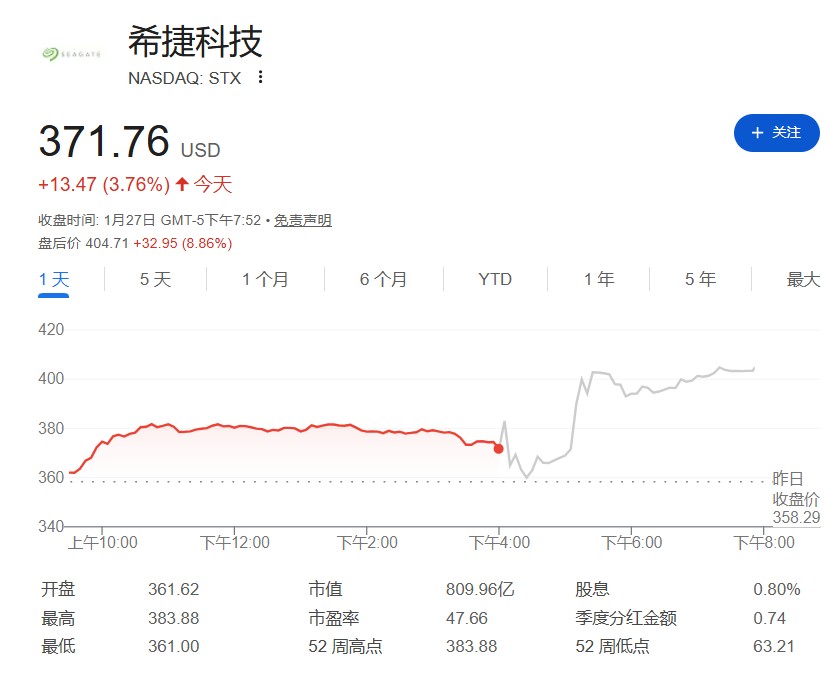
The subsequent conference call further ignited market enthusiasm, with the company's stock price soaring about 9% in after-hours trading. This conference call unusually provided long-term judgments on demand sustainability, supply boundaries, and profit structure. The company's management was not eager to reiterate the achievements in the earnings report but instead focused repeatedly on one core question: Is this round of storage demand driven by AI a short-term boom or a structural change?
CEO Dave Mosley’s answer was very clear:
“Our nearline capacity is fully booked until the end of the 2026 calendar year.”
“We expect to start accepting orders for the first half of the 2027 calendar year in the coming months.”
“Multiple cloud customers are discussing their demand growth forecasts for the 2028 calendar year.”
For a cyclical industry that has experienced overcapacity multiple times, such statements carry significant weight. It signals a key message: The market is not worried about insufficient demand, but whether supply can keep up with demand.
AI in "Sustained Amplification of Storage"
More importantly, management explicitly linked the sustainability of this demand to structural changes in AI applications.
Mosley pointed out that video content has become the core driver of data growth in recent years:
“YouTube's daily new video uploads have reached 20 million, compared to only 2 million three years ago.”
In his view, this is not even the whole picture.
“This does not include the surge in content generation expected from emerging AI-driven video applications.”
On this basis, Seagate repeatedly emphasized a concept that was not commonly mentioned in previous conference calls—Agentic AI. Mosley explained:
“Agentic AI requires long-term, continuous access to vast amounts of historical data to plan, reason, and make autonomous decisions.”
This means that AI does not just bring a one-time investment in computing power but will continuously drive up the demand for data to be stored, retained, and repeatedly accessed.
It is against this backdrop that Seagate provided a very clear positioning of its own situation:
“Hard drives are the cornerstone of large-scale capacity storage layers, storing the vast majority of EB-level data.”
"From the checkpoint data required for model training to the data for supporting vector databases and inference contexts, hard drives are the underlying infrastructure."
The first key signal released during the conference call is already very clear: AI is not diminishing the demand for hard drives, but rather amplifying their value.
Not simply "selling more hard drives" + price increases, the company's profit structure is systematically improving
One of the most concerning issues for the market is whether Seagate will enter a significant price increase cycle in a tight supply-demand environment. The management's answer is not aggressive but points to a more important change—the improvement in profitability comes more from structural changes rather than one-time price increases.
Seagate's growth logic has shifted from relying on "shipment expansion" to enhancing capacity density + improving unit profit structure.
Moseley clearly stated:
"We will not meet the demand growth by increasing production, but by achieving EB-level growth through increased areal density."
This is specifically reflected in:
"The average capacity of nearline hard drives has increased by 22% year-on-year, approaching 23TB per drive, with cloud customers using even higher average capacities."
"The average capacity for cloud data center customers is now close to 26TB."
This means: growth comes from "storing more data on each drive," rather than "selling more drives."
At the same time, on the pricing front, the signals given by the company are also very subtle but clear. Moseley explicitly stated in response to an analyst's question:
"In the current demand environment, it is entirely possible for prices to remain stable or increase slightly."
CFO Gianluca Romano further added that Seagate is achieving a better profit leverage than previously modeled for investors:
"Our current performance is actually better than the model presented at the investor day."
"After exceeding $2.6 billion in revenue, the target incremental profit margin in the long-term model previously disclosed by the company was about 50%, and our current execution is better."
This is a typical structural improvement model: increased capacity density → decreased unit costs → improved gross profit structure → released profit elasticity, rather than simple cyclical price increases.
HAMR: From a technical story to a profit engine
If HAMR was more of a "roadmap" over the past two years, it has been repeatedly described in this conference call as having entered a substantive profit phase.
Moseley emphasized:
"Mozaic 3 HAMR products have been certified by all major cloud service providers in the U.S."
"We will begin to accelerate the rollout of Mozaic 4 this quarter and obtain certifications from multiple cloud customers in the coming months."
More importantly, HAMR not only brings capacity increases but is also reshaping the cost structure. Romano candidly stated:
"When we begin to scale up the 40TB hard drives, the cost per TB will see significant declines, which will become an important factor driving further increases in gross margins."
What is truly scarce is not hard drives, but "certainty of delivery capability"
What was repeatedly emphasized during the conference call was not "how strong the demand is," but Supply Discipline.
Mosley clearly stated: "Our near-line capacity is fully booked until the end of the 2026 calendar year... multiple cloud customers are discussing their demand growth forecasts for the 2028 calendar year."
This means the market has entered a new phase: from "who can sell" to "who can deliver consistently."
In this structure, pricing power naturally changes:
"People are starting to say, 'If I can't get the goods now, I will plan better for next year and the year after.'"
Mosley clearly stated that for cloud customers, "supply assurance remains their top priority."
This is the underlying logic that allows Seagate to maintain price stability and continuous improvement in profitability.
Full translation of Seagate Technology's Q2 FY2026 earnings call:
Event Date: January 27, 2026
Company Name: Seagate
Speaker Segment
Operator:
Welcome to Seagate Technology's Q2 FY2026 earnings call. All participants will be in listen-only mode. (Operator instructions) Please note that this event is being recorded.
Now I would like to turn the call over to Senior Vice President of Investor Relations, Shanye Hudson. Please go ahead.
Shanye Hudson (Senior Vice President of Investor Relations and Finance):
Thank you, everyone. Hello, and welcome to today's earnings call. Joining me are Dave Mosley, Chairman and CEO of Seagate; and our Chief Financial Officer, Gianluca Romano. We have posted the earnings press release and detailed supplemental information for the December quarter in the investor section of our website.
In today's call, we will refer to GAAP (Generally Accepted Accounting Principles) and non-GAAP metrics. Non-GAAP data has been reconciled to GAAP data in the earnings press release and Form 8-K posted on our website. We have not reconciled certain non-GAAP outlook metrics because significant items that may affect these metrics are outside our control and/or cannot be reasonably predicted. Therefore, it would not be possible to reconcile to the corresponding GAAP metrics without unreasonable effort.
Before we begin, I would like to remind everyone that today's call contains forward-looking statements that reflect management's current views and assumptions based on information available as of today and should not be relied upon as of any subsequent date. Actual results may differ materially from those contained in or implied by these forward-looking statements due to risks and uncertainties associated with our business To learn more about these risks, uncertainties, and other factors that may affect our future business results, please refer to the press release issued today and our SEC filings, including our latest annual report on Form 10-K and quarterly report on Form 10-Q, as well as supplementary information, all of which can be found in the investor section of our website.
After our prepared remarks, we will open the floor for questions. To give all analysts the opportunity to participate, we thank everyone in advance for asking only one main question and then re-queueing. With that, I will turn the call over to you, Dave.
Dave Mosley (Chairman and CEO):
Thank you, Shanye, and hello everyone. Seagate ended the 2025 calendar year with a record-breaking quarter, driven by sequential revenue growth across nearly all end markets. The financial performance for the December quarter exceeded expectations in both revenue and profit, setting new company records in Exabyte shipments, gross margin, operating margin, and non-GAAP earnings per share.
Our non-GAAP gross margin expanded to over 42%, thanks to the execution of our pricing strategy and the improvement in our high-capacity hard drive mix as HAMR shipments increased. Looking back over the calendar year, 2025 marked a transformative period for Seagate both financially and operationally. During this year, our revenue grew by over 25%, gross margin improved by nearly 740 basis points, and the increase in operating margin was even greater, showcasing the profit leverage in our financial model.
2025 also solidified HAMR technology's position as a long-term driver of high-capacity storage. We shipped our first single-disk 3TB HAMR product based on Mozaic technology to our cloud service provider (CSP) customers by the end of the year, with quarterly HAMR shipments exceeding 1.5 million units and continuing to grow. The Mozaic 3 HAMR drives are now qualified with all major U.S. cloud service provider (CSP) customers, and the qualification of our second-generation Mozaic single-disk 4TB product is progressing smoothly as planned. These advancements align with our long-term areal density roadmap, which extends to single-disk 10TB, and we expect to deliver this in the early part of the next decade.
I want to thank the global Seagate team for exceeding our performance expectations and delivering exceptional value to our global customers. We continue to operate in an exceptionally strong demand environment, particularly within the data center end market. In the December quarter, we saw sustained demand from global cloud data centers for our high-capacity nearline hard drives, while the enterprise edge market also continued to improve. Based on our build-to-order pipeline, we expect these positive demand trends to continue for some time.
**Our nearline capacity is fully booked until the end of the 2026 calendar year, and we expect to begin accepting orders for the first half of the 2027 calendar year in the coming months Looking further, demand visibility is increasing based on long-term agreements signed with major cloud customers that extend until 2027. Additionally, several cloud customers are discussing their demand growth forecasts for the 2028 calendar year, emphasizing that supply assurance remains their top priority.
We will continue to meet the growing demand through our strategy, which is to maintain supply discipline and meet the growth in exabytes through advancements in areal density without increasing unit output. In the December quarter, our average nearline hard drive capacity grew by 22% year-over-year, approaching 23TB per drive, while the average capacity sold to cloud customers was significantly higher. This trend underscores the strong adoption of our higher-capacity drives to support demand growth.
Meanwhile, revenue per TB sold remains relatively stable, reflecting the effectiveness of our pricing strategy. Seagate is well-positioned to continue benefiting from a combination of strong long-term tailwinds and supply discipline.
Video applications continue to drive enormous demand for hard drives, with platforms like YouTube witnessing 20 million video uploads daily, compared to just 2 million three years ago. This astonishing growth rate extends to other cloud video platforms and does not even account for the anticipated surge in content generation brought about by emerging AI-driven video applications.
These applications not only boost social media uploads but also change how organizations convert their data into tangible value, empowering personalized marketing, interactive education, and advanced simulations capable of training professionals in manufacturing, engineering, healthcare, and other fields. As new applications and use cases for cross-cloud and edge workloads emerge, the strategic value of data is further highlighted. Among the most promising is Agentic AI, which relies on continuous access to vast amounts of historical data for effective planning, reasoning, and independent decision-making. Momentum for this technology has increased, with a recent survey conducted by a leading cloud service provider showing that over half of participating customers are actively using AI agents. Early adopters have achieved measurable returns, with benefits ranging from cost reductions to increased revenue opportunities.
As AI agents are deployed at the edge where untapped data often resides, we believe this lays the foundation for sustained and meaningful growth in data generation and storage, which will support reasoning, continuous training, and model integrity maintenance. Modern data centers have evolved to address the complexities and scale challenges posed by massive workloads through sophisticated data tiering architectures, ensuring that the right data is available at the right time and place.
Hard drives are critical to these architectures, anchoring the high-capacity data layer that stores the vast majority of exabytes, from storing checkpoint datasets used for training and maintaining model integrity to supporting vector databases that provide the context needed for accurate reasoning results and Agentic AI performance. By leveraging hard drives, data center operators, whether in the cloud or on-premises, can achieve the optimal balance of performance, capacity, and cost efficiency at scale
In this context of transformation, Seagate's HAMR technology roadmap enables us to meet the growing demand and provide our customers with continuous improvements in TCO (Total Cost of Ownership). HAMR is a proven technology, with a large number of drives operating in cloud production environments for over three quarters and performing well across a wide range of use cases. We are systematically ramping up the production of Mozaic 3 HAMR products for qualified customers while maintaining a focus on optimizing the profitability of our available supply.
As mentioned earlier, Mozaic 3 is now qualified with all major CSP customers in the U.S. and is expected to have all global CSPs certified by the first half of the 2026 calendar year. Additionally, our second-generation Mozaic 4 product is progressing well in its qualification. We expect to begin ramping up Mozaic 4 production later this quarter and have multiple CSPs certified in the coming months, in line with our plans. We continue to set the pace for the industry, recently demonstrating the capability of a single 7TB disk in our lab.
As aptly described by one of our largest cloud service provider customers, hard drives are an "engineering marvel," a sentiment we clearly share. Our deep expertise in mechanical engineering, materials science, nanoscale manufacturing, and now advanced photonics not only enables Seagate to realize the HAMR roadmap but also creates a lasting competitive moat for hard drive technology for a long time to come.
In summary, 2025 is a milestone year for Seagate in all aspects—financial performance, operational execution, and technological leadership. We are carrying this momentum into the 2026 calendar year, supported by strong demand as new AI applications begin to complement traditional workloads. We will maintain high discipline and focus on expanding profitability through our higher-capacity product portfolio, supported by the strong economic benefits of HAMR. Our areal density roadmap enables Seagate to maintain the core TCO and efficiency advantages of hard drives as data creation and storage demands accelerate in the AI era. We believe this foundation provides a compelling long-term value proposition for the company, our customers, and shareholders. Now I will turn the call over to Gianluca for a more detailed overview of our performance.
Gianluca Romano (Executive Vice President and Chief Financial Officer):
Thank you, Dave. Seagate has delivered another quarter of strong year-over-year revenue growth and set new profitability records in the December quarter, highlighting the durability of data center demand trends. Additionally, we strengthened our financial position by repaying $500 million in total debt and generating over $600 million in free cash flow, marking the highest level in eight years.
Revenue for the December quarter was $2.83 billion, up 7% sequentially and up 22% year-over-year. We achieved a non-GAAP gross margin of 42.2%, an increase of 210 basis points sequentially, and expanded our non-GAAP operating margin by 290 basis points sequentially to 31.9%. Our final non-GAAP earnings per share (EPS) was $3.11, up 19% sequentially These strong financial results demonstrate our ability to execute strategic objectives, including leveraging our technology roadmap to support demand growth.
To this end, we shipped 190 exabytes (EB) in the December quarter, a year-on-year increase of 26%, while maintaining overall unit capacity relatively stable. The data center market accounted for 87% of our shipments, benefiting from the sustained demand momentum from global cloud customers and sequential growth in the enterprise OEM market. We shipped 165 EB in the data center market, a sequential increase of 4% and a year-on-year increase of 31%.
Data center revenue grew at a roughly similar pace, totaling $2.2 billion this quarter, a sequential increase of 5% and a year-on-year increase of 28%. Against this backdrop of strong demand, both cloud and enterprise customers are transitioning to higher-capacity hard drives. The average cloud nearline capacity increased to nearly 26TB in the December quarter and will continue to grow with the ramp-up of capacity for the HAMR-based Mozaic products. As Dave emphasized, Mozaic drives are performing very well in production environments, meeting all performance, reliability, and integration expectations.
In the enterprise OEM market, we benefited from a slight improvement in traditional server sales, as well as an increase in storage server demand driven by the adoption of AI applications and the need to store data at the enterprise edge. The edge IoT market accounted for 21% of remaining revenue, totaling $601 million, benefiting from anticipated seasonal improvements in the EMEA (Europe, Middle East, and Africa) client market for consumer products. We expect the broader EMEA market to grow over time, with the largest growth contribution coming from VIA nearline products, which are part of our data center end market.
Turning to the rest of the income statement, non-GAAP gross profit increased to $1.2 billion, a sequential increase of 14% and a year-on-year increase of 44%, significantly outpacing revenue growth. The non-GAAP gross margin expanded to 42.2% in the December quarter, up from 40.1% in the previous quarter. These improvements reflect the continued execution of our pricing strategy and the growing adoption of our latest generation of high-capacity products, which together drove moderate sequential growth in revenue per TB, a trend we expect to continue into the March quarter.
Non-GAAP operating expenses were $290 million, relatively flat sequentially, in line with our expectations. The percentage of operating expenses to revenue decreased to 10.3%, rapidly approaching our long-term target of 10%. The combination of strong revenue growth and significant financial leverage drove non-GAAP operating profit to a sequential increase of 18% to $901 million, nearly 32% of revenue.
Other income and expenses were $70 million, reflecting slightly reduced interest expenses due to a decrease in the outstanding debt balance. We currently expect other income and expenses to remain relatively flat in the March quarter. We increased non-GAAP net income to $702 million, with a corresponding non-GAAP earnings per share of $3.11, based on $129 million in tax expenses and approximately 226 million diluted shares, including the net impact of our 2028 convertible notes
Now turning to cash flow and the balance sheet. We invested $116 million in capital expenditures (CapEx) in the December quarter, approximately 4% of revenue. We are maintaining capital discipline while continuing to transition and enhance HAMR technology. To support these goals, we expect capital expenditures for fiscal year 2026 to fall within our target range of 4% to 6%. Free cash flow generation was strong at $607 million, a 42% increase from the previous quarter.
Looking ahead, we expect free cash flow generation to further expand in the March quarter, driven by ongoing demand trends, operational efficiency, and capital discipline. These factors position us well for sustainable long-term cash flow generation.
As of the end of the December quarter, cash and cash equivalents totaled just over $1 billion, with $2.3 billion in ample liquidity, including our undrawn revolving credit facility.
In the December quarter, we returned $154 million to shareholders through dividends. We repaid approximately $500 million of exchangeable senior notes due in 2028, which helps limit the further dilution impact of these notes and optimizes cash deployment for future stock buybacks. Our total debt balance at the end of the quarter was approximately $4.5 billion.
The net leverage ratio improved to 1.1 times, based on adjusted EBITDA of $962 million for the December quarter, with EBITDA growing 16% quarter-over-quarter and 63% year-over-year. We expect the net leverage ratio to trend downward as profitability and cash generation increase, while we continue to evaluate opportunities for further debt reduction.
Now turning to the outlook for the March quarter. The demand environment remains strong, particularly among global cloud customers. Therefore, we expect data center demand to be sufficient to offset the typical seasonal impact of the edge IoT market in the March quarter. We expect revenue for the March quarter to be in the range of $2.9 billion plus or minus $100 million, representing a year-over-year growth of 34% at the midpoint.
Non-GAAP operating expenses are expected to be approximately $290 million. Based on the midpoint of our revenue guidance, the non-GAAP operating margin is expected to approach the mid-30s. Non-GAAP earnings per share are expected to be $3.40 plus or minus $0.20, based on an estimated tax rate of about 16% and 230 million non-GAAP diluted shares, including approximately 7.6 million estimated dilutive shares from our 2028 convertible notes.
Seagate's strong performance in the December quarter and guidance for the March quarter underscores our continued focus on driving growth, enhancing profitability, and optimizing cash generation. Based on our current outlook, we expect to achieve sequential improvements in revenue and profits throughout the 2026 calendar year and remain well-positioned to create long-term value for customers and shareholders.
Operator, let's begin the Q&A session.
Q&A Session
Operator:
Thank you. We will now begin the Q&A session. (Operator instructions) The first question today comes from C.J. Muse of Cantor Fitzgerald. Please go ahead
CJ Muse (Analyst):
Yes, good afternoon. Thank you for taking my questions. Given the supply and demand dynamics, you are clearly in a very favorable position (catbird seat), and I want to really try to understand more about the details of future gross margins. Your historical philosophy has been to share the benefits with customers and yourselves. But at the same time, given this tight environment, you are raising prices on comparable products. So I'm curious, is there a framework to think about how we should model the incremental gross margins going forward?
Then I want to perhaps take a bigger picture view; when you think about the overall average pricing per exabyte, we have gone from double-digit declines to high single-digit declines. I believe the quarter we just finished saw a year-over-year decline of 4%. Do you see a world where pricing could stabilize or even turn positive year-over-year? Thank you very much.
Dave Mosley (Chairman and CEO):
Yes, thank you, C.J. I’ll let Gianluca chime in as well, but pricing will be driven by demand. Right now, demand is very strong. So I think as we move into 2027 and 2028, we’ll look at how much capacity we have, and through all these positive product transitions we are undergoing, we are bringing more exabytes, and then people will renegotiate for that. I think flat to slightly up is certainly possible. That’s how we really manage it. When we talk to customers, as new hard drive capacities increase by 5, 10 TB at a time, the value proposition is very strong.
Gianluca Romano (Executive Vice President and CFO):
Hey, C.J. Regarding gross margins, we are not executing very well, but I think it will be a bit better than what we discussed on the investor day, when we presented a model of a 50% incremental profit margin above $2.6 billion in revenue. We are doing better each quarter, and of course, the goal now is to continue optimizing the products we produce, the products we sell, and to extract the profitability we can from those products.
So the model covers a longer time frame, two to three years, rather than two to three quarters, but I am confident we are continuing to move in the right direction. Thank you.
Dave Mosley:
Thank you, C.J.
Operator:
The next question will come from Wamsi Mohan of Bank of America. Please go ahead.
Wamsi Mohan (Analyst):
Yes, thank you. A similar type of question. I want to point out that the gross margins in the guidance and the quarter-over-quarter incremental gross margins are very strong. Can you help bridge the drivers between mix and price? Clearly, your data center revenue mix will be better next quarter, **just wondering if you can quantify that. Dave, regarding the pricing opportunities, you just mentioned that flat to up is possible. But when we think about what might be embedded in these LTAs (long-term agreements) and pricing beyond 2026, given the tight supply-demand environment, why can’t it be much higher? Thank you.
Dave Mosley:
Yes. I think this relates to how long the demand will last, Wamsi. We have talked about the situation two or three years down the line. One behavioral change that I have really liked over the past year is that people are starting to say, if I can't get the goods now, I will plan better for next year and the year after. So we have had good conversations in that regard. Of course, supply has increased a lot, the industry’s exabyte supply last year. The industry has responded quite well, but I think demand remains quite strong. My point is that I believe demand will remain strong for a considerable period of time. So in this world, we have had good discussions with customers at further time points. The biggest part that helps us in our planning is the transformation through these products. They know this is how they will get more exabytes.
Wamsi, we mentioned in today’s script that for the remainder of this calendar year, we expect revenue and profitability to continue to improve quarter over quarter. So we are by no means suggesting that this trend is changing; in fact, it is getting better now.
Wamsi Mohan:
Thank you.
Operator:
The next question will come from Erik Woodring of Morgan Stanley. Please go ahead.
Erik Woodring (Analyst):
Great. Good afternoon, guys. Thanks for taking my question, and congratulations on these results. Incredible. Dave, at last year’s analyst day, you pointed out that the compound annual growth rate (CAGR) for exabyte growth is in the mid-20s. I was just wondering where you think the supply growth will land for this calendar year. As you approach the HAMR crossover point later this year, will the pace of exabyte growth accelerate? I ask this because demand clearly exceeds supply. So can you help us better understand the shape of your exabyte supply growth, as this will clearly dictate exabyte shipments for the year? Thank you very much.
Dave Mosley:
Yes. Thank you, Erik. So we are planning to transition to single-disk 4TB, and quite aggressively, but I think people need to remember that we are quite tight across the entire manufacturing process. So we have commitments to customers for products in the pipeline, etc. As things come in, we won’t be quickly transitioning to single-disk 3 or 4TB, which is actually a good question. Our manufacturing is running very, very tight right now.
So I think it will be a fairly standard uplift, in terms of what you are saying. It won’t be as fast as some of the uplifts we have done in the past, but it will be very profitable, and that’s how we look at it. As we move further into the future, I am very optimistic about the single-disk 4TB being a very strong product. It will start to replace some of the other traditional products, I would say, because it has a better value proposition in many of these markets
Then when that happens, we will see more opportunities.
Erik Woodring:
Great. Thank you, and good luck.
Dave Mosley:
Thank you.
Operator:
The next question will come from Asiya Merchant of Citi. Please go ahead.
Asiya Merchant (Analyst):
Great. Thank you for taking my question, the results here are fantastic. I have just a few related to previous questions. You provided some forecasts regarding HAMR, not just for fiscal year 2026, but even into fiscal year 2027. So if you could talk about the upside potential for achieving those HAMR rollout targets. Related to this, how should we think about the reduction in mixed costs, impressive again, the margins here, and the guidance for profitability improvement. So if you could talk to us about future cost reductions, especially as you ramp up HAMR production here through Mozaic 4, that would be great. Thank you.
Gianluca Romano:
Yes, Asiya. So I would say, first, we are very pleased with the transition to HAMR. We have completed the qualification with the last major cloud service provider in the U.S., and we have certified six out of the top eight cloud service providers. So the transition from HAMR technology to HAMR technology is progressing very smoothly. We are now certifying new products, single disk 4TB, which is a full 40TB. Of course, this will help increase the exabytes in mixed terms. We provided a good indication at Investor Day, and I think we want to stay consistent with that.
Costs will be favorably impacted, especially as we start ramping up high-volume production of the 40TB drives, which will certainly drive a significant reduction in cost per TB compared to the current HAMR, and of course, this will be a good contributor to further increasing our gross margins.
Operator:
The next question will come from Karl Ackerman of BNP Paribas. Please go ahead.
Karl Ackerman (Analyst):
Yes, thank you, Gianluca and Dave. I hope you can clarify which portion of your LTA or overall near-line total addressable capacity (AGV) has fixed or multi-quarter pricing agreements? I ask because as these LTAs expire in 2026, any new agreements will lock in at a higher value, which not only reflects mid-range use cases but also reflects the gap between the price per TB for hard drives and enterprise SSDs? Thank you.
Shanye Hudson (Senior Vice President of Investor Relations):
Karl, your— the second part of your question is a bit unclear. So we caught the first part, but we may need you to clarify that second part
Karl Ackerman:
Of course. Yes, if possible, I would repeat it. As these LTAs expire throughout 2026, I imagine the pricing of those new LTAs may be higher, or the order values may be higher, especially considering the widening gap between hard drives and SSDs. So if you could comment on the LTA mix and how you think this will develop in 2026, that would be great. Thank you.
Dave Mosley:
Yes. Thank you, Karl. So when we launch, for example, someone may have already qualified for a single-disk 2.4TB product, and then they may qualify for a 3.2 or even a single-disk 4TB product as we progress. So we change—based on the demand we see, we change, and based on our available supply, we change the pricing dynamics there. I think that’s one of the biggest things you pointed out. I would say 2026 is already quite booked. We talked in the conference call that as long as we can exceed our plans, it will be marginal, just like you saw last quarter. We are slightly faster in completing qualifications. We are shipping a bit more hard drives, and that’s how we do better than planned. But aside from that, 2026 is quite predictable, and we are looking to start 2027 in the same way.
Karl Ackerman:
Thank you.
Operator:
The next question will come from Jim Schneider of Goldman Sachs. Please go ahead.
Jim Schneider (Analyst):
Good afternoon. Thank you for taking my question. I was wondering if you could address, given everything said earlier about demand and the HAMR mixed effects this year, perhaps you could give us any directional guidance on where you expect exabytes shipped in calendar year 2026 to end up compared to calendar year 2025, relative to the long-term targets you previously outlined. It looks like you could do much better than that, but I just wanted to confirm what your expectations are, if you could provide a numerical range. Thank you.
Gianluca Romano:
Hey, Jim, no, we are not guiding for calendar year 2026. But we have said in our financial model that we expect exabytes, near-line exabytes to grow in the mid-20% range. If you look at the past few quarters, we have done a bit better; we always—just as Dave mentioned earlier, we always try to extract as many exabytes as possible from our manufacturing. So no, we will continue this trend, but we are not guiding for calendar year 2026.
Dave Mosley:
But moving from single-disk 2.4 to single-disk 3 to single-disk 4, you can see we are on a trajectory as you described. This—when it comes down to the individual customer level, obviously, we have to be very predictable because they need—what they need and what we committed to in order to build that data center. So we will continue to execute that plan, and perhaps as we transition (inaudible), we can do a little bit better
Operator:
The next question will come from Amit Daryanani of Evercore. Please go ahead.
Amit Daryanani (Analyst):
Good afternoon, everyone. Thank you for taking my question. I wanted to ask, Gianluca, if you could talk a bit about the guidance for the March quarter, as it seems like there’s a significant increase in gross margins. I believe it’s up about 250 basis points or more than 100% incremental. Could you just—are there any unique factors in the March quarter that you would point to that are helping to drive that kind of margin expansion? Is it all coming from the core business, or are there potential benefits from the legacy systems business that are also helping you? Thank you.
Gianluca Romano:
Hey, Amit. Well, I would say we expect this to be a very good quarter. I don’t think it’s different from what we’ve done before. It’s always based on pricing strategy and mix. As you know, we’ve certified another customer on HAMR, so we’ll be ramping up more HAMR production slightly. That’s helping us achieve better margins. But fundamentally, it’s not really different from how we think we will execute this quarter, no, it’s good. I think the incremental margins are very good.
Dave Mosley:
Yes. And it’s not the systems business. The systems business is doing well, but it’s relatively small in comparison.
Amit Daryanani:
Got it.
Operator:
The next question will come from Mark Newman of Bernstein. Please go ahead.
Mark Newman (Analyst):
Great. Hi, thanks for taking my question, and congratulations on the big numbers today. Just wanted to touch again on the LTAs and pricing arrangements you have. Just curious if you see any opportunities for more significant price increases here, in NAND Flash, we’ve heard some contracts quarter-over-quarter going up 40% to 100%. I understand with disk drives, you have very long-term agreements, but I think there are a lot of questions. I also wanted to touch on this.
And a lot—with LTAs expiring, is there an opportunity to reprice some of these at more significant—more significantly higher prices to change the trajectory? Of course, the numbers you released are great. We’re just trying to figure out if you can start to see more significant price increases, rather than what you’re currently seeing, which is a bit flat, down a little, up a little. But overall, your average price is flat, and I understand that’s a mix result where slight increases in like products are offset by new products entering at lower prices.
I just wanted to know if that might change. And then if there’s any quick update on the HAMR mix, if there are any updates to the HAMR mix trajectory you outlined previously? Thank you very much
Dave Mosley:
Thank you, Mark. A few points. Regarding HAMR hybrid, we are inevitably limited to single-platter 3TB because the factories are quite full, and we know we will transition to single-platter 4TB. So we have been pushing harder on that and ensuring it goes through the development and qualification phases.
Over time, we will be very proactive in transitioning and moving to single-platter 4TB. So that helps you in terms of hybrid. Another thing about HAMR hybrid is that it will inevitably mix upwards. I believe the demand for those products will be at high capacity points, not necessarily at the currently lower capacity points.
Then regarding pricing, I think I mentioned before that when we—when a long-term agreement rolls into next year or the following year, we have already met our existing supply commitments, and people are looking at new products, and our supply of those new products is constrained, then we look at what the demand is, and we set our pricing accordingly. One of the earliest questions I answered was that it might be flat to slightly up. That’s how I’m thinking about it right now, but it completely depends on what the demand is. If demand continues to be very strong, that’s great. Again, what we are seeing is those who are not getting what they need today are saying, okay, I need to be able to plan my future data center purchases. Let’s make it more predictable going forward. This gives us better visibility and helps us operate our factories at better costs, etc. So that’s great.
Mark Newman:
Thank you very much.
Operator:
The next question will come from Krish Sankar of TD Cowen. Please go ahead.
Krish Sankar (Analyst):
Thank you for taking my question. I have a question. I just want to split it into two parts. First, what percentage of your exabyte shipments is HAMR? What do you expect it to be this year? The origin of the question is that I’m just trying to figure out, obviously, there are a lot of questions about very strong gross margins. If there’s a way to break it down into three buckets, like how much of the gross margin uplift is driven by pricing, how much is driven by product mix, and how much is driven by lower offshore manufacturing costs? Thank you.
Dave Mosley:
Yes, there really isn’t anything involving offshore manufacturing or anything like that. We are doing quite well with our manufacturing operations around the world, and they are quite full. So that helps from a cost perspective. But there really isn’t anything noteworthy in terms of changes in manufacturing strategy. Regarding—I would say a lot of the benefits we are seeing are from mix and hybrid, not only because we are actually transitioning to better products over time but also because the demand for those products is quite high.
Think about it, if you are building a data center with single-platter 3TB versus single-platter 4TB, you are going to run that data center for a long time, and you will want high capacity points. As long as we can do that as predictably as possible, that kind of mix is a factor driving market stability and helping us plan. Yes, Krish, we don’t provide specific details on pricing, mix, and cost impacts, but they are somewhat interrelated I believe that the mixed changes help reduce costs, and the supply and demand situation certainly supports our pricing strategy. So they are all very good contributors to the increase in gross margin.
As we mentioned earlier, this will continue throughout the calendar year.
Krish Sankar:
What percentage does HAMR occupy in the portfolio mix?
Gianluca Romano:
Well, Dave provided guidance on our unit shipments from last quarter. So I think you can recalculate that quite well.
Krish Sankar:
Thank you very much. Thanks.
Gianluca Romano:
Thank you.
Operator:
The next question will come from Steven Fox of Fox Advisors LLC. Please go ahead.
Steven Fox (Analyst):
Thank you. Good afternoon. I just wanted to ask about your mix issue, looking at the average capacity of your hard drives, which has increased by 22%. For example, how much of that is due to the tightening supply-demand environment over the past year? In response to that, as customers push you, are you taking steps to accelerate that upward mix? I'm just curious how much you can control that now, even under tighter supply, to help your customers in terms of the absolute petabytes you deliver.
Gianluca Romano:
Thank you, Steve. So yes, we are—wafer fab delivery times are quite long. So we have to be predictable for our customers, like six months, nine months out, etc. That’s one of the reasons why we talk about a year at a time within these LTAs. So we start wafers based on what we know we will be able to deliver, to be as predictable as possible for our customers.
When we—if we are deploying manufacturing engineering resources, we are trying to transform through these products because that’s the way we get the most petabytes afterward. So upward mix is also our goal. If that helps clarify what our strategy is.
Steven Fox:
That’s helpful, Dave. I just wanted to know, for example, when you hold analyst meetings, you mentioned there’s a fairly clear node transition timeline. Maybe you could give yourself a report card on how you’re performing against some of those timelines if we look at the next year or longer term?
Dave Mosley:
Yes. I think that’s good. We are on track or slightly ahead of schedule. Again, most of this is under our control. We can—we execute well. We have been executing well. Some of this is also under our customers’ control. The behavior changes we see among our customers, as I mentioned earlier, they are really pushing hard because they need more petabytes. So that helps expedite certification, you know, that helps with roadmap alignment, and then supply-specific alignment helps our factories
Steven Fox:
That's great. That's very helpful. Thank you.
Operator:
The next question will come from Aaron Rakers of Wells Fargo. Please go ahead.
Aaron Rakers (Analyst):
Yes. Thank you for taking my question. And congratulations on the results. I want to go back to gross margins. I know you've talked a lot about pricing dynamics and the visibility you have. But what stands out to me is that you've been executing a mid-teens year-over-year decline in cost per TB for the past few quarters. How should I think about that cost decline curve when we launch the single-platter 4TB Mozaic drive? Is it mid-single digits? Can you maintain double digits? Shouldn't we expect that the single-platter 4TB HAMR drive could actually accelerate cost declines, given its ability to be brought into lower-end areas beyond nearline platforms? I'm just curious how you think about that cost decline curve.
Gianluca Romano:
Yes, I— we're very optimistic about the cost impact of the single-platter 4TB. As we've discussed before, unit costs are often quite similar now, but of course, we are adding a lot of content per unit. So that will be a good help in reducing costs and improving profitability. As you know, we are certifying two major customers for this new product. So the timing of completing the certification and ramping up production may stretch through the end of the calendar year, certainly well into— I think the impact will be strong, and I believe into the next calendar year as well.
Dave Mosley:
And we plan to make a significant transition to single-platter 4TB over the next few years. Then also reach single-platter 5TB, which does add complexity as we make those transitions. But I would say the primary factor that will determine the pace of the ramp is our ability to manage scrap and yield across our supply chain, etc., and we are working very hard on that. I like this product. So I think it provides us with a bright and stable future. We just need to stay focused on it.
Aaron Rakers:
Thank you.
Operator:
The next question will come from Timothy Arcuri of UBS. Please go ahead.
Timothy Arcuri (Analyst):
Thank you very much. I want to ask about LTSA (Long-Term Supply Agreement). I think you said that nearline capacity is allocated through 2026. So it sounds like pricing and exabytes are locked in for this year. But for 2027, I think you mentioned something that I understood as exabytes and pricing not being locked, but you have some sort of agreement. So I guess I have two questions. First, is it correct that pricing is also locked for the entire 2026? If sales and pricing are not locked for next year, what kind of agreement are you referring to for 2027? Thank you
Gianluca Romano:
Yes. For this calendar year, we can basically say that we have purchase orders (POs) in place for all our quarters. So sales volume and pricing are clearly defined. As Dave mentioned earlier, if we can produce more in a quarter, of course, we will sell those A-Bytes on the open market with good profitability. But I would say that the vast majority of our volume has already been allocated.
For the 2027 calendar year, we will soon start working on this. Of course, we have good indications and agreements on volume, but we do not have fixed prices yet.
Dave Mosley:
Yes, so we haven't really started on the longest lead-time components, but we will soon start for early 2027, and we need to begin discussions with our customers about which certifications we will go through together and what the exact plans are, because many of them also need predictability. So we will have to build based on how hard they want to pull those new products into our factories.
Timothy Arcuri:
Okay, thank you.
Operator:
The next question will come from Mehdi Hosseini of Susquehanna Financial Group. Please go ahead.
Mehdi Hosseini (Analyst):
Yes. Just a quick housekeeping item, Gianluca, your capital expenditures (CapEx) have been increasing on a quarter-over-quarter basis. How should I think about depreciation, especially since it did decline in the December quarter? Any color (details) looking forward would be great?
Gianluca Romano:
Yes. No, our capital expenditures are in line with our target of 4% to 6% of our revenue. Right now, we are actually at the bottom of that range. So in terms of what we want to achieve or what we have said, it hasn't increased. Of course, in dollar terms, it is higher compared to periods when we were more in a downturn cycle. We are supporting our transformation and HAMR. So I think this is consistent with what we have said.
Dave Mosley:
Yes, I think that's how I think about it. Similarly, Mehdi, if you go back two years and use that as a benchmark, our revenue was still significantly lower at that time, and we were also challenged on supply-demand balance. Now we are in a completely different environment, of course. So we may stay in the 4% to 6% range, but as revenue rises, we will spend a little more, possibly prioritizing maintenance tools and things we didn't do a few years ago.
Mehdi Hosseini:
Yes. I apologize if I got confused; I was more focused on depreciation. Given the increase in capital expenditures over the past few quarters, should I expect a step-up in future depreciation?
Gianluca Romano:
Depreciation will follow capital expenditures. So no, you have your— I guess you have a model for revenue. So you can calculate 4% to 6% capital expenditures, and then depreciation for us is just a 10-year lifespan. So you might be able to model it that way.
Dave Mosley:
It's not like some of the other fabs; it's not necessarily a huge component of cost drivers. We can manage a lot of other parts of the cost.
Mehdi Hosseini:
Got it. Thank you.
Operator:
The next question will come from Ananda Baruah of Loop Capital. Please go ahead.
Ananda Baruah (Analyst):
Yes, guys. Good afternoon. Thanks for taking my question. Dave, since you're here, a somewhat technical question. What kind of activity are you seeing in the so-called warm tier? This is a question that comes up often in our conversations. We've heard that it is obviously growing. It's growing, and both hard drives and flash are participating well, but I’d love to hear your input because I think there’s still— first, if that’s accurate to what we’re hearing, we’d love to know. But secondly, I think a lot of people assume that it’s really becoming a NAND layer and primarily in the GenAI world. In short, just would love to get any background you have. Thank you.
Dave Mosley:
Yes, I think you have to be a little careful, Ananda. So there are some memory-dependent applications that are attached to compute, and some of those applications are great. I love them. When you get— when you start talking about big data storage, if you will, in data centers, the tiered architecture is fairly fixed and probably won’t change based on economics, and the architecture is also well-known; people know how to play it.
So if the concept is that hard drives are not working hard, they’re just sitting in the background storing data, that’s not a good way to think about it. That’s not how hard drives are being used now. They are working around the clock. A lot of times they are optimized for performance itself, primarily streaming performance, rather than random small block workloads. That’s more of a memory thing.
So if you have an application that is random small blocks, it might be memory. If you have big data, it might be a little bit of memory on the front end and a lot of hard drives on the back end. We think there are applications across the entire spectrum, certainly, but we think that in the future, when we start talking about huge concepts around checkpoints and physical AI and video, etc., it’s big, big data, so the architecture layer for storing data may remain unchanged for the next decade.
Ananda Baruah:
That's super helpful. I'll stop here. Thank you very much. That's great.
Operator:
The next question will come from Vijay Rakesh of Mizuho. Please go ahead.
Vijay Rakesh (Analyst):
Yes. Hi, thank you, Dave and Gianluca. Just a quick question about HAMR. I know you are ramping it up faster in the March quarter. Should that drive a much better gross margin profile, I think, and any thoughts on how we should see margin improvement as HAMR starts to ramp? I have a follow-up.
Gianluca Romano:
Vijay, if you are referring to the March quarter, certainly, the ramp of HAMR is included in our guidance, and our guidance again indicates a pretty good improvement in gross margin. Then I would say for the remainder of this calendar year, we expect both revenue and profitability to improve sequentially. Of course, part of that comes from additional HAMR products.
Dave Mosley:
We believe the demand for single-disk 4TB will certainly be strong. So that's one of the reasons why we are prioritizing it in the transformation we are doing this calendar year and next year.
Vijay Rakesh:
Got it. Very helpful. Just one quick question on OpEx (operating expenses). Obviously, OpEx is very good, down from around 14% year-over-year to now 10%. I know, Gianluca, you mentioned that might be a long-term target, but it seems, as Dave mentioned, with the top line (revenue) uplift from all the design wins, OpEx might be coming down again. Is that fair? As a blended percentage?
Gianluca Romano:
Yes. Well, I would say we are getting closer to our long-term target of 10% OpEx as a percentage of revenue. We are almost there. We should actually be fair in the March quarter (to achieve that). Then, of course, since we have relaxed our cost controls, we will continue to maintain our cost controls and our revenue growth. So we can do a little bit better.
Dave Mosley:
Yes, I'm glad, just Vijay, because obviously, a few years ago, we went through a tough time where we weren't investing in ourselves at the rate I wanted to. Of course, that was the HAMR transformation in front of us, and that was a lot of work. Now that we have somewhat cleared that transformation, we can see quite clearly into the future. If you will, the clouds have parted, and we can see the area density opportunities in front of us, and we will take that money, even though it stays within the same model, we will reinvest that money back into ourselves so that we can continue to drive area density.
Vijay Rakesh:
Understood. That's great. Thank you very much, guys. I appreciate it.
Operator:
That concludes our Q&A session. I would like to turn the meeting back to management for any closing remarks.
Dave Mosley:
Thank you, Nick, and thank you all for joining our conference call. The Seagate team executed very well, delivering on our financial goals and advancing our areal density roadmap, successfully qualifying customers on our HAMR-based Mozaic products to address the ongoing and growing data storage needs. As data creation accelerates driven by traditional workloads and these emerging AI applications, Seagate's transformative technologies position us well to capture the significant demand opportunities ahead.
I want to thank our employees for their dedication and innovation, as well as our customers and suppliers for their trust and collaboration. And our shareholders for their continued support. Together, we will drive Seagate's ongoing success. Thank you.
Operator:
The meeting has now concluded. Thank you for participating in today's presentation. You may now disconnect
