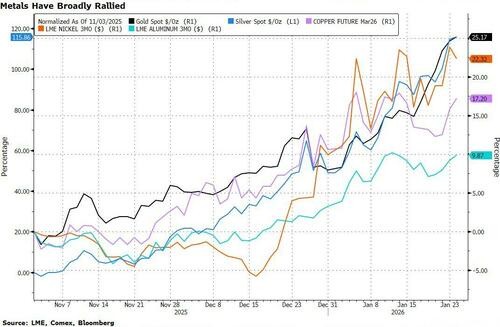
The era of "safety premium" in commodities has arrived

Bloomberg macro strategist Michael Ball stated that commodity prices are no longer just the result of marginal supply and demand, but rather a pre-compensation for potential disruption risks. Silver is not an exception, but rather a pricing template for other metals such as copper and nickel: once supply tightens, production relies on by-products or processing stages are highly concentrated, any policy restrictions or disturbances could trigger inventory competition and drive prices to exhibit non-linear upward trends
For the past few decades, the core assumption regarding commodity prices has been that as long as prices are high enough, supply can always be allocated in the global market. However, in the current context of accelerated regionalization and prioritization of national security, this premise is failing.
Bloomberg macro strategist Michael Ball points out that in a world divided by camps and where supply chains are repeatedly scrutinized, critical metals are no longer ordinary cyclical goods but rather strategic assets.
The market prices of commodities are beginning to systematically include a new component—a pricing premium for supply security. This means that even if prices seem "expensive," they may not return to the easily retrievable range of the past.
From "Abundant Supply" to "Secure Scarcity": The Shift in Commodity Pricing Logic
Ball believes that many metal prices appear overvalued if still referenced against the past era of "supply always available." The problem is that this reference point is no longer applicable.
In a world oriented towards regionalization and national security, the clearing prices of commodities increasingly reflect the value of ensuring continuous supply. This premium comes from multiple aspects: structural bottlenecks in mining, processing, and manufacturing; tariffs and trade policies; national strategic reserves; and corporate-level "just in case" inventory strategies.
In this context, the convenience yield of critical metals is continuously elevated. Prices are no longer just the result of marginal supply and demand but are a pre-compensation for potential disruption risks.
Electrification and AI Overlap, Rigid Demand for Strategic Metals
Changes on the demand side also exhibit structural characteristics.
"Electrification of everything" has significantly raised the baseline demand levels for copper, aluminum, lithium, nickel, rare earths, and hardware related to power grids. Meanwhile, the rapid expansion of AI data centers has further increased the investment demand for power infrastructure.

Ball emphasizes that when metal shortages could lead to stagnation in grid construction, delays in data center projects, insufficient battery backup capacity, and even weaken defense preparedness, the cost of supply disruptions becomes unacceptable. In this case, expanding inventory is a rational choice, and the pre-positioning of inventory itself will drive demand, support prices, and allow the safety premium to continue.
The recent rapid rise in silver prices is a real-world manifestation of this mechanism. Silver, which has both store of value attributes and industrial uses, was listed as a critical mineral by the U.S. Department of the Interior. This has heightened market expectations for potential policy restrictions, combined with long-term supply tightness, prompting importers to accelerate physical stockpiling. The result is that silver has outperformed gold while also demonstrating how scarcity can trigger rapid repricing.
The Real Bottleneck is in the Midstream, "Safety Premium" Hard to Fade
Ball points out that silver is not an isolated case but rather a pricing template for other metals (such as copper and nickel): Once supply tightens, and production relies on by-products or is highly concentrated in processing stages, any policy restrictions or disruptions can trigger inventory competition and push prices to rise non-linearly. **
More critically, the current supply of commodities is increasingly constrained by the "physical asset balance sheet"—separated rare earths, standardized battery chemicals, transformer capacity, and skilled metallurgical labor cannot be rapidly replicated by capital.
This is also why national policies are beginning to focus on the midstream segment. The EU's Critical Raw Materials Act specifically targets mining, processing, and recycling capabilities, and restricts concentration.
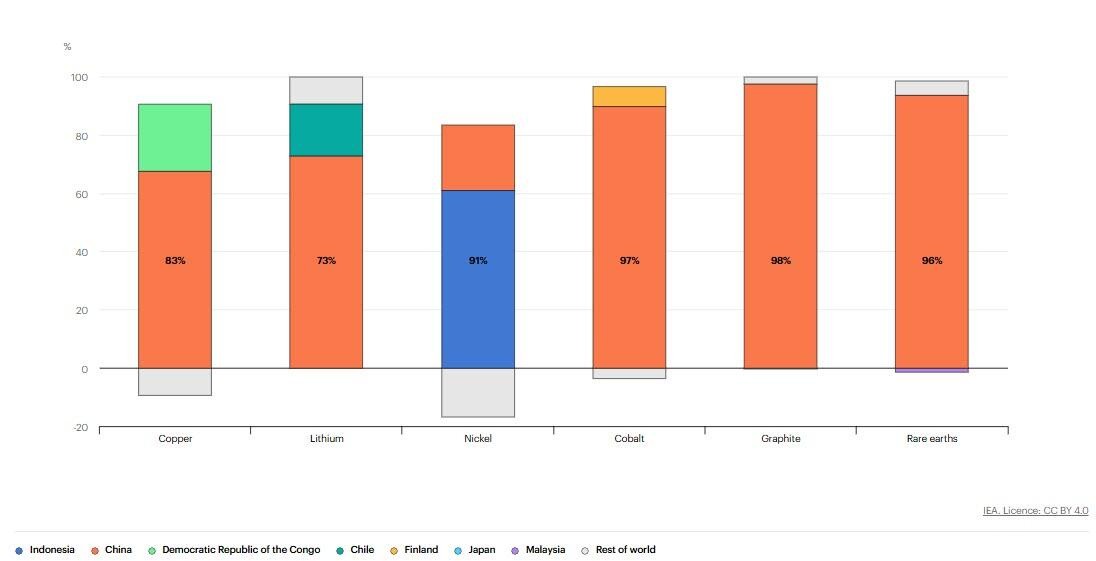
Data from the International Energy Agency shows that the market share of the top three refining countries has continued to rise, from 82% in 2020 to 86% in 2024, with new supply highly concentrated in a few countries. Nickel is supplied by Indonesia, while cobalt, graphite, copper, lithium, and rare earths are supplied by China.

Ball believes that all of this means that merely ensuring mining supply is not enough; countries also need to ensure the production of equipment that converts raw materials into usable inputs and the large-scale deployment of energy equipment.
In the context of AI-driven demand becoming a "necessity," commodity prices are no longer just cyclical variables. Even if the short-term price increases of some metals may exceed what can be explained by the safety premium itself, Ball believes that any price correction in the future will be shallower than in the past.
Because what supports prices is no longer just demand, but safety