


U.S. stock futures rise, the dollar falls to a four-year low, Asian currencies strengthen, and gold, copper, and aluminum all rise

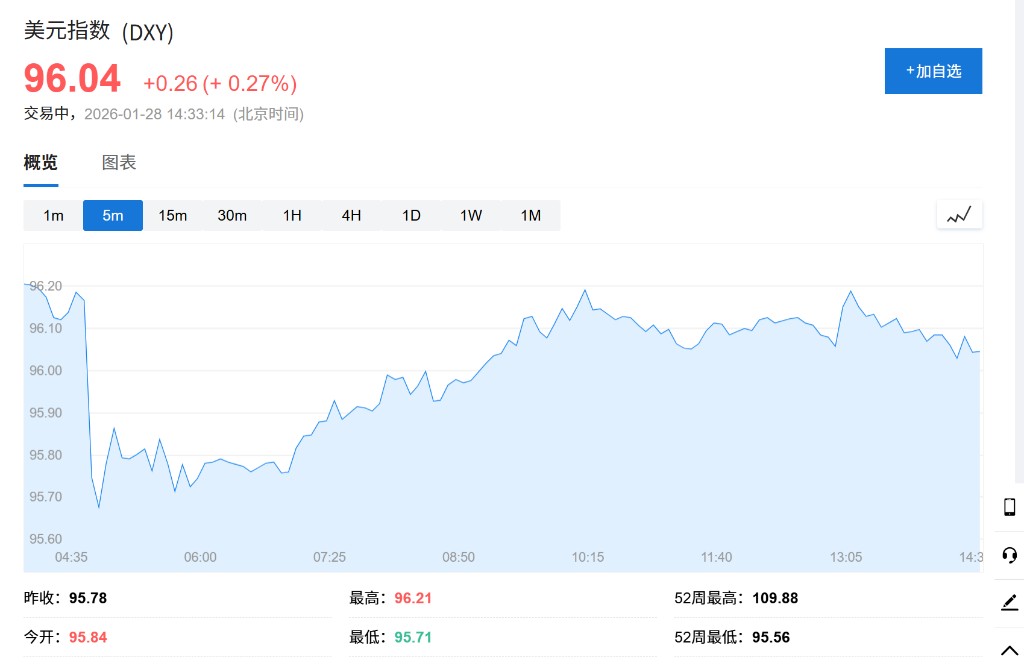
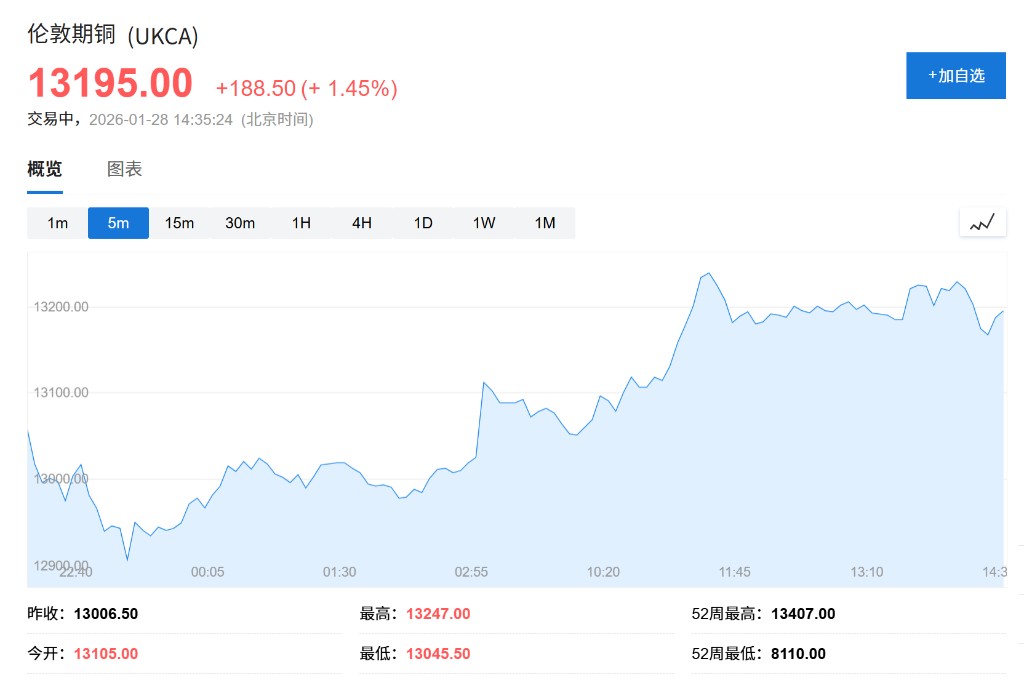
Nasdaq 100 index futures rose over 1%, and S&P 500 index futures increased by 0.47%. The US dollar rebounded slightly against all G10 currencies but remains in a weak range since February 2022. Gold broke through $5,200 per ounce, setting a new historical high, with a cumulative increase of about 20% this year, while silver surged over 50%. Aluminum prices reached a nearly four-year high, copper prices rose by 1.4%, and zinc prices climbed by 1.7%
The weakness of the US dollar is reshaping the global market landscape, with a rotation of assets driven by "devaluation trades" accelerating from precious metals to industrial metals and emerging market currencies.
Following a drop in the dollar index to its lowest level since February 2022 yesterday, on Wednesday the 28th, the dollar rebounded slightly against all G10 currencies but remains in a weak range. Gold broke through $5,200 per ounce, reaching a historic high, with a cumulative increase of about 20% this year, while silver surged over 50%. Aluminum prices hit a nearly four-year high, copper prices rose by 1.4%, and zinc prices climbed by 1.7%.
The Asian currency market benefited simultaneously. The MSCI Emerging Markets Currency Index reached an all-time high. The Malaysian ringgit and the South Korean won led the gains. Wee Khoon Chong, senior market strategist for the Asia-Pacific region at Bank of New York Mellon, stated: "The overnight weakness of the dollar is a key catalyst for the strengthening of Asia-Pacific currencies at the opening, along with more fundamental factors such as the recovery momentum in growth—especially in the technology sector—and the continued capital inflow into the region." The Federal Reserve's policy meeting on Thursday has become the market's focus, with investors seeking further clues on the dollar's trajectory.
- US stock futures rose, with Nasdaq 100 futures up over 1%, S&P 500 futures up 0.47%, and Dow futures up 0.1%.
- The Nikkei 225 index closed up 0.05% at 53,358.71 points. The Tokyo Stock Exchange index closed down 0.8% at 3,535.49 points.
- The Taiwan Stock Exchange weighted index closed up 1.5% at 32,803.82 points.
- The Indonesian stock market's decline widened to 8%, triggering a trading halt.
- The dollar index rebounded slightly by 0.2%, currently at 96.4.
- The South Korean won rose to its highest level against the dollar since October last year.
- The yield on the US 10-year Treasury bond fell by 1 basis point to 4.23%.
- The yield on Japan's 20-year Treasury bond decreased by 2 basis points to 3.180%. The yield on Japan's 10-year Treasury bond fell by 3.5 basis points to 2.25%.
- Spot gold rose to $5,250 per ounce, up 1.35% for the day; spot silver rose 3.44% to $115.82 per ounce.
- Aluminum prices rose 1.2% on Wednesday to $3,246.50 per ton, reaching $3,252 at one point in early trading, the highest level since April 2022. Copper rose 1.4%, and zinc climbed 1.7%.
- West Texas Intermediate crude oil rose 0.7% to $62.81 per barrel.
Concerns Over Policy Triggered by Continuous Dollar Decline
The Bloomberg Dollar Spot Index plummeted nearly 3% over four trading days ending Tuesday, hitting a nearly four-year low. This round of selling stems from market unease over the Trump administration's erratic policy-making and ongoing attacks on the Federal Reserve.
US stock futures rose, with Nasdaq 100 futures up over 1%, S&P 500 futures up 0.47%, and Dow futures up 0.1%

"The Trump administration is taking a calculated risk," said Win Thin, chief economist at Bank of Nassau 1982 Ltd. "The foreign exchange market is often a leading indicator of market dissatisfaction with a country's policies and economic outlook, so this weakness in the dollar is worth noting."
Rob Kaplan, vice chairman of Goldman Sachs and former president of the Dallas Federal Reserve, warned in an interview with Bloomberg Television in Hong Kong that while a weaker dollar benefits exports, the U.S. has about $39 trillion in debt. "When you have that much debt, currency stability is more important than exports," he said. "The U.S. wants to see a stable dollar and hopes to sell long-term government bonds. A stable dollar helps achieve that."
The Federal Reserve is expected to pause its interest rate cut cycle on Thursday, as a stabilizing labor market has rebuilt some consensus among officials. Chris Brigati of SWBC stated that given the economy's extraordinary resilience, the Fed's messaging may emphasize a data-driven approach to future policy decisions. Investors will also be watching its impact on the dollar.
Gold and Silver Continue Record Surge
The precious metals market is experiencing a surge not seen since 2026. Gold broke through $5,200 per ounce on Wednesday, continuing to set historical records after surpassing the $5,000 mark for the first time this week. The weak dollar, geopolitical uncertainty, and Trump's attacks on the Federal Reserve have reignited the "devaluation trade."
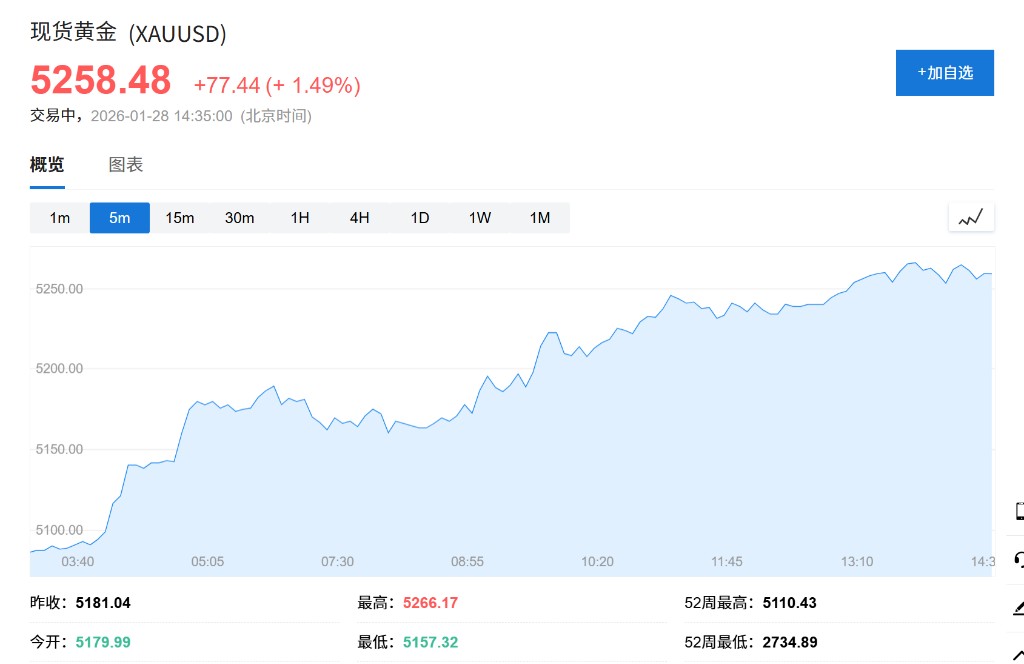
Silver's rise has been even more remarkable, soaring over 50% this year, far exceeding gold's approximately 20% increase. This bull market in precious metals has attracted investors away from currencies and sovereign bonds towards hard assets, amid concerns that the fiscal deficit issue continues to fester.
Asian stock markets have also benefited from this asset rotation. The MSCI Asia-Pacific Index rose 0.7% to a record high on Wednesday, with the technology stock index also reaching an all-time high, led by memory chip manufacturer SK Hynix. Asian stock markets have continued their three-year rally driven by artificial intelligence, with more attractive valuations and stronger growth prospects drawing investors to accelerate their shift towards stocks in the region.
Aluminum, Copper, and Other Industrial Metals Strengthen Collectively
The base metals market has had a strong start in 2026. Aluminum prices rose 1.2% to $3,246.50 per ton on Wednesday, reaching as high as $3,252 in early trading, the highest level since April 2022. Copper increased by 1.4%, and zinc climbed by 1.7%.
 Goldman Sachs has raised its aluminum price forecast, stating that the adjustment comes "after strong price performance and continued bullish sentiment from investors." The bank expects the average aluminum price in the first half of the year to be $3,150 per ton, up from a previous forecast of $2,575, but still below current prices. Goldman Sachs has been one of the more pessimistic commentators on the aluminum market in recent months.
Market analysts point out that "devaluation trades" are driving investors from currencies and sovereign bonds towards hard assets, while Trump's erratic policymaking and attacks on the Federal Reserve further fuel this trend. Supply constraints provide additional support for some metals.
Asian Currencies Reach Multi-Month Highs
Emerging Asian currencies hit their highest levels since July last year on Wednesday, as "dollar devaluation trades" accelerated. The Bloomberg Asian Dollar Index rose 0.4%, and the MSCI Emerging Markets Currency Index reached an all-time high.
"The overnight weakness of the dollar was a key catalyst for the strengthening of Asia-Pacific currencies at the open," said Wee Khoon Chong, Asia-Pacific market strategist at BNY Mellon. "There are also more fundamental factors at play, such as the recovery momentum in growth—especially in the tech sector—and the continued inflow of capital into the region."
"Trump's latest comments on the dollar further exacerbated its weakness," said Christopher Wong, currency strategist at OCBC Bank. The risks for the dollar against Asian currencies (excluding Japan) are "asymmetrically skewed to the downside," unless there is a hawkish surprise from the Federal Reserve or risk sentiment takes a hit.
The strengthening of Asian currencies may provide some relief for currencies like the Philippine peso, Indian rupee, and Indonesian rupiah, which are "burdened by deficits and fiscal issues," Wee Khoon Chong added. The yen reached its strongest level since October during U.S. trading hours on Tuesday, following comments from Japanese officials, including the finance minister, which sparked speculation that the government might intervene in the market to prevent the currency from resuming its decline
