


Aluminum prices hit a new high since April 2022, Goldman Sachs remains bearish

Goldman Sachs pointed out in its latest report that although it raised the target price for aluminum in the first half of 2026 to USD 3,150 per ton, it maintains a bearish outlook in the medium to long term. The report believes that as new production capacity in places like Indonesia is gradually released, and the demand growth in key sectors such as photovoltaics and automobiles faces slowing pressure, the global aluminum market is expected to enter a structurally oversupplied phase in 2026, with the average price in 2027 potentially dropping to USD 2,400 per ton. The report also warns that the current aluminum price already contains significant risks of scarcity premium
According to the Wind Trading Platform, Goldman Sachs adjusted its aluminum price forecast in a research report on January 27, raising the target price for the first half of 2026 to $3,150 per ton. The report believes that short-term price support mainly comes from low global inventories, uncertainties in power supply for new production capacity in Indonesia, and sustained demand in the new energy sector.
However, Goldman Sachs maintains a bearish view on aluminum prices in the medium to long term. The report points out that as new production capacities in Indonesia, Saudi Arabia, and other regions come online, coupled with a potential slowdown in global macroeconomic demand growth, the aluminum market is expected to shift to structural oversupply by 2026. Based on this, the bank predicts that aluminum prices will fall to $2,500 per ton in the fourth quarter of 2026, with the average price further declining to $2,400 per ton in 2027.
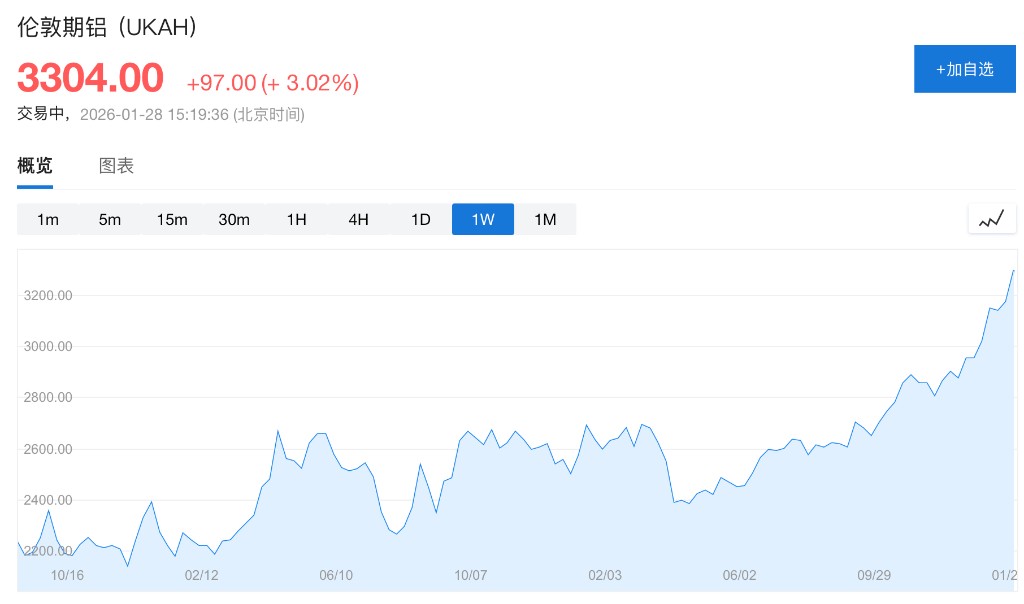
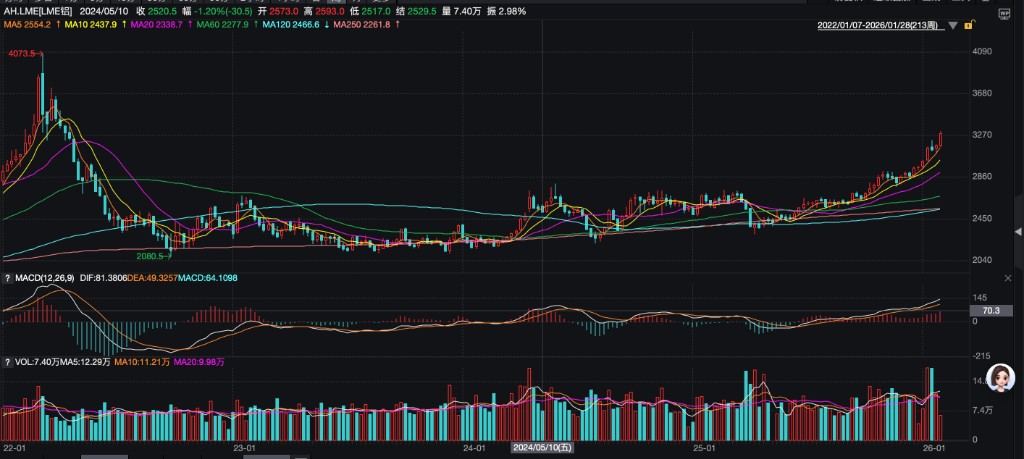
London aluminum futures continued their strong performance on Wednesday, briefly breaking through $3,300 per ton, reaching a new high since April 2022. Since mid-September 2025, London aluminum has cumulatively risen about 27% from around $2,600.
Short-term Surge in Aluminum Prices: Three Major Drivers Supporting the Increase
Goldman Sachs' report indicates that this round of price increases is mainly driven by the following three factors:
First, global aluminum inventories remain low, with inventory coverage days decreasing from about 50 days in 2023 to 46 days in 2025, and the low inventory structure directly supports spot premiums, enhancing bullish market expectations. Second, there are doubts about the power supply capacity for Indonesia's new aluminum smelting production capacity, and its actual production progress may fall short of expectations, further reinforcing expectations of supply tightness. Finally, the rapid development of new energy sectors such as electric vehicles and grid construction has significantly boosted terminal demand for aluminum, providing solid fundamental support for prices.
It is worth noting that the average aluminum price in January 2026 is expected to be around $3,130 per ton, which, although not surpassing the historical high during the European energy crisis in 2022, has already set the second-highest record since that period.
Long-term Bearish Logic: Accelerated Supply Release + Slowing Demand Growth
Goldman Sachs points out that the current aluminum price above $3,000 per ton reflects overly optimistic scarcity pricing, and the market underestimates the systematic supply increase led by Indonesia, with a medium to long-term oversupply pattern already established.
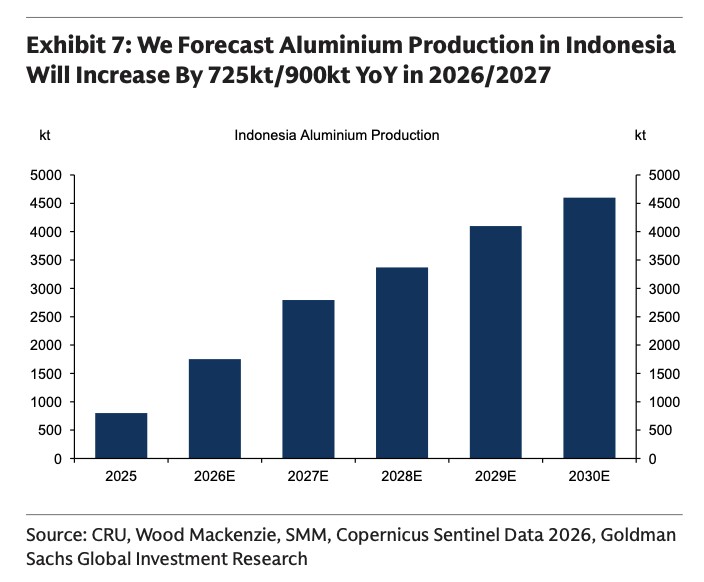
On the supply side, Indonesia has become the core of global aluminum capacity expansion, with expected production increases of 725,000 tons and 900,000 tons in 2026 and 2027, respectively, reaching a total production of 4.25 million tons by 2030. Large projects represented by Adaro and Juwana have secured power supply, with high certainty of production commencement. Meanwhile, smelting capacities in regions such as Saudi Arabia, Kazakhstan, and Angola, led by Chinese capital, will gradually be released after 2027 China continues to increase production, with an expected primary aluminum output of 46.2 million tons by 2029, breaking through the previous capacity expectation limit of 45 million tons.
The demand side is facing structural pressure. Aluminum demand in the photovoltaic sector is expected to decline year-on-year in 2026-2027, while the unit aluminum consumption strength of photovoltaic modules is projected to decrease from 7.3 tons/MW in 2025 to 5.1 tons/MW by 2030, further weakening demand support. In the automotive sector, although the aluminum usage per electric vehicle is higher, the global production and sales growth expectations for electric vehicles have been revised down, resulting in the actual driving effect on aluminum demand being less than previously anticipated by the market.
Based on the above supply and demand changes, Goldman Sachs has slightly lowered its forecast for the global aluminum market surplus in 2026 to 80,000 tons, maintained its 2027 surplus forecast at 1.6 million tons, and significantly raised the 2028 surplus forecast to 2.3 million tons. As inventory levels gradually return to levels seen around 2018, aluminum prices will return to cost and fundamental equilibrium in the medium to long term.
"China Shock 2.0": Cost and Efficiency Reshape Global Supply Patterns
Goldman Sachs analysis points out that China's aluminum smelting industry is driving structural changes in the global supply pattern through systematic output of technology and models. With significant advantages in cost control and engineering efficiency, Chinese companies have reduced the construction cost of electrolytic aluminum capacity by about 50% compared to 20 years ago, and shortened the construction cycle of "power plant-smelter" integrated projects from the 30 months typically required by international peers to 18 months, achieving a 40% increase in efficiency.
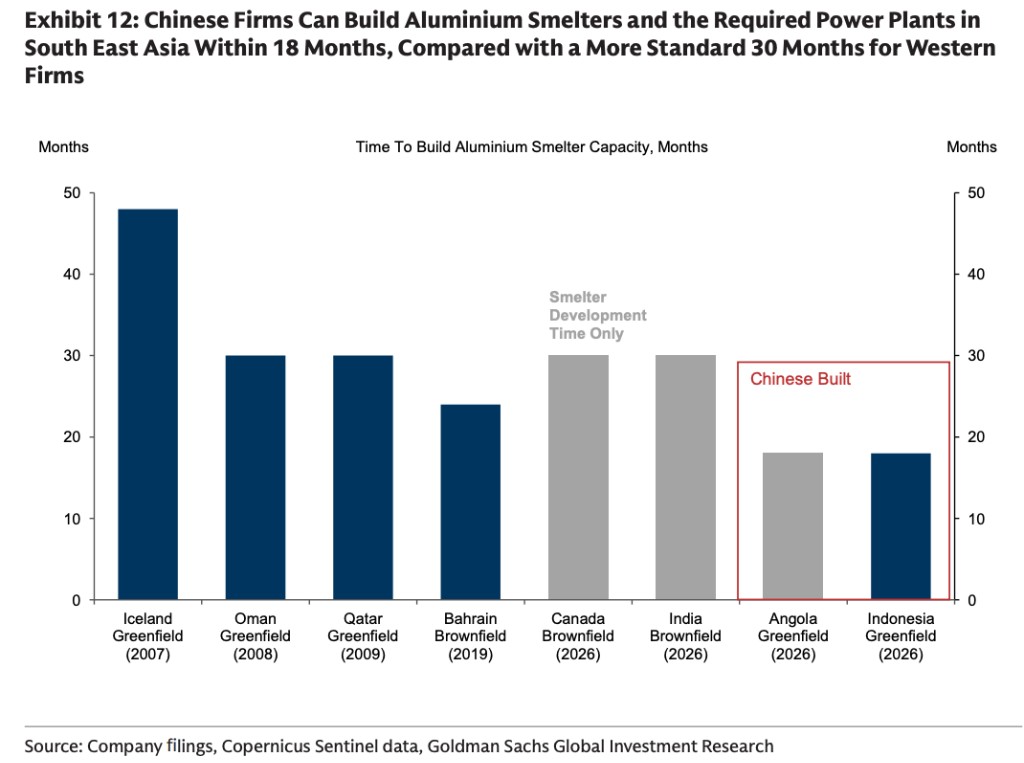
This efficient capacity expansion model is rapidly being implemented in Southeast Asian countries such as Indonesia and Vietnam. Leveraging mature industrial chain support and project execution capabilities, Chinese companies are promoting the rapid deployment of low-cost capacity overseas. Goldman Sachs believes that this trend will continue to exert downward pressure on the long-term equilibrium level of global aluminum prices, with a similar impact logic to the shock effects brought to the global market by domestic capacity expansion in China from 2007 to 2025
