The Mag 7 earnings season kicks off tomorrow, and the market is closely watching one thing—capital expenditures!

Investors' attention to capital expenditure guidance is at an all-time high. Goldman Sachs believes that this earnings season will ultimately revolve around one core question: "Who is cutting spending, and who is increasing spending?" Morgan Stanley expects Meta to announce a capital expenditure guidance of approximately $120 billion for 2026, while Microsoft, Google, and Amazon are expected to be $140 billion, $150 billion, and $175 billion, respectively. In addition, investor sentiment towards Meta has clearly deteriorated, while for Amazon and Google, the growth rate of cloud business is key
The earnings season for the tech giants "Mag 7" will kick off on Wednesday, with Microsoft, Meta, and Tesla announcing their results after the market closes, followed by Apple on Thursday. The total market capitalization of these four companies reaches $10.5 trillion. Rich Prvorotsky, head of Goldman Sachs' Delta One division, recently stated that this earnings season will ultimately revolve around one core question: "Who is cutting spending, and who is increasing spending?"
The market expects "Mag 7" to see a 20% profit growth in the fourth quarter, which would be the slowest growth rate since the beginning of 2023. Against this backdrop, these companies are under pressure to prove that their promised massive capital expenditures are generating returns in a more significant way. Investor attention to capital expenditure guidance is at an all-time high, and this data will directly impact the market's judgment on the AI investment return cycle.
This week, one-third of the S&P 500 constituents (by market capitalization) will report earnings. According to Bloomberg data, nearly 80% of S&P 500 companies have exceeded analyst expectations so far. Ulrike Hoffmann-Burchardi from UBS Global Wealth Management stated: "We expect tech stocks to perform strongly, but we also anticipate that earnings growth will extend across various sectors."
Despite solid performance, Chris Senyek from Wolfe Research pointed out that companies with both revenue and profit exceeding expectations have seen negative stock performance after earnings reports. "In other words, the double beat is being punished due to solid performance," he said, "We believe this trend is unsustainable during the earnings season."
Capital Expenditure Becomes the Core Focus
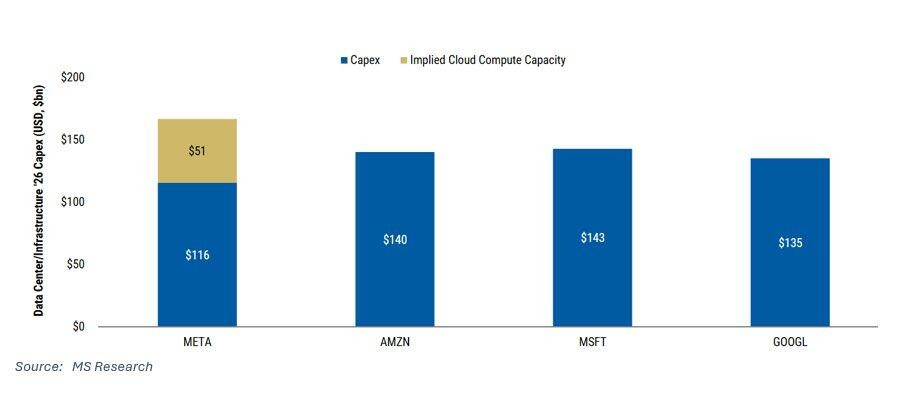
Morgan Stanley's expectations for companies' capital expenditures in 2026 show that tech giants are undergoing unprecedented investment expansion.
Meta is expected to announce a capital expenditure guidance of about $120 billion for 2026, with management previously stating that 2026 will be "significantly greater" than the 2025 guidance of $70-72 billion. Morgan Stanley analysts noted that Meta's off-balance-sheet leases with companies like Google, CoreWeave, and NBIS amount to an additional approximately $50 billion in incremental capital expenditure, bringing the theoretical total to $170 billion.
Microsoft's latest statements indicate that capital expenditure growth for fiscal year 2026 (ending in June) will accelerate compared to fiscal year 2025 (over 58%), with Morgan Stanley and market consensus expecting it to exceed $140 billion. This quarter, Microsoft guided for a quarter-over-quarter increase in capital expenditure, meaning it will exceed $35 billion.
Google's capital expenditure expectation for 2026 is about $135 billion, but given the growth momentum of Google Cloud and TPU businesses, it could reach $150 billion. This is a significant increase from the 2025 guidance of $91-93 billion, with management already indicating that 2026 will see further increases.
Amazon's capital expenditure is the least transparent, as it has not separated AWS infrastructure from retail business. Morgan Stanley expects the infrastructure capital expenditure for 2026 to be $140 billion, with total capital expenditure at $175 billion, while the 2025 guidance was $125 billion
Microsoft: Trapped Between SaaS and OpenAI
JP Morgan analyst Mark Schilsky pointed out that from an investor's perspective, Microsoft is currently "trapped between SaaS and OpenAI." The only way out is to significantly accelerate Azure's growth to a low-to-mid range of over 40%.
The market expects Microsoft's second fiscal quarter Azure constant currency revenue growth to be around 39%, two percentage points higher than the management's guidance of 37%. If Azure achieves a 40% growth rate this quarter, it would be enough to drive the stock price up. For the third fiscal quarter guidance, investors hope to see a constant currency growth of about 38%, indicating an acceleration in growth.
Schilsky emphasized that the market generally believes OpenAI is losing to Google, and OpenAI needs to prove investors wrong by launching GPT-6. Despite the overall SaaS/software sector sentiment being sluggish, investors will focus on companies with accelerating revenue growth.
It is worth noting that based on Bloomberg's consensus expected earnings per share for 2026, Microsoft's valuation (approximately 26.5 times) is lower than Google's (approximately 29.5 times).
Meta: Investor Sentiment is Cautious
Since the third-quarter earnings report, investor sentiment towards Meta has noticeably deteriorated, when Zuckerberg clearly stated that he would continue to significantly increase operating expenses and capital expenditures. So far, investors have seen little concrete evidence that Meta's superintelligent lab can produce leading models.
JP Morgan analyst Doug Anmuth stated that investor sentiment is "cautious," with concerns about spending/capital expenditures and AI strategy for 2026, despite revenue growth consistently exceeding expectations. The firm expects capital expenditures for 2026 to be $115 billion (a year-on-year increase of 61%), and GAAP operating expenses to be $153 billion (a year-on-year increase of 30%).
The most critical KPI for the fourth quarter is revenue, with investors expecting about $60 billion (a year-on-year increase of 24%), slightly above the upper limit of the guidance range of $56-59 billion. For the 2026 operating expense guidance, investors generally believe that the street's expectation of about $150 billion (a year-on-year increase of 28%) is too low, expecting it to be above $155 billion.
Investors want to see some assurance that operating profit for 2026 will increase year-on-year. A flat or slight decline is unacceptable. Based on recent investor conversations, most buyers expect GAAP earnings per share for 2026/2027 to be around $30/$35, while the street's expectation is $30/$33.50.
Tesla: Musk's Showcase
Morgan Stanley believes that Tesla's fourth-quarter earnings report and the financial KPI expectations for 2026 are particularly dispersed. The stock price reaction will depend on incremental updates regarding the scaling of Robotaxi/Cybercab, the launch of unsupervised FSD, Optimus Gen 3, and AI5.
The firm expects 2026 delivery volume to be 1.6 million units (a year-on-year decrease of 2.5%), which is 9% lower than the market consensus. The expected automotive gross margin (excluding carbon credits) for the fourth quarter is 14.2%, below the market consensus of 14.8%. The expected free cash flow for 2026 is negative $1.5 billion, while the market consensus is positive $3.1 billion Key highlights include: the public launch date of Texas Robotaxi, the rollout path of unsupervised FSD, progress in AI5 chip design, and the preliminary release date of Optimus Gen 3 robot (the company previously pointed to February/March 2026). Tesla's decision to cancel Robotaxi safety supervisors in Austin may indicate that personal unsupervised FSD is about to be launched.
Amazon and Google: Cloud Business Growth is Key
Amazon remains the most frustrating stock for internet investors. Despite poor performance in recent months (and years), the stock still has a crowded long position. Investors are betting that AWS revenue growth will significantly accelerate, partly due to the continued rapid growth of Anthropic; the stock is cheap, trading at historical lows based on GAAP price-to-earnings ratio.
The most important KPI for the fourth quarter is AWS revenue growth. The street expects about a 21% year-over-year increase, while most investors expect it to be in the range of 22%-23%, with specific targets of 22.5%-23.0%. Investors expect AWS growth to continue accelerating in the first and second quarters. Some Amazon bulls believe that AWS revenue growth could approach 30% by the end of the year.
For Google, investors expect search revenue to grow by 15%-16% year-over-year (including about 1 percentage point of favorable currency effects), higher than the street's expectation of 13.5%. Google Cloud revenue is expected to grow by 38%-40% year-over-year, exceeding the street's expectation of 35%, and needs to accelerate significantly in the first quarter.
JP Morgan analyst Schilsky warned that Google is shifting from "strong stocks" to the "lazy bulls" territory. Buy-side expectations for 2027 earnings per share are not significantly higher than the street, with investors betting more on the continued expansion of valuation multiples rather than substantial performance exceeding expectations. Notably, Google is currently more expensive than Microsoft, Amazon, and Meta based on the 2026 GAAP price-to-earnings ratio.