


What happened with the collapse of the Indonesian stock market?

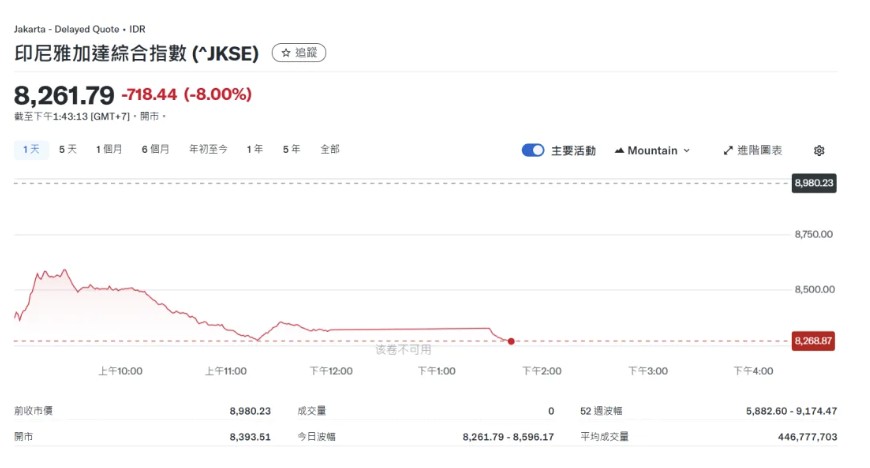
The Indonesian stock market experienced a severe sell-off on Wednesday, with the Jakarta Composite Index falling 7.4%, marking the largest single-day decline in over nine months. MSCI announced a suspension of adjustments to certain indices due to excessive concentration of equity among listed companies. If Indonesia fails to improve market transparency before May, it may face downgrade risks. Foreign capital outflow intensified, with a net outflow of approximately $180 million on Wednesday. The exchange has committed to responding to MSCI's requirements to enhance market transparency
The Indonesian stock market experienced a severe sell-off on Wednesday, with the benchmark Jakarta Composite Index closing down 7.4%, marking the largest single-day decline in over nine months. This followed the announcement by MSCI Inc. that it would immediately suspend certain index adjustments, including the addition of new constituent stocks, until regulators address the issue of excessive concentration of ownership among listed companies.
MSCI stated in a release that the Indonesian market has long faced structural issues such as a low free float, a small number of shareholders controlling a large number of shares, and insufficient liquidity. The company warned that if Indonesia fails to make significant progress in market transparency and regulation by May, it may be reassessed in its position within the emerging market index, and could even face a downgrade to "frontier market."
In response to this news, the Jakarta Composite Index plummeted 8.8% at one point during trading on Wednesday, triggering a trading halt. Stocks that were expected to be included in the MSCI index were severely impacted, with many hitting the daily limit down. Foreign capital has shown signs of outflow, with global investors net selling $192 million in Indonesian stocks in the week ending January 23, ending a streak of 16 consecutive weeks of net inflows. On Wednesday morning, the Indonesian exchange recorded a net outflow of approximately 30 trillion Indonesian rupiah (about $18 million).
MSCI Issues a "Warning Shot"
Tareck Horchani, head of brokerage at Malayan Banking Berhad in Singapore, stated:
“MSCI's freeze decision is more of a warning signal than a final conclusion. The market has begun to price in potential negative outcomes, which explains the selling pressure currently faced by the index-weighted stocks in Indonesia.”
This decision by MSCI was made after months of market consultation. Previously, the company proposed tightening the criteria for determining the free float of Indonesian securities, considering the use of alternative data sources provided by the Indonesian Central Securities Depository (KSEI) to more accurately assess the actual tradable shares. If a company's actual free float is lower than the reported figure, passive funds tracking the relevant index will have to reduce their holdings passively.
I Gede Nyoman Yetna, head of the listing department at the Indonesian exchange, stated on Wednesday that the exchange is committed to responding to MSCI's request to enhance market transparency and will collaborate with the company to seek consensus. The exchange also plans to consult market participants on reasonable levels of free float and will work with KSEI to provide clearer data on shareholder structure classification.
Free Float Issues Become a Long-Term Pain Point
The issue of free float has become a focal point in the Indonesian stock market. Last year, the Jakarta Composite Index outperformed the MSCI Indonesia Index by a record margin, highlighting the price divergence between the two and market concerns over liquidity mismatches. Due to the low trading volumes of many constituent stocks in the MSCI Indonesia Index, many passive fund managers reported that the benchmark index is actually difficult to track effectively, prompting funds to shift towards the more stringently compiled MSCI Emerging Markets Index Indonesian regulatory authorities have begun addressing related issues, planning to gradually raise the minimum public float requirement from the current 7.5% to 10%-15%, with a long-term goal of 25%, but no clear timetable has been set yet. In comparison, the minimum public float requirements in Hong Kong and India are set at 25%, while Thailand's is 15%.
Yiping Liao, a global portfolio manager at Franklin Templeton, pointed out:
"If the Indonesian market is ultimately downgraded, the impact on passive fund outflows will be enormous. In fact, due to macroeconomic conditions and policy uncertainties, foreign investment participation in the Indonesian market has already significantly declined."
Policy Uncertainty Heightens Investor Concerns
MSCI's decision may exacerbate market concerns about Indonesia's economic development path. President Prabowo Subianto is attempting to guide fiscal and monetary policies to achieve his economic growth targets, but investor confidence is already fragile. The dismissal of Sri Mulyani Indrawati, who served as finance minister for a long time, and Prabowo's increasing influence over the central bank have caused market unease.
Coordinating Minister for Economic Affairs Airlangga Hartarto stated that he will meet with financial regulators on Thursday to discuss MSCI's requirements and mentioned that Indonesia could learn from mechanisms implemented by other countries to enhance the transparency of its local exchanges.
John Foo, founder of Valverde Investment Partners, pointed out:
"The risk is that Indonesia does not do enough. If downgraded to frontier market status, it could trigger panic selling. We are underweight on Indonesia, with almost zero exposure."
Since the beginning of this year, the Indonesian stock market has lagged behind other Southeast Asian countries. Before the sharp decline on Wednesday, the Jakarta Composite Index had only risen 2.7% year-to-date, while the MSCI ASEAN Index had increased by as much as 5.3% during the same period.
Risk Warning and Disclaimer
The market carries risks, and investments should be made cautiously. This article does not constitute personal investment advice and does not take into account the specific investment objectives, financial situation, or needs of individual users. Users should consider whether any opinions, views, or conclusions in this article are suitable for their specific circumstances. Investment decisions made based on this are at their own risk.
