Is Silver Facing a "Delivery Failure" Crisis? March May Become a "Critical Moment" for Precious Metals

In January, over 40 million ounces of silver have been applied for delivery on COMEX, and as the main delivery month of March approaches, delivery demand is expected to reach 70 million to 80 million ounces, potentially exhausting COMEX's current registered inventory of 110 million to 120 million ounces. Veteran precious metals analyst Bill Holter warned that if COMEX fails to fulfill its delivery obligations, it will completely destroy the credibility of the existing pricing mechanism and trigger a chain reaction that spreads to the gold and credit markets, ultimately leading to the collapse of the entire financial system
The precious metals market is facing a potential delivery crisis.
Senior precious metals analyst Bill Holter recently warned that the New York Mercantile Exchange (COMEX) may experience a physical delivery default for silver as early as March 2026, which would completely destroy the credibility of the existing pricing mechanism and trigger a chain reaction spreading to the gold and credit markets, ultimately leading to the collapse of the entire financial system.
Abnormal delivery demand has already emerged. According to Holter, in January, which is traditionally a non-delivery month, COMEX has already seen over 40 million ounces of silver applied for delivery, while in previous years, this number typically ranged from 1 million to 2 million ounces. As the major delivery month of March approaches, delivery demand has reached 70 million to 80 million ounces, potentially exhausting COMEX's currently registered inventory of 110 million to 120 million ounces.
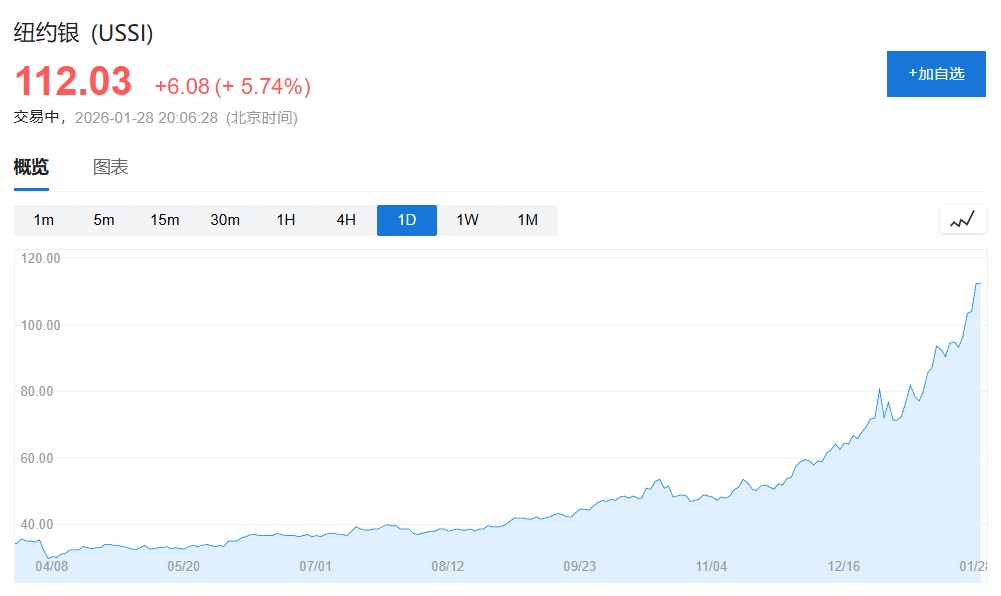
This warning comes at a time when the silver market is experiencing unprecedented gains. Silver prices have soared 154% so far in 2025, with a rise of about 40% in January alone, far exceeding the performance of the stock market during the same period. UBS strategists have warned clients this week that the recent gains in precious and industrial metals are "out of control."

What happens if delivery fails? Risk of financial system collapse?
The COMEX silver market is facing unprecedented physical delivery pressure. Holter pointed out that the application for 40 million ounces of delivery in January, a non-delivery month, is an extreme anomaly, indicating that a larger-scale run on deliveries may occur in March, the major delivery month.
"If COMEX cannot fulfill its delivery obligations, the contract value will drop to zero," Holter stated. He emphasized that a delivery default would completely negate the pricing authority of COMEX, as contracts that cannot be fulfilled hold no value.
More seriously, a failure in silver delivery would immediately transmit to the gold market. Holter warned that since gold is essentially a "counter-dollar" or "counter-U.S. Treasury" asset, defaults in the gold market would directly impact the credit market, thereby threatening the stability of the entire financial system.
Currently, the registered deliverable silver inventory at COMEX is about 110 million to 120 million ounces, but there are doubts in the market regarding whether these inventories are subject to double pledging or other encumbrances. If the delivery demand in March exceeds the available inventory, the market will face the most severe liquidity crisis since the Silver Thursday event in 1980.
Holter painted a grim picture of the consequences of delivery defaults. He predicts that if a delivery failure occurs in March 2026, it will trigger currency devaluation and the collapse of the entire financial system.
"The real economy relies on credit to operate; everything you touch and everything you do involves credit participation," Holter stated. If credit becomes inaccessible, the real economy will come to a complete standstill.
This warning is not alarmist. The pricing mechanism in the precious metals market has long relied on paper contracts, with a very low ratio of physical delivery. Once market trust in paper contracts collapses, investors will rush to demand physical delivery, while the exchange's inventory is far from sufficient to meet the delivery demands of all contracts Considering the total debt and commitments of the United States at $200 trillion, the financial system's reliance on credit has reached a historical extreme. A crisis of confidence in any key market could trigger a chain reaction, and the precious metals market is precisely the last anchor point of trust in the entire monetary system.
Price Prediction "Ridiculously Underestimated"
Although the price of silver has surpassed $100 per ounce, Holter believes the market is still in the early stages of an upward trend. He stated that all current price predictions—including the target of $600 per ounce proposed years ago—will ultimately prove to be "ridiculously underestimated."
Renowned silver analyst Peter Krauth shares an optimistic view, expecting that in the upcoming "frenzy phase," silver prices could hit $300 per ounce. Krauth believes that $50 per ounce has become the new price floor, and the dramatic adjustment of the gold-silver ratio will be the core driving force behind rising silver prices.
Holter provides a more extreme valuation framework from a monetary perspective. He pointed out that if calculated based on the U.S. federal government's $38 trillion debt, with 8,000 tons of gold reserves as support, the gold price should reach $200,000 per ounce. This logic also applies to the repricing of silver.
Some large traders and banks that are shorting precious metals have fallen into financial difficulties. Holter stated that the continuously rising metal prices—especially silver prices—are putting severe pressure on these institutions, which may exacerbate market instability.
The strong performance of silver is rooted in deep fundamental imbalances. As a metal with both monetary and industrial properties, silver is being squeezed by multiple demands.
Industrial demand remains robust, particularly in sectors such as solar energy, electric vehicles, and electronics. Meanwhile, investment demand is also surging, with investors viewing silver as a hedge against inflation and currency devaluation.
On the supply side, there are structural constraints. Silver is primarily mined as a byproduct of basic metals like copper, lead, and zinc, making its output difficult to respond quickly to price signals. This supply rigidity can lead to sharp price fluctuations during periods of surging demand.
Krauth emphasizes that all factors supporting the upward trend are in place to last "for quite a long time." Although there are short-term risks of a pullback, the medium to long-term trend has already been established