


Musk's "Space Photovoltaic Dream" is inseparable from the Chinese supply chain

Musk's "Space Photovoltaic Dream" relies on the Chinese supply chain. Chinese photovoltaic companies have become the core of his space energy blueprint. The A-share market has heated up due to the "space photovoltaic" craze, with the photovoltaic sector remaining strong. Musk announced at the Davos Forum that SpaceX and Tesla will build a 200GW photovoltaic production base, expected to be operational within three years, promoting the commercialization of "space photovoltaic." The market's high expectations for space photovoltaic have sparked discussions, and whether it has long-term industrial logic support remains to be seen
Space photovoltaics are rewriting the "value anchor" of Chinese photovoltaic companies. As the dominant force in global photovoltaic manufacturing, Chinese enterprises are becoming an unavoidable core of the supply chain in Elon Musk's space energy blueprint.
Recently, the A-share market has seen a wave of "space photovoltaics" enthusiasm, with the photovoltaic sector continuing to heat up and maintain a strong trend. On January 26, Runze New Energy hit a 20% daily limit and maintained that status, while companies like Tuojiri New Energy, Yamaton, GCL-Poly Energy, and Mingyang Smart Energy also reached their daily limits. By January 28, the market began to differentiate, but sub-sectors like photovoltaic adhesive films and BIPV continued their upward trend.
The direct trigger for this market surge came from the Davos Forum on January 22: Musk publicly stated that SpaceX and Tesla are collaborating to build a photovoltaic production base in the U.S. with an annual capacity of 200GW, expected to be operational within three years, primarily for powering ground data centers and space AI satellites. According to estimates, the planned scale of 200GW is close to a quarter of the national electricity demand in the U.S., making the concept of "space photovoltaics," which was originally more research-oriented, move to the forefront of commercialization narratives.
Feng Fan, founder of photovoltaic technology company Yanhe Technology, stated: "The current high expectations in the capital market for space photovoltaics are not unusual, as capital typically intervenes during the technology incubation phase rather than waiting for maturity." AI and commercial space are typical examples.
Behind the market's exuberance is a fleeting speculative hype, or is it a long-term track truly supported by industrial logic? What is the market space and opportunity for this track?
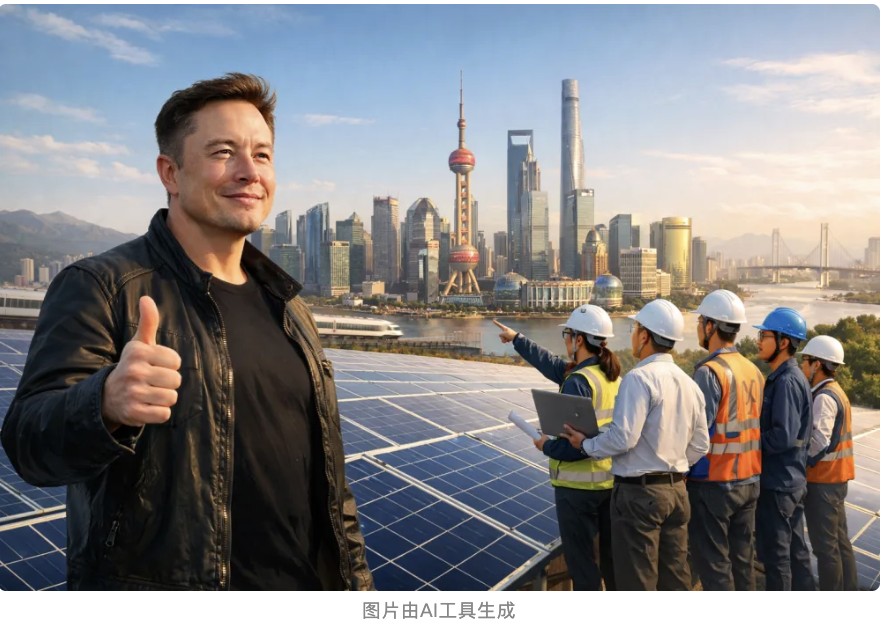
The "Space Photovoltaics Fever" Triggered by Musk
Not long ago, Musk repeatedly mocked nuclear fusion in public, for a simple reason: the nuclear fusion industry has been promising for decades, yet every ten years it still claims, "it needs another ten years." He believes that, in contrast, space photovoltaics are ready, feasible, and can be scaled immediately.
Previously, we detailed in this article Musk's reasons for insisting on space photovoltaics, as Silicon Valley is witnessing a battle over energy routes. Overall, Musk's bet on space photovoltaics is fundamentally about seeking breakthroughs in engineering to overcome current energy bottlenecks.
Compared to ground photovoltaics, space photovoltaics can be considered an "upgraded version": solar panels on the ground work for a maximum of 8-12 hours and depend on "the weather"; solar power stations in geostationary orbit can be in sunlight most of the time, unaffected by day-night cycles, weather, or seasonal changes; in space, they can provide nearly 24-hour uninterrupted power, with energy density much higher than that on the ground.
Musk's ultimate vision is to deploy giant photovoltaic arrays in space, transmitting electricity back to the ground via microwaves or lasers, connecting to the power grid. This means that space photovoltaics can upgrade from being "the charging treasure of spacecraft" to "the power plant for all humanity." This vision of moving from "energy supplementation solutions" to "infrastructure" has led the capital market to begin reassessing the long-term value of this sector. According to predictions from institutions such as CITIC Construction Investment and Guojin Securities, the global space photovoltaic market may reach a range of USD 500 billion to USD 1 trillion by 2030.
An industry analyst stated that this sector naturally escapes the three major limitations of ground photovoltaic: subsidy policies, grid absorption, and land resources, which means it represents a true market demand increment, no longer a zero-sum game of "resource grabbing" and "subsidy competition."
Feng Fan pointed out that currently, China has a global monopoly advantage in photovoltaic manufacturing. Affected by intense industry competition, ground photovoltaic prices are not ideal; in contrast, space photovoltaic has higher added value and greater conversion potential, representing an important incremental opportunity for photovoltaic companies.
An energy revolution is happening at a visibly rapid pace; it does not require the long wait of nuclear fusion, just the launch of rockets.
Can Musk Not Rely on the Chinese Supply Chain?
Why can this "space photovoltaic" ignite the A-share market? The reasons go far beyond the so-called "concept hype."
During this early part of the year, Musk has repeatedly praised China's energy capabilities on multiple occasions, emphasizing that China's speed and scale in solar power generation, electricity expansion, and grid construction have far surpassed that of the United States.
The excitement in the capital market regarding the photovoltaic industry is not just about "hype," but rather that the global energy landscape is undergoing structural changes. Moreover, China has a real industrial foundation and strategic position in this context. In other words, what capital sees is the engineering closed loop of the sector, predictable policies, and long-term industrial value, rather than just topic traffic.
In fact, China has been laying out plans for space photovoltaic for a long time. As early as 2010, some domestic experts proposed relevant roadmaps at a technical seminar on space solar power stations, clearly planning a step-by-step strategy: initially constructing megawatt-level experimental stations in space for scientific research and emergency power supply, ultimately achieving the long-term goal of gigawatt-level commercial space stations.
Musk's statements have had an unexpected effect, helping Chinese photovoltaic companies to establish a "tone-setting" at the global market level. When American tech giants begin to seriously promote space photovoltaic, A-share investors will naturally reassess whether those photovoltaic companies that have long supplied solar wings for aerospace and possess aerospace certification are undervalued.
This is not merely a case of "overheated emotions" in the capital market, but rather a re-pricing logic based on real industrial capabilities.
Chinese photovoltaic companies are highly compatible in this sector. Feng Fan noted that from the perspective of the global photovoltaic industry chain, whether in the field of photovoltaic manufacturing equipment or in the field of photovoltaic module manufacturing, China is in an absolutely advantageous position.
Feng Fan stated: "Currently, Chinese companies account for over 70% of the global capacity and shipment volume from equipment, materials to modules, forming the true infrastructure layer of the global photovoltaic industry. In other words, if Musk wants to promote a large-scale, low-cost space photovoltaic route, he will inevitably rely on China, regardless of whether he localizes deployment in the United States." In addition, there is another factor quietly accelerating the trend: policy expectations. Space photovoltaics encompass multiple strategic keywords such as "commercial space," "new productive forces," and "upgrading the new energy system," and have the opportunity to be included in the category of "new infrastructure" in the future.
Therefore, behind this wave of price surges, four forces are simultaneously at play: the industry itself is under pressure, domestic space photovoltaic layouts have been in place for a long time, policy directions are aligning, and capital is seeking new stories. Musk acted as the trigger, but what truly supports the frenzy is the accumulation, anxiety, and shifting demand in China's photovoltaic sector.
Will the collectively losing Chinese photovoltaic industry be redeemed?
To understand why capital is excited, we must first see the real situation of photovoltaics over the past two years.
The current market re-evaluation coincides with a low point in the photovoltaic industry. Over the past two years, the photovoltaic industry has been mired in a situation of "overcapacity + price wars," with prices of silicon materials and components continuously declining, leading to widespread pessimism in the market.
According to incomplete statistics from Futures Daily, as of March 2025, 33 photovoltaic listed companies have issued performance forecasts, most of which face revenue declines, profits turning negative, and even project suspensions and changes in equity, leading to a chain reaction. A more impactful set of data provided by Wang Bohua, honorary chairman of the industry association, indicates that the performance reductions and losses of these 33 companies total about 40 billion yuan, which is roughly ten times the scale of performance increases, indicating that industry losses are continuing to expand.
A seasoned practitioner pointed out that the core reason for such significant losses lies in a typical structural bubble. Capacity has expanded disorderly under similar products and the same technological route, leading to a cost war, inventory pressure, and price crashes.
Just as the industry was being written into the "overcapacity cycle," Musk's plans for "space photovoltaic capacity" were making headlines globally, effectively reopening a completely different growth logic for photovoltaic companies. However, can Musk's statements and the enthusiasm of capital truly "redeem" the photovoltaic industry?
Feng Fan believes that the sustainability of this market trend will not be short-lived, as it is driven by the overlap of two long-term trends: first, commercial space is entering a critical expansion period, with the accelerated construction of satellites and constellations making space photovoltaics a new engineering export for China's photovoltaic capacity; second, the maturity of the domestic commercial space system allows photovoltaic companies to see a path extending from ground power stations to space energy infrastructure.
The so-called "commercial space entering a critical expansion period" refers to the growth of tangible engineering indicators such as the number of satellites, launch frequency, and constellation networking. When satellites shift from "launching by individual units" to "launching by constellations," it signifies that the demand for space energy has, for the first time, presented a large-scale engineering scenario. In this context, space photovoltaics represent a new demand-side export that can absorb a portion of China's photovoltaic capacity.
Trillion-yuan market for space photovoltaics, who will benefit first
If the long-term logic of space photovoltaics holds, the core topic in the capital market will shift to "who will realize value first."
The technological route determines the order of commercial realization. According to predictions from CITIC Securities, the technological route for space photovoltaics will evolve in three stages: in the short term, gallium arsenide batteries will dominate high-value aerospace scenarios; within the next five years, HJT technology will gradually penetrate low Earth orbit satellite missions; and in the long term, perovskite tandem batteries will support the deployment of GW-level space data centers, with technological iterations continuously reshaping the competitive landscape of the industry
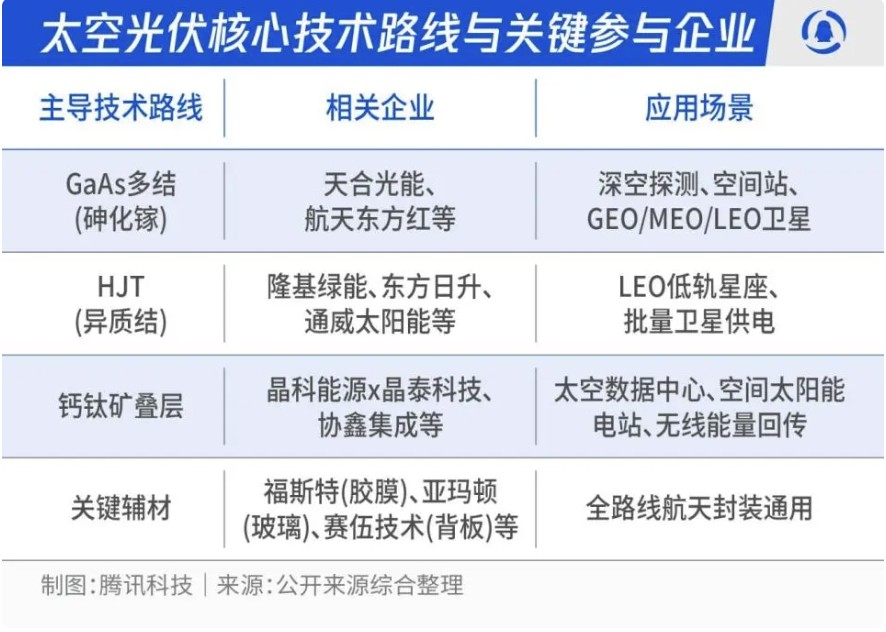
Currently, China's space photovoltaic industry has shown different directions of exploration, with several leading and innovative companies already laying the groundwork in relevant technological directions.
From the perspective of potential participants, they can be roughly divided into several categories:
One category consists of companies that focus on technological routes, hoping to obtain future tickets through breakthroughs in efficiency and lightweight design.
For example, JinkoSolar collaborates with Jingtai Technology to develop perovskite tandem solar cells. The tandem route has attracted attention because it is expected to break through the efficiency ceiling of ground-based solar cells, and in space scenarios, every percentage point increase in conversion efficiency means a significant reduction in launch weight and costs.
There are also companies that have entered the aerospace supply chain and possess on-orbit verification experience. For instance, Trina Solar is developing three routes: crystalline silicon, perovskite tandem, and gallium arsenide multi-junction solar cells, with its gallium arsenide products already deployed on orbiting satellites.
A photovoltaic industry practitioner stated: "The aerospace supply chain may seem inconspicuous, but it has a kind of hidden barrier. Aerospace certification itself is a multi-layer filtering of technology, reliability, and material systems." The requirements for materials regarding radiation damage, extreme temperature cycling, mechanical strength, and high vacuum emissions are extremely stringent, and a complete certification cycle usually takes several years, while on-orbit application experience is even harder to replace. This means that once space photovoltaics move towards engineering, these companies will also gain a first-mover advantage.
Another category of companies focuses on the longer-term system interface aspects. For example, LONGi Green Energy established a space laboratory in 2022 to participate in the technological verification between aerospace and new energy through space-mounted experiments. Such actions involve issues of reliability, operational adaptability, and standard interfaces, which are less related to short-term shipments and orders but are one of the necessary preliminary steps in the space photovoltaic system.
In addition, some companies choose to enter from a more "lightweight scenario," using consumer electronics, IoT, or special equipment as transitional scenarios for material and device verification.
Feng Fan uses Yanhe Technology as an example, stating, "We are conducting research and development in the direction of lightweight perovskite batteries, simultaneously verifying material stability, packaging processes, and power density in low-power consumer electronics scenarios such as wearable devices and small sensors, as well as in the high-reliability space photovoltaic scenarios. This simultaneous advancement helps to improve the material system and process chain, filling in the characteristics that space photovoltaics may need in the future, such as being lightweight, high energy density, and flexible."
The competition in space photovoltaics is a comprehensive struggle involving materials engineering, aerospace certification, energy transmission systems, and national strategic layouts. The current market enthusiasm is just the curtain rising; the real push will unfold fiercely on the engineering and technology fronts in the future.
Risk Warning and Disclaimer
The market has risks, and investments should be made cautiously. This article does not constitute personal investment advice and does not take into account individual users' specific investment goals, financial conditions, or needs. Users should consider whether any opinions, views, or conclusions in this article align with their specific circumstances. Investing based on this is at one's own risk
