


Strong growth in optical communication business drives Corning's Q4 core revenue to a record high with a year-on-year increase of 14%, double-digit profit growth, and expected accelerated expansion in the first quarter | Earnings Report Insights

The optical communication business has become the main growth engine, with double-digit growth in both fourth-quarter and annual revenue. Based on strong orders and demand, the company has raised its "Springboard" growth plan and expects that the year-on-year growth rate of core sales in the first quarter of 2026 will further accelerate to approximately 15%
Benefiting from strong growth in optical communication and other businesses, US materials giant Corning achieved record high core performance in both the fourth quarter and the full year, and announced an upward adjustment to its medium- to long-term "Springboard" growth plan, maintaining an optimistic outlook for the start of 2026.
On January 28 local time, Corning announced its performance for the fourth quarter and full year of 2025: the company achieved double-digit growth in revenue and profit on a core basis, stating that both the fourth quarter and the full year set records.
- Fourth quarter core sales reached $4.412 billion, a year-on-year increase of 14%; core earnings per share (EPS) was $0.72, a year-on-year increase of 26%. Fourth quarter GAAP revenue was $4.215 billion, a year-on-year increase of 20%; GAAP EPS was $0.62, a year-on-year increase of 72%.
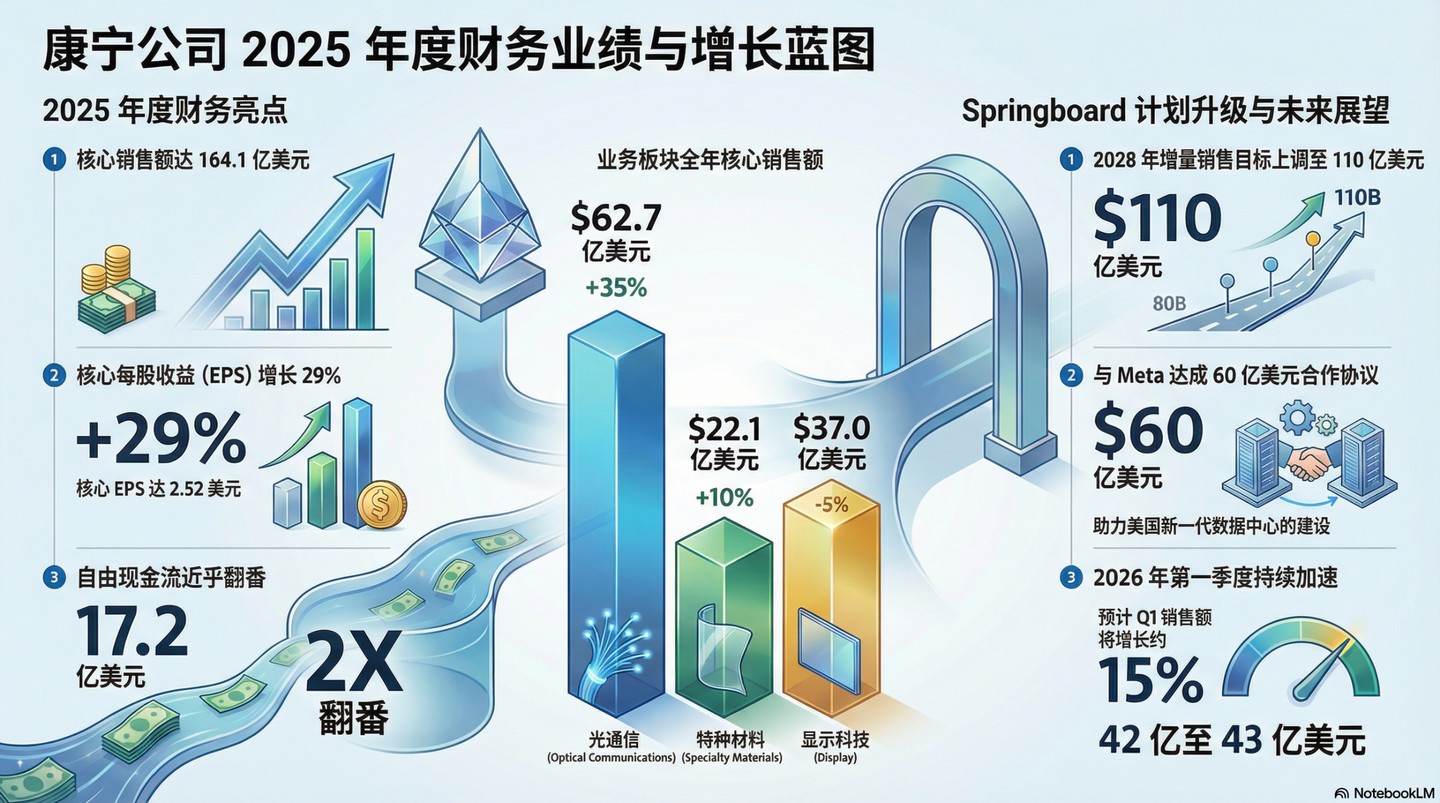
- For the full year, Corning's core sales reached $16.408 billion, a year-on-year increase of 13%; core EPS was $2.52, a year-on-year increase of 29%. Full year GAAP revenue was $15.629 billion, a year-on-year increase of 19%; GAAP EPS was $1.83, a year-on-year increase of 216%.
- Profitability continues to improve. The core operating profit margin for the fourth quarter rose to 20.2%, while the full year core operating profit margin was 19.3% (17.5% in 2024), indicating that besides revenue expansion, the support from expense ratios and operating leverage for profits remains.
- Cash flow is also strong: operating cash flow for 2025 was $2.7 billion, and adjusted free cash flow was $1.717 billion (compared to $1.253 billion in 2024).
- The company has raised its Springboard growth targets and provided guidance for the first quarter of 2026: core sales are expected to be between $4.2 billion and $4.3 billion, a year-on-year increase of about 15%, with core EPS expected to be between $0.66 and $0.70.
The "Scissors Gap" Between Core and GAAP Metrics: Exchange Rates and Hedging Items Amplify Apparent Growth Rates
Corning's financial report continues to emphasize "core metrics" (non-GAAP): excluding foreign currency debt translation, fair value fluctuations of foreign exchange hedging (translated earnings contracts), as well as non-recurring or non-operating items related to mergers and acquisitions, restructuring, litigation, and pension actuarial matters, and presenting operational trends for major segments using "constant currency."
- Fourth quarter: GAAP revenue increased by 20% year-on-year, but core sales increased by 14% year-on-year. The difference mainly comes from the significant convergence of "constant currency adjustments" compared to last year (Q4 2025 was +$197 million, Q4 2024 was +$331 million), indicating that the exchange rate drag on GAAP metrics has lessened compared to last year, thereby elevating the apparent year-on-year growth rate.
- Full year: GAAP revenue increased by 19% year-on-year, while core sales increased by 13% year-on-year; the full year constant currency adjustment was +$779 million (compared to +$1.309 billion in 2024), also reflecting the enhancement of GAAP growth rates due to the "weakened negative impact of exchange rates." The profit side is similar: the GAAP EPS for the fourth quarter is $0.62, and the core EPS is $0.72; the full-year GAAP EPS is $1.83, and the core EPS is $2.52. The significance of the core metric lies in stripping out "volatile items" such as foreign exchange hedging and translation from the operating trend, making it easier to observe the real changes in profit margins and segment prosperity.
Optical Communications business leads the way, Display and Life Sciences remain flat, Hemlock sees revenue growth without profit increase
The growth structure for 2025 is highly clear: Optical Communications becomes the strongest engine and further increases its weight in the revenue structure.
Optical Communications: Annual sales +35%, stronger profit elasticity
- Fourth quarter sales of $1.701 billion, up 24% year-on-year; net profit of $305 million, up 57% year-on-year.
- Annual sales of $6.274 billion, up 35% year-on-year; net profit of $1.048 billion, up 71% year-on-year.
This segment significantly leads other sectors in both revenue growth and profit growth, and is also the most imaginative point when the company mentions cooperation on "next-generation data center technology." Previously, Corning announced a multi-year cooperation agreement with Meta worth up to $6 billion, focusing on key technologies for next-generation data centers.
Display Technology: Revenue declines but profit resilience remains
- Fourth quarter sales of $955 million, down 2% year-on-year; net profit of $257 million, down 2% year-on-year.
- Annual sales of $3.697 billion, down 5% year-on-year; net profit of $993 million, down 1% year-on-year.
The display business remains an important "foundation" for Corning's profits, but its contribution to growth in 2025 is limited.
Specialty Materials: Moderate revenue growth, faster profit increase
- Fourth quarter sales of $544 million, up 6% year-on-year; net profit of $99 million, up 22% year-on-year.
- Annual sales of $2.211 billion, up 10% year-on-year; net profit of $367 million, up 41% year-on-year.
Despite moderate revenue growth, profits have risen significantly, reflecting stronger operational leverage and cost/structural improvements.
Automotive: Revenue under pressure after new segment establishment, slight profit growth
(The company will incorporate automotive glass and environmental technology into a new "Automotive segment" starting January 1, 2025, and will retrospectively restate comparable data.)
- Fourth quarter sales of $440 million, down 1% year-on-year; net profit of $63 million, up 3% year-on-year.
- Annual sales of $1.794 billion, down 3% year-on-year; net profit of $278 million, up 7% year-on-year.
Life Sciences: Stable scale, but profit declines
- Fourth quarter sales were $246 million, down 2% year-on-year; net profit was $14 million, down 22% year-on-year.
- Annual sales were $972 million, down 1% year-on-year; net profit was $61 million, down 3% year-on-year.
Hemlock and Emerging Business: High Revenue Growth but Still Losses for the Year
- Fourth quarter sales were $526 million, up 62% year-on-year; net profit was $1 million, significantly down year-on-year.
- Annual sales were $1.46 billion, up 33% year-on-year; however, net profit was -$26 million (projected to be +$42 million in 2024).
This segment contributed to revenue growth, but profitability is unstable, and it may still be a "disturbance item" for overall profit margins in the short term.
2026 Guidance and Springboard Upgrade: Q1 Growth Rate Raised Again, Meta's Up to $6 Billion Agreement Provides Order Clues
The company expects core sales in Q1 2026 to be $4.2 billion to $4.3 billion, approximately up 15% year-on-year; core EPS is projected to be $0.66 to $0.70. Compared to the core EPS of $0.72 in Q4 2025, the new guidance shows a certain seasonal decline, but management emphasizes that the year-on-year growth rate will accelerate further.
More notably, the growth roadmap has been raised: starting from Q4 2023, Corning has increased the annualized sales target for the Springboard plan by the end of 2028 from $8 billion to $11 billion; at the same time, it has raised the internal plan for annualized sales by the end of 2026 from $6 billion to $6.5 billion, and increased the "high confidence" metric from $4 billion to $5.75 billion.
In conjunction with the multi-year, up to $6 billion data center-related cooperation agreement announced with Meta, the company aims to convey two messages to the market: first, that orders and capacity layout in core tracks such as optical communications are being realized, and second, that a "better starting point" for profit margins and cash flow will support more aggressive growth targets
