


North America and China markets have both recovered, Starbucks' same-store sales have seen positive growth for two consecutive quarters, cost pressures continue, and adjusted EPS has decreased by 19% year-on-year | Earnings report insights

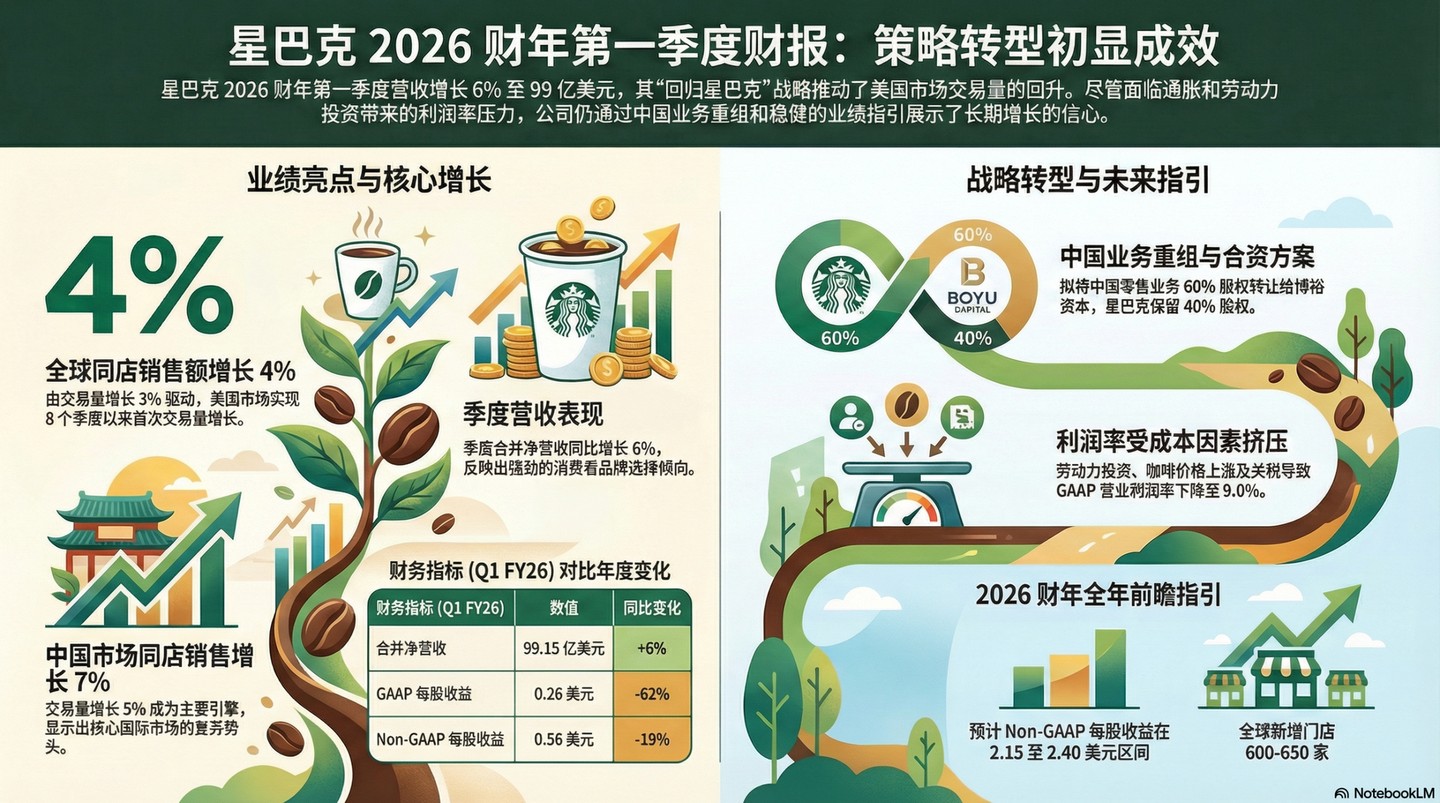
Revenue in the first fiscal quarter increased by 6% year-on-year to $9.9 billion, with global same-store sales growing by 4%, driven by a rebound in transaction volume. The U.S. market saw positive customer traffic for the first time in eight quarters. International business performed outstandingly, with same-store sales in China increasing by 7%, along with growth in both transaction volume and average transaction value. The store network continues to expand, with the total number of stores worldwide exceeding 41,000. The company also provided full-year guidance, expecting same-store sales to maintain mid-single-digit growth, indicating that the core business is gradually emerging from the trough
On Wednesday evening, Starbucks delivered an exhilarating financial report. The world's largest coffee chain achieved a 4% growth in global same-store sales in the first fiscal quarter of 2026, marking positive growth for the second consecutive quarter, exceeding Wall Street's most optimistic expectations.
More notably, customer traffic in the U.S. market turned positive for the first time in eight quarters, indicating that CEO Brian Niccol's "Back to Starbucks" transformation strategy is yielding substantial results.
Key points from the financial report are as follows:
Consolidated revenue for the first fiscal quarter grew by 6% to $9.9 billion, driven by a 3% increase in transaction volume and a 1% increase in average ticket size for global same-store sales.
Despite strong sales growth, adjusted earnings per share were $0.56, a 19% year-over-year decline, marking the sixth consecutive quarter of double-digit declines.
High labor investments and rising coffee costs continue to erode profit margins, with the GAAP operating margin for the first fiscal quarter contracting by 290 basis points to 9.0%.
When releasing guidance for fiscal year 2026, the company stated that global same-store sales are expected to grow by at least 3%, and operating margins are anticipated to improve slightly.
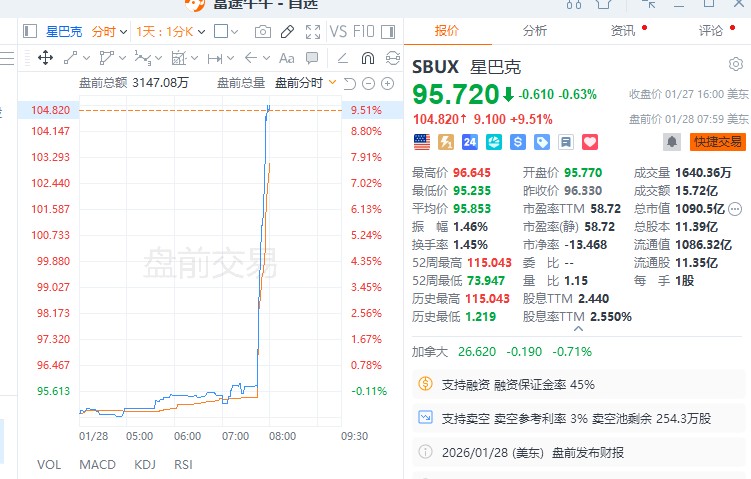
Following the earnings report, Starbucks' stock surged by 9% in pre-market trading. This performance not only validates the series of reforms implemented by Niccol since taking over in 2024 but also restores market confidence in the coffee giant, which has over 41,000 stores.
North American Market Turns Around, Transaction Volume Growth is Key Breakthrough
The performance of the North American market is the biggest highlight of this quarter. Same-store sales in the region grew by 4%, with comparable transaction volume increasing by 3%—the first positive growth in eight quarters, indicating that Starbucks has successfully reversed the previously declining customer traffic trend. The U.S. market, as Starbucks' most important region, also achieved a 4% growth in same-store sales.
However, the deterioration in profitability cannot be overlooked.
Revenue in the North American market grew by 3% to $7.3 billion, but operating profit plummeted by 27% to $867 million, with the operating margin significantly contracting from 16.7% in the same period last year to 11.9%, a decline of 480 basis points. This is primarily due to the large-scale labor investments required by the "Back to Starbucks" strategy, as well as inflationary pressures from tariffs and rising coffee prices. The financial report shows that the proportion of store operating expenses to revenue from operating stores increased from 54.3% to 57.0%.
The North American market currently has 18,360 stores, a decrease of 1% compared to the same period last year. This quarter saw a net increase of 49 stores, including the closure of 3 as part of a restructuring plan
Strong Performance in International Business, Clear Recovery Momentum in the Chinese Market
The international market continued its growth momentum, with same-store sales increasing by 5%, surpassing the performance in North America. Revenue in this region surged by 10% to $2.06 billion, and operating profit grew by 19% to $283 million, with the operating profit margin improving from 12.7% to 13.7%, an expansion of 100 basis points.
The performance in the Chinese market was particularly impressive, with same-store sales rising by 7%, including a 5% increase in transaction volume and a 2% increase in average transaction value. This growth rate is significantly higher than the global average, indicating that Starbucks' competitiveness in this key market is recovering. The number of stores in China reached 8,011, a 4% increase compared to the same period last year, accounting for nearly 20% of the total number of stores worldwide.
It is noteworthy that the improvement in the profit margin of international business is partly due to changes in accounting treatment. By classifying the assets of the Chinese retail business as held for sale, related depreciation and amortization expenses have ceased, reducing store operating and depreciation costs. However, restructuring costs and rising coffee prices continue to exert pressure on profit margins.
In this quarter, the international market net added 79 stores, but closed 162 stores as part of the restructuring plan, including 83 stores in the Chinese market.
The company announced a significant restructuring of its Chinese business this quarter. In November last year, Starbucks reached an agreement with Boyu Capital to establish a joint venture to operate its retail business in China, with Boyu Capital acquiring up to 60% equity, while Starbucks retains 40% equity and continues to own and license the brand and intellectual property.
This transaction is expected to be completed in the spring of this year, pending regulatory approval. By classifying the related assets and liabilities as held for sale, Starbucks has ceased depreciation and amortization of related long-term assets, resulting in a reduction in depreciation and store operating expenses, but also leading to a significant increase in income tax expenses.
As of the end of the first fiscal quarter, the held-for-sale assets on Starbucks' balance sheet reached $4.7 billion, with held-for-sale liabilities of $1.8 billion. This transaction is seen as an important milestone in Starbucks' ongoing transformation, aimed at accelerating its long-term growth in this key market.
Rapid Growth in Channel Development Business
The channel development business performed brilliantly this quarter, with revenue skyrocketing by 20% to $523 million, primarily benefiting from the growth of the Global Coffee Alliance business and increased revenue from ready-to-drink products. Operating profit grew by 4% to $216 million.
However, the operating profit margin significantly contracted from 47.7% in the same period last year to 41.3%, a decrease of 640 basis points. This was mainly due to changes in the product mix and rising global product costs. The revenue growth from the North American Coffee Partnership joint venture somewhat alleviated the profit pressure.
Ongoing Cost Pressures, Profitability Remains the Biggest Challenge
Despite strong sales growth, the decline in profitability remains a core issue facing Starbucks. The GAAP operating profit margin for the first fiscal quarter contracted by 290 basis points to 9.0%, while the non-GAAP operating profit margin contracted by 180 basis points to 10.1%. This is primarily due to pressures from two aspects: First, there has been a significant increase in labor investment. To improve service quality and speed, Starbucks has made substantial investments in store staffing. The company's store operating expenses rose from $4.2 billion to $4.55 billion, an increase of 8.3%, with the proportion of total revenue rising from 44.7% to 45.9%.
Second, raw material costs have increased. The surge in coffee prices and the impact of tariffs have led to an increase in product and delivery costs from $2.9 billion to $3.3 billion, a growth of 13.1%, with the proportion of total revenue rising from 30.8% to 33.0%.
There have also been anomalies in taxation. Due to classifying the China retail business as held for sale and changing the indefinite reinvestment assertion, the effective tax rate soared from last year's 23.6% to 61.7%. The non-GAAP effective tax rate also rose from 23.6% to 26.8%.
Ultimately, the GAAP earnings per share were $0.26, a year-on-year plunge of 62%; the non-GAAP earnings per share were $0.56, a year-on-year decline of 19%, marking six consecutive quarters of double-digit declines.
Fiscal Year 2026 Outlook: Cautiously Optimistic, Focus on Margin Improvement
Starbucks, under Niccol's leadership, has released its first complete fiscal year guidance, demonstrating a cautiously optimistic attitude. The company expects global and U.S. same-store sales growth of at least 3% in fiscal year 2026, with consolidated revenue expected to grow at a similar rate. The non-GAAP operating margin is anticipated to improve slightly compared to the previous year, with non-GAAP earnings per share expected to be between $2.15 and $2.40.
Globally, the company plans to net add 600 to 650 stores, including both company-operated and franchised businesses. It is important to note that this guidance assumes the China retail business will still be operated by the company in the second half of the fiscal year.
Jefferies analyst Andy Barish pointed out before the earnings release that the company needs to maintain stronger customer traffic growth in the second half of fiscal year 2026 to improve profitability and justify the "significant" investment costs. Currently, sales momentum is indeed accelerating, but converting this into sustainable profit growth remains a key challenge for management
