


Bescent: The United States has consistently pursued a strong dollar policy and will "absolutely not" intervene in the foreign exchange market to support the yen

Bessent believes that the reduction of the U.S. trade deficit should automatically strengthen the dollar over time, stating that "a strong dollar policy means setting the right fundamentals; if we have sound policies, capital will flow in"; there are still four candidates for the position of Federal Reserve Chair; Trump hopes to avoid a government shutdown. After his speech, the yen fell more than 1% during the session. JPMorgan strategists stated that Bessent's remarks did not rule out verbal intervention or even actual intervention, but he reiterated that setting the right fundamentals is crucial for the currency market in the long run
U.S. Treasury Secretary Becerra made it clear on Wednesday that the United States consistently adheres to a strong dollar policy and firmly denied that the Trump administration is currently intervening or will intervene in the foreign exchange market to support the yen. This statement led to a rebound in the dollar after it fell to a four-year low the previous day, temporarily calming market speculation about a possible joint intervention by the U.S. and Japan in the foreign exchange market.
During the early trading session of U.S. stocks on Wednesday, Eastern Time on the 28th, when asked by the media whether the U.S. is intervening in the currency market or supporting the yen, Becerra responded, "Absolutely not." When pressed on whether the U.S. has plans for such actions, he said, "We will not comment beyond reiterating our strong dollar policy."
Becerra reiterated that the U.S. consistently follows a strong dollar policy, believing that a reduction in the U.S. trade deficit should naturally strengthen the dollar over time. He stated:
"The U.S. consistently adheres to a strong dollar policy, but a strong dollar policy means setting the right fundamentals. If we have sound policies, capital will flow in. We are reducing the trade deficit, so this should naturally lead to a stronger dollar over time."
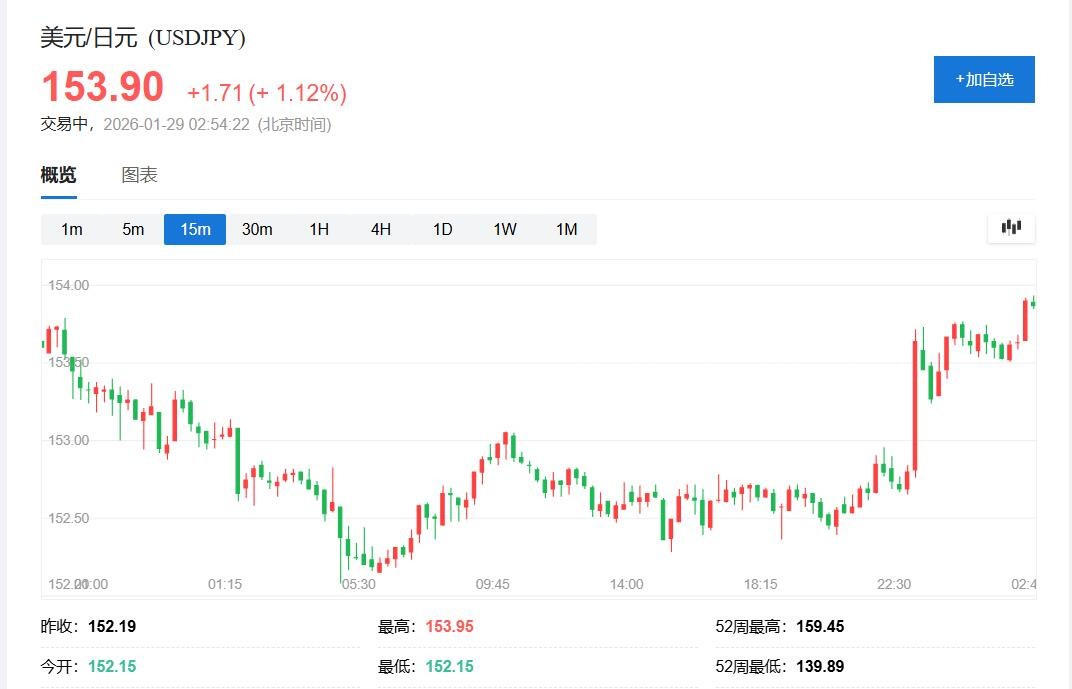
After Becerra denied any intervention in the yen exchange rate, the yen, which had risen for three consecutive days and gained over 4% during that period, saw its decline rapidly expand. The dollar's rise against the yen quickly accelerated, with U.S. stocks approaching 154.00 at midday, up more than 1.1% from a low of 152.10, the lowest since October 2025.
As the yen retreated, the ICE dollar index accelerated its rebound, with U.S. stocks breaking above 96.60 in early trading and reaching a daily high of nearly 0.5% at midday, recovering from a low of below 95.90 in the early European session on Wednesday, marking the lowest level since February 2022.
Becerra Discusses Strong Dollar, U.S. Stocks, U.S. Economy, and Federal Reserve Chair Candidates
In a media interview, Becerra elaborated on the U.S. government's understanding of the strong dollar policy. He stated, "A strong dollar policy means setting the right fundamentals. If we have sound policies, capital will flow in."
He further pointed out, "I believe that under President Trump's leadership, with the 'Great American Plan' and our regulatory policies, we are making the U.S. the best place for business investment, with tax certainty, regulatory certainty, and energy certainty."
Becerra expressed confidence in attracting capital inflows to the U.S., stating that Trump's tax and deregulation policies are attracting trillions of dollars into the country. He also noted that a narrowing trade deficit should automatically boost the dollar.
Regarding the S&P 500 index breaking above 7000 points for the first time in history at the beginning of trading on Wednesday, Becerra attributed it to the Trump administration's implementation of "growth-friendly policies."
Becerra revealed that he had a long conversation with Trump on the plane regarding the candidates for the Federal Reserve Chair. He emphasized that the range of candidates "has not changed," still consisting of four individuals, and clarified that his role is to provide advice to the president rather than directly recommend specific candidates Bessent also stated that Trump has taken measures to "calm" the social unrest in Minnesota caused by the federal government's tough immigration policies. Trump hopes the Democrats will not allow the government to shut down on January 30.
Market Speculation on Intervention
The Japanese currency has been declining since October last year, recently falling to its weakest level against the US dollar since 1986 earlier this month. This decline has been accompanied by investor concerns over Prime Minister Fumio Kishida's embrace of massive fiscal stimulus amid high debt burdens. Japanese authorities have repeatedly warned that they are prepared to take action to address the yen's decline.
Last Friday, the yen experienced two waves of appreciation in one day. The market first speculated that the Japanese Ministry of Finance had conducted a currency check, which is typically seen as a warning signal from the government to traders. Subsequently, media reports cited some traders saying that the New York Federal Reserve had inquired about the USD/JPY exchange rate that day, which Wall Street interpreted as a sign that the Fed was preparing to assist Japanese officials in directly intervening in the market to support the yen.
Japanese Finance Minister Shunichi Suzuki warned again this Tuesday after the G7 meeting that intervention may be necessary, stating that the Japanese government is ready to coordinate closely with the United States and will take "appropriate measures" regarding the exchange rate if necessary.
JPMorgan forex strategist Pat Locke stated:
"Bessent's comments about non-intervention do not rule out additional verbal intervention or even actual intervention, but he reiterated a core position that setting the correct fundamentals for the forex market is crucial in the long run—not just for the US, but also for other countries including Japan."
Sonja Marten, head of forex and monetary policy at DZ Bank, commented on Bessent's remarks this Wednesday, saying: "Bessent seems to be trying to soothe the nervous market. While the US may generally welcome a weaker dollar, the rapid depreciation of the currency is clearly not in their interest."
Trump's Dollar Remarks
Bessent's comments came a day after President Trump made remarks about the dollar. On Tuesday, when asked by reporters in Iowa if he was concerned about the dollar's depreciation, Trump stated:
"No, I think the dollar is doing great. I think the value of the dollar—look at the trade we are doing, the dollar is performing excellently."
"I hope the dollar can—find its own reasonable level, that is the fair thing to do."
Trump hinted that he could manipulate the dollar's exchange rate, saying, "I can make it fluctuate like a yo-yo." However, he believes that doing so is not a good thing and compared it to hiring unnecessary employees to boost employment data, while criticizing some Asian economies that he believes are trying to devalue their currencies. Trump stated that economies like Japan are allowing their currencies to "devalue," which he considers unfair.
Traders viewed Trump's remarks as a green light to short the dollar, accelerating its decline on Tuesday. By the end of Tuesday's trading, the ICE Dollar Index (DXY) had widened its losses, dropping below 96.00 to below 95.60, marking its lowest level since February 2022, with an intraday decline of about 1.5%, the largest single-day drop since Trump announced the so-called reciprocal tariffs last April The US Dollar Index has fallen more than 10% in the past 12 months and has dropped nearly 2% since the beginning of 2026. Although Trump seems unconcerned about the depreciation of the dollar, commentators believe that the decline of the dollar is not over. In the long term, structural factors such as the independence of the Federal Reserve, the continuously expanding budget deficit, concerns related to fiscal profligacy, and political polarization are exerting downward pressure on the dollar
