


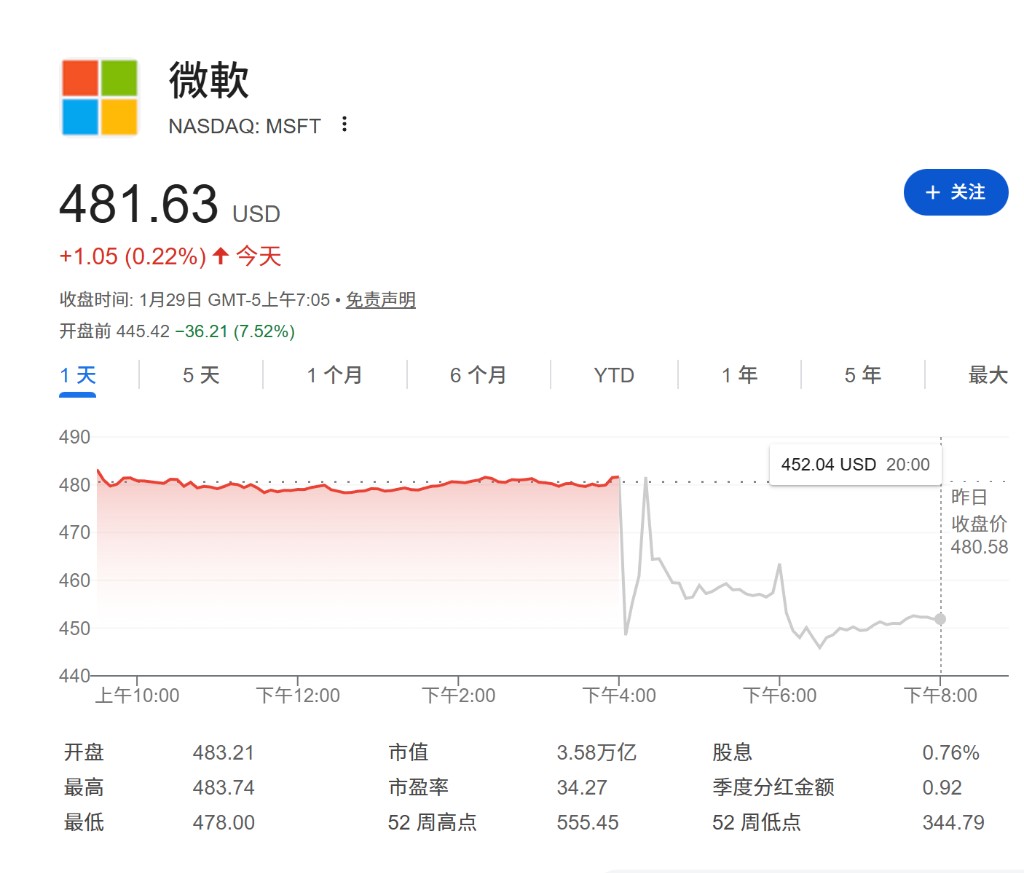
The financial report data is impressive, but it fell 7% in pre-market trading. Where are Microsoft's market expectations lacking?

Microsoft's capital investment of up to $37.5 billion in a single quarter far exceeded market expectations, but did not immediately drive a significant increase in cloud business growth. The company is prioritizing the allocation of a large amount of new computing power to self-developed AI products and internal research and development, rather than fully utilizing it for revenue-generating Azure cloud services. This strategic layout has led to market concerns about short-term capital efficiency and return visibility, creating a core expectation gap
Microsoft's financial report for the second quarter of fiscal year 2026, released on Tuesday, showed that both revenue and profit exceeded Wall Street expectations. However, its stock price faced pressure and declined in after-hours trading. The volatility in market sentiment primarily stemmed from the gap between the surge in the company's capital expenditures and the accelerated growth of its cloud business.
Microsoft's second-quarter revenue reached $81 billion, a year-on-year increase of 17%, surpassing market expectations by 1%. The non-GAAP earnings per share (EPS) was $4.41, a year-on-year increase of 23%, exceeding market expectations by 5%. The highly anticipated Azure cloud business grew by 38% at constant exchange rates, slightly above Wall Street's expectation of 37%.
Despite the robust performance of core data, investors expressed concerns over Microsoft's rising capital expenditures. Data showed that Microsoft's capital expenditures for the quarter reached $37.5 billion, 9% higher than the general market expectation. The market had originally anticipated that such a massive investment would lead to a significant acceleration in Azure's growth rate, but the existing data failed to meet this heightened appetite immediately.
According to the latest research report released by Goldman Sachs on January 28, despite facing short-term stock price fluctuations, Microsoft's current strategy is to sacrifice short-term Azure revenue growth to prioritize the computing power needs of first-party applications (such as Copilot) and internal R&D (such as Microsoft AI). Goldman Sachs maintained a "Buy" rating on Microsoft but lowered the 12-month target price from $655 to $600, considering the uncertainty regarding the specific timing of capital expenditures translating into revenue upside.
Concerns Arising from Mismatch Between Capital Expenditures and Growth
Goldman Sachs believes that the market's negative reaction to Microsoft's stock price mainly reflects investors' anxiety over several consecutive quarters of capital expenditures exceeding expectations. The $37.5 billion in quarterly spending (including financing leases) indicates that Microsoft is actively building AI infrastructure. However, this investment has not immediately translated into a proportional leap in Azure's growth rate.
Analysis points out that this is actually a strategic trade-off for Microsoft. The company is prioritizing the allocation of valuable computing resources to strategic products like Copilot and internal R&D projects, rather than merely pursuing short-term external revenue from Azure. Goldman Sachs believes that this strategy will ultimately drive more strategically significant AI positioning across multiple layers of the technology stack and yield better returns in the medium term.
Azure Facing Capacity Constraints Rather Than Insufficient Demand
Regarding the core cloud business, Microsoft's management revealed that Azure is currently facing capacity constraints. Goldman Sachs emphasized that investors should view Microsoft's guidance of 37%-38% growth for Azure in the third quarter as "guidance based on capacity allocation capabilities," rather than a mere reflection of demand. This means that under capacity constraints, the performance ceiling for any specific quarter has essentially been determined The report estimates that if Microsoft had not shifted its capacity towards first-party applications and internal research in the past two quarters, Azure's revenue growth rate should have exceeded 40%. Against this backdrop, with the launch of new capacity (such as the Fairwater project) and the easing of supply chain constraints, Azure is expected to usher in the next phase of outstanding performance. Additionally, the MAIA 200 chip released by Microsoft on January 26 is seen as a positive signal, with benchmark tests showing performance superior to competitors' internal chips, which will be a key driver of future gross margin and cost-performance differentiation.
The commercialization path of Copilot is becoming clearer
Although cloud infrastructure is receiving attention, the monetization of AI at the application layer is accelerating. Microsoft pointed out that the adoption and usage of Copilot are speeding up, with the number of M365 Copilot seats increasing by 160% year-on-year, reaching 15 million paid seats.
Goldman Sachs analysts believe that Copilot will have a better customer lifetime value to customer acquisition cost ratio (LTV:CAC) compared to Azure revenue. This is mainly due to the product's higher gross margin (pricing power stronger than Azure) and higher customer stickiness. Although the growth guidance for M365 commercial cloud has slightly slowed to 13%-14%, this partly reflects the addition of new seats at a lower average revenue per user (ARPU) (such as frontline workers and small and medium-sized enterprises). Industry conversations indicate that the output quality of Copilot is improving, and with the launch of new SKUs and features (such as WorkIQ), its functionality will continue to enhance.
Valuation adjustments and potential risks
Based on the judgment that visibility into the timeline for capital expenditures converting into revenue is limited, Goldman Sachs has adjusted Microsoft's valuation model. Analysts lowered the target price-to-earnings ratio from 32 times to 28 times, subsequently reducing the target price to $600.
The report also lists key downside risks faced by Microsoft, including: revenue contributions from the OpenAI partnership falling short of expectations, prolonged ramp-up time for internal chip capacity limiting market share acquisition or gross margin expansion, investments in non-Azure projects exceeding expectations, key leadership changes, and a more significant shift towards customized software potentially negatively impacting the application business. For the stock price to outperform the market, the market needs to see more substantial evidence of successful revenue from Copilot, verification points for the commercialization of internal research, and a renewed acceleration in Azure's growth with the launch of new capacity within the next 6 to 12 months
