


Why didn't Apple surge despite bright performance guidance? It's all because of storage

Apple's revenue greatly exceeded expectations, with the iPhone achieving its best quarterly performance ever, and it is expected that revenue in the second fiscal quarter will grow by 13% to 16%, surpassing Wall Street's expected increase of 10%. However, Cook warned that rising memory prices will have a "greater impact" on the gross margin for the current quarter. In addition to memory costs, Apple is also facing supply constraints for the 3nm processors used in the iPhone and AirPods Pro 3
Apple announced record quarterly sales on Thursday and provided performance guidance that exceeded Wall Street expectations, but warnings about rising memory costs raised investor concerns about profit margins, limiting the stock's gains.
Apple expects revenue in the second fiscal quarter to grow by 13% to 16%, surpassing Wall Street's expected increase of 10%. This indicates that the company can maintain growth momentum even after experiencing a surge in holiday season sales.
However, CEO Tim Cook warned during Thursday's analyst call that rising memory prices would have a "greater impact" on gross margins for the current quarter. Cook stated, "We are indeed continuing to see significant increases in market prices for memory." In addition to memory costs, Apple is also facing supply constraints for the 3nm processors used in iPhones and AirPods Pro 3.
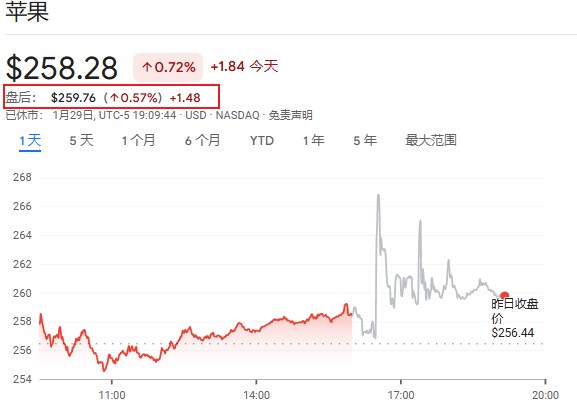
This statement left investors uneasy. Following the earnings report, Apple's stock fluctuated in after-hours trading, currently up less than 1%. The stock has fallen 5% this year, while the S&P 500 has risen 1.8% during the same period.
Record iPhone Performance Drives Revenue Well Above Expectations
Apple achieved revenue of $143.8 billion for the holiday season ending December 27, a year-over-year increase of 16%, far exceeding the average analyst expectation of $138.4 billion. The company's previous forecast for growth was 10% to 12%. Cook stated in the earnings announcement, "The iPhone achieved its best quarterly performance ever, with unprecedented demand, setting records in all geographic regions."
iPhone revenue reached $85.3 billion, exceeding the expected $78.3 billion, with a year-over-year increase of 23%. This product line accounts for about half of Apple's total revenue, with high-end models particularly popular, further driving sales and profit growth. Earnings per share reached $2.84, surpassing the average expectation of $2.68.
The Chinese market performed exceptionally well, with revenue reaching $25.5 billion, a year-over-year increase of 38%, far exceeding Wall Street's expectation of $21.8 billion. This marks a strong rebound for Apple in this key market. Apple recently reclaimed the top position in global smartphone sales, surpassing Samsung Electronics.
Steady Growth in Services, Mixed Performance in Other Product Lines
The services business became another growth engine, with quarterly revenue reaching $30 billion, a year-over-year increase of 14%, in line with market expectations. This business continues to provide Apple with a stable source of high-margin revenue.
iPad sales were $8.6 billion, a year-over-year increase of 6.3%, exceeding Wall Street's expectation of $8.18 billion. However, the Mac business showed weakness, with revenue declining 6.7% to $8.39 billion, below the expected $9.13 billion.
The wearables, home, and accessories segment continued to struggle, with sales declining 2.2% to $11.5 billion, falling short of analyst expectations of $12.1 billion. The ongoing weakness in this business segment highlights Apple's challenges in seeking new growth points beyond the iPhone
Cost Pressures and Supply Chain Challenges Coexist
Although the impact of memory costs was limited in the previous quarter, Cook clearly stated that the current quarter will face greater pressure. The significant rise in memory market prices is threatening the company's profit margins.
On the supply chain front, Apple is also facing supply constraints for the 3nm processors used in iPhones, as well as supply constraints for AirPods Pro 3. Additionally, tariff issues have had an adverse impact of $1.4 billion on the company during the holiday season.
Emarketer analyst Jacob Bourne pointed out in a research report:
The uncertainty in maintaining market dominance may be greater than ever, depending on pricing strategies and the correct decisions in the development of the next generation of devices, particularly wearables and the anticipated foldable iPhone. Apple is also facing concerns regarding its artificial intelligence strategy, as the company is making adjustments to related businesses this year
