


Worrisome signals? Asia's gold ETF inflows hit record highs

In January, net inflows into Asian gold ETFs reached a record of $7.1 billion, with several funds breaking historical highs in fundraising. However, this "frenzy" is raising alarms among professional institutions: when retail investors rush in, it often signals that the upward trend is entering a phase of overvaluation. Analysts indicate that the current gold price trend has shown "non-linear" emotional fluctuations, and short-term overbought signals are extremely dangerous
Asian investors are pouring into gold ETFs at a record scale, raising concerns in the market about whether the rise in gold prices is nearing its peak. High levels of retail buying are often seen as warning signals that asset valuations are too high and that the upward trend is entering a late stage.
On Friday, according to data compiled by Bloomberg, net inflows into precious metal ETFs in Asia reached $7.1 billion in January, with several funds setting records for the highest inflows ever. Among them, the Huaxin Yifu Gold ETF listed in China attracted $1.9 billion in inflows, the largest increase.
Gold prices have surged recently, rising more than 20% since the beginning of January, despite a pullback on Friday. Market analysts warn that the recent price movements have become rapid, emotional, and nonlinear, which is a warning signal that the trend is overextended at a tactical level.
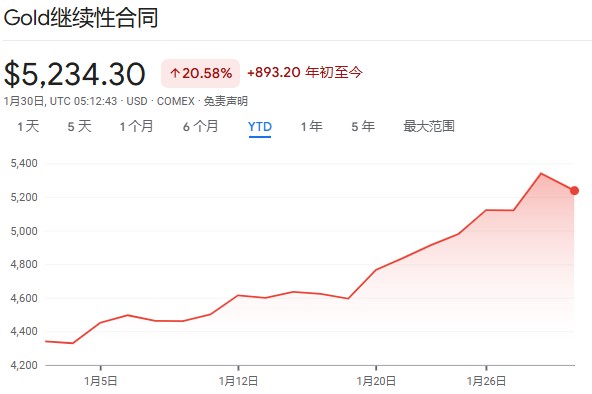
The relative strength index (RSI) for gold has climbed to about 90, which is a very rare extreme overbought condition (typically, 70 is considered overbought). The World Gold Council noted in its outlook for 2026 released last month that if the Trump administration's policies succeed, they will accelerate economic growth, leading to rising interest rates and a stronger dollar, which would push gold prices lower.
China Market Becomes Main Source of Fund Inflows
Gold ETFs listed in China attracted a large amount of funds in January. In addition to the $1.9 billion inflow into the Huaxin Yifu Gold ETF, the ChinaAMC Gold ETF attracted $420 million, and the GF Shanghai Gold ETF attracted $191.4 million, all setting historical records.
Silver ETFs are also in high demand. The Samsung KODEX Silver Futures Special Asset ETF listed in South Korea saw a net inflow of $231.6 million in January, also setting a record.
China's only pure silver fund, the Guotou Ruijin Silver Futures Fund LOF, suspended subscriptions on Wednesday and was suspended from trading on Friday. The previous large inflows had led to a significant premium of the fund relative to its underlying assets, highlighting the fervor of market demand.
Professional Investors Issue Cautious Signals
"We have been major bulls on gold during this cycle," said Nick Ferres, Chief Investment Officer of Vantage Point Asset Management in Singapore, which has been buying both gold mining stocks and ETFs. "However, the recent price movements have become rapid, emotional, and nonlinear, which is a warning signal that the trend is overextended at a tactical level."
The rapid rise in gold has been supported by substantial purchases by central banks and inflows into gold ETFs. According to data from the World Gold Council, the total holdings of gold-backed funds have been increasing every month last year except for May. Precious metals have also benefited from the unpredictability of U.S. policymaking and the outflow of dollar funds due to increasing U.S. isolation.
New Products Emerge to Meet Demand
According to Bloomberg Industry Research, asset management companies are preparing to launch new products to respond to the rising demand for gold ETFs.
Analysts Rebecca Sin and Michelle Leung wrote in a research report: "ETF issuers may meet the demand for safe-haven assets by launching more gold-related funds." Hong Kong offers a variety of tools ranging from low-cost physical tracking to leveraged futures and mining stocks. This week, two new funds are being launched, seeking to solidify its position as a gold trading center
