


Is AI monetization just the beginning? Morgan Stanley significantly raises Meta's target price: Q2 advertising revenue is expected to surpass Google Search for the first time

Morgan Stanley significantly raised its target price for Meta to $825, expecting that in Q2 2026, advertising revenue will surpass Google Search for the first time. Analysis indicates that Meta's potential for AI transformation is not fully reflected, and future growth will be driven by AI. Zuckerberg stated that Meta is rewriting its recommendation system, with significant improvements expected in personalization, agent services, and wearable devices. Morgan Stanley predicts that Meta's advertising revenue growth rate will exceed that of Google, demonstrating its competitiveness in the digital advertising space
Morgan Stanley pointed out that Meta's current stock price does not fully reflect the potential value of its AI transformation, and its growth logic is undergoing a qualitative leap. If the previous rise was based on cost reductions during the "year of efficiency," the next phase of growth will be entirely driven by the core return on invested capital (ROIC) brought by AI.
According to the Wind Trading Desk, on January 29, Morgan Stanley's Brian Nowak analysis team significantly raised Meta's target price from $750 to $825 in a report, indicating about a 15% upside from current levels.
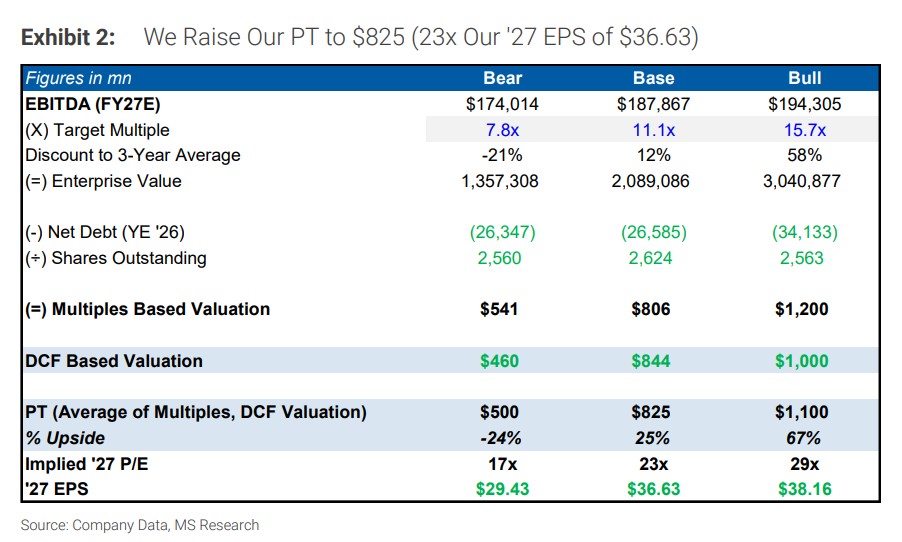
Morgan Stanley's report not only raised the earnings per share (EPS) forecast for 2027 by 10%, but also made a prediction: Meta's advertising revenue is expected to surpass Google Search's advertising revenue for the first time in the second quarter of 2026, ending the latter's long-term dominance in the digital advertising space.
The confidence behind this stems from Zuckerberg's clear signals to investors during the conference call: Meta is completely rewriting its recommendation system with large models, and the current system appears "very primitive" in his eyes. Morgan Stanley believes that if the current system is still very primitive, then long-term opportunities and improvements are likely to bring more growth. Morgan Stanley expects further improvements in personalization (due to META's ability to analyze more data more efficiently), agency services (such as MetaAI), new creative/communication services for users/advertisers, and wearable devices. This is not just a technological upgrade, but a generational leap from "traffic monetization" to "personal superintelligence" infrastructure.
The most striking prediction in the research report is the comparison of the advertising businesses of the two giants. Morgan Stanley pointed out that although Google is also accelerating execution, Meta's engagement and monetization benefits brought by AI are more astonishing. To provide a reference, Morgan Stanley mentioned that when Google's search business reached a quarterly revenue scale of $57 billion, its year-on-year growth rate was 15%; while Meta's growth rate reached 34%-35% when reaching the same scale.
Based on Morgan Stanley's current model calculations, Meta's quarterly advertising revenue will officially surpass Google Search's advertising revenue in the second quarter of 2026, and the gap between the two will further widen from that point on. This prediction not only marks an enhancement of Meta's dominance in the advertising market but also validates its AI-driven recommendation algorithm's absolute advantage in capturing user time and advertiser budgets.
Zuckerberg's "Versailles": The recommendation system is being rewritten by large models, and the existing system is still very "primitive"
During the conference call, Zuckerberg's remarks provided underlying technical support for Morgan Stanley's bullish view. He stated that although Meta's world-class recommendation system has driven Instagram Reels' viewing time in the U.S. to grow by over 30% year-on-year, the current system is still very "primitive" compared to the upcoming technological revolutionMeta is undertaking a massive project: transforming the entire recommendation system into a scalable engineering system similar to large language models (LLM). Although the current recommendation system is effective, it will soon be replaced by large models that can understand users' unique goals, backgrounds, and interests. This reconstruction of the technological architecture not only determines the duration of user engagement on the platform but also directly affects the unit price and conversion rate of advertisements. Data shows that Facebook has increased the views of organic feeds and video posts by 7% in Q4 simply by simplifying its ranking architecture, which management claims is the largest product optimization driving revenue in the past two years.
The Visualization of AI Monetization: Comprehensive Efficiency Improvement from Reels to Conversion Rates
Morgan Stanley's report details how Meta converts computing power into real revenue through AI technology. This is not an empty concept but is reflected in every key operational metric:
- Engagement Side: Through more efficient model scaling, the viewing time of Instagram Reels surged over 30% year-on-year; Facebook increased the views of organic feeds and video posts by 7% through a simplified ranking architecture, marking the largest product optimization driving revenue in the past two years.
- Advertising Side: Meta expanded the coverage of its advertising ranking model GEM to all Reels, supported by double the number of GPUs for training. Results show that Facebook ad clicks increased by 3.5%, and Instagram's conversion rate improved by over 1%.
- Efficiency Side: The introduction of new runtime models improved Instagram's conversion rate by 3%; the widespread use of AI coding tools for internal employees led to a 30% increase in engineer output by 2025, with some advanced users seeing output surging by 80%.
Capital Expenditure and Infrastructure: Paying for the Future
In response to market concerns about capital expenditure, Morgan Stanley's report provides clear expectations. Meta's capital expenditure guidance for 2026 is between $115 billion and $135 billion, primarily for the construction of super-intelligent laboratories and core business infrastructure. Morgan Stanley's model predicts that infrastructure spending (including cloud spending, depreciation, etc.) will grow by approximately $36 billion, driving about 75% of the increase in operating expenses in 2026.
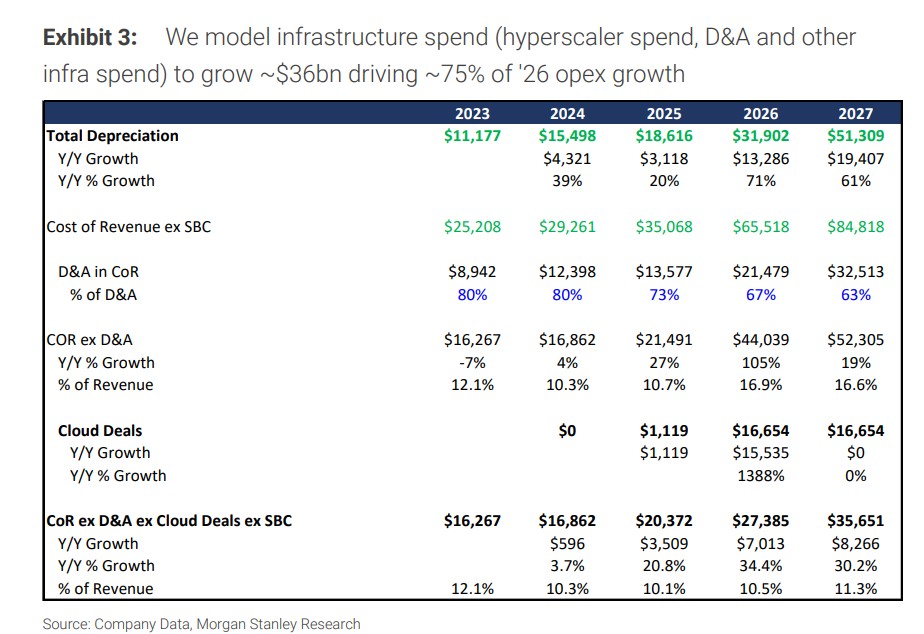
Although the investment is substantial, Morgan Stanley believes this is a necessary cost to maintain "sustainable growth." Meta has clearly stated that there are still capacity bottlenecks, with demand growing faster than supply. To address this issue, Meta is not only making large purchases of chips (including NVIDIA, AMD, and self-developed MTIA) but is also building the Andromeda architecture that can run across chips. For investors, as long as revenue growth can outpace investment costs—as Morgan Stanley predicts—this high-intensity capital expenditure is justified, as it is building a formidable AI moat for Meta.**
Risk Warning and Disclaimer
The market has risks, and investment should be cautious. This article does not constitute personal investment advice and does not take into account the specific investment goals, financial situation, or needs of individual users. Users should consider whether any opinions, views, or conclusions in this article are suitable for their specific circumstances. Investment based on this is at one's own risk.

