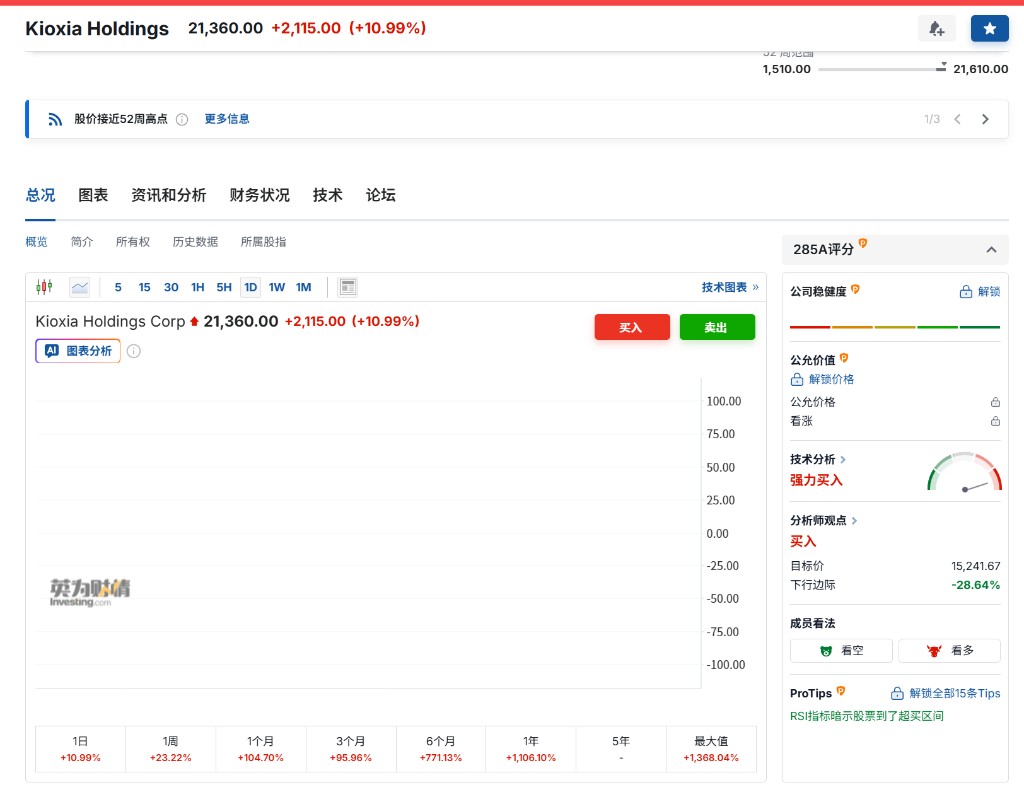
No need to compete for HBM production capacity! Kioxia executives: We have the "right products," AI data centers are in a storage hunger period
Kioxia executives clearly pointed out that during the "storage hunger period" of AI data centers, the company has the "right products." Its strategic core is to avoid the fierce competition in the HBM market and instead fully bet on and expand the production capacity of high-density NAND/SSD to meet the urgent demand for massive data storage from cloud service providers. This differentiated choice has enabled it to gain strong pricing power and growth, with its stock price soaring more than 13 times since its IPO
In this round of investment frenzy driven by artificial intelligence, while competitors are fiercely battling for market share in high-bandwidth memory (HBM), Japanese storage giant Kioxia has chosen a different path, focusing its strategic efforts on the urgent demand for high-density storage in AI data centers, thereby achieving significant cash flow growth and market advantages.
According to Bloomberg, Kioxia's Executive Chairman Stacy Smith stated in an interview in Tokyo that competitors are currently fully focused on the HBM market, leading to insufficient investment in capacity expansion for solid-state drives (SSD) and other advanced NAND storage devices. However, cloud service providers are also in urgent need of such devices to support the massive data throughput demands of AI. Smith emphasized that Kioxia has "the completely right product leadership" and has entered this niche market "at the completely right time."
This differentiated strategy is driving the Tokyo-based chip manufacturer to achieve a strong recovery. Since its initial public offering (IPO) on the Tokyo Stock Exchange at the end of 2024, Kioxia's stock price has soared more than 13 times, with investors betting on its growth potential in the AI storage sector. The renewal of its long-term partnership with SanDisk and related financial arrangements further solidify market confidence in the competitiveness of its products.
Avoiding the HBM Red Sea, Targeting the NAND Supply Gap
The current landscape of the memory chip market is polarized. Giants like Samsung, SK Hynix, and Micron are deeply entrenched in the arms race of the HBM market, as these high-margin products are essential components of NVIDIA's AI accelerators. This has led to a relative decrease in their investment in the traditionally strong NAND sector.
Smith pointed out that this resource tilt has created opportunities for Kioxia. The high-performance storage demand from AI has significantly enhanced the pricing power of NAND products with higher density. Hyperscale cloud service providers are actively exploring NAND-based solutions in search of more energy-efficient storage options, which not only exacerbates the overall chip supply tightness but also directly enhances Kioxia's pricing power. This dynamic is reshaping an industry that was once known for its severe cyclical fluctuations.
Bloomberg Industry Research analyst Jake Silverman noted that SanDisk's third-quarter earnings guidance exceeded expectations by 163%, reflecting the continued rapid rise in NAND prices since October. Due to a lack of substantial capacity increases in the next 1 to 2 years, coupled with larger models and increased context windows driving higher storage intensity, prices still have room for further increases supported by strong AI inference demand.
Strategic Capacity Expansion and Management Changes
To capture market share, Kioxia plans to adopt a capacity expansion strategy that is slightly faster than the overall market growth rate. Smith revealed that the company's bit growth rate is expected to be around 20% this year, with the pace of capacity expansion slightly exceeding this.
This expansion plan will be implemented under new leadership. Kioxia announced this week that Executive Vice President Hiroo Oota (63) will succeed Nobuo Hayasaka (70) as CEO. Hayasaka previously led the company through a severe industry downturn and successfully achieved the IPO However, supply bottlenecks may persist. TrendForce storage analyst Bryan Ao warned that due to chip manufacturers' cautious attitude towards NAND capacity expansion in recent years, the number of flash memory factories is expected to be unable to meet market demand until 2027.
Deepening Partnerships, Improving Financial Conditions
As partners for over 25 years, Kioxia and SanDisk announced the extension of their joint venture agreement at the Yokkaichi plant in central Japan for another five years until the end of 2034. According to the agreement, SanDisk will pay Kioxia $1.165 billion over the next four years until 2029. Smith stated that this is the first such arrangement between the two parties and a strong testament to Kioxia's product leadership.
Boosted by this news and SanDisk's optimistic forecast, Kioxia's stock price surged over 11% on Friday. Kioxia was spun off from Toshiba and renamed after being sold to a consortium led by Bain Capital in 2018. Smith admitted that while success seems within reach now, it is the result of the company struggling under heavy debt, the unexpected death of its former CEO, and navigating through the industry's most severe downturn. "When you finally emerge from the trough, everything feels particularly wonderful," Smith said.