


Trump claims that the U.S. and India have reached a trade agreement to reduce tariffs on India, with India halting purchases of Russian oil and increasing purchases of American oil

Trump stated that the "reciprocal tariffs" from the United States to India will be reduced from 25% to 18%, and India will correspondingly lower its tariffs and non-tariff barriers against the United States until they reach zero, while committing to purchase products from the United States, including energy, worth over $500 billion, and may also buy oil from Venezuela
The United States and India have made breakthrough progress on tariff issues. U.S. President Trump announced that the two countries have reached a trade agreement and will take immediate action to reduce tariffs on both sides.
On February 2nd, Eastern Time, according to CCTV News, Trump stated on the social media platform "Truth Social" that he spoke with Indian Prime Minister Modi that morning. The two sides reached a U.S.-India trade agreement, reducing the "reciprocal tariff" from 25% to 18%. India will also correspondingly lower tariffs and non-tariff barriers on U.S. goods until they reach zero.
Trump stated that Modi promised to significantly increase purchases of U.S. products, including over $500 billion worth of U.S. energy, technology, agricultural products, coal, and many other products.
Trump also mentioned that Modi agreed to stop purchasing Russian oil and to buy more oil from the United States, and India may also purchase oil from Venezuela.
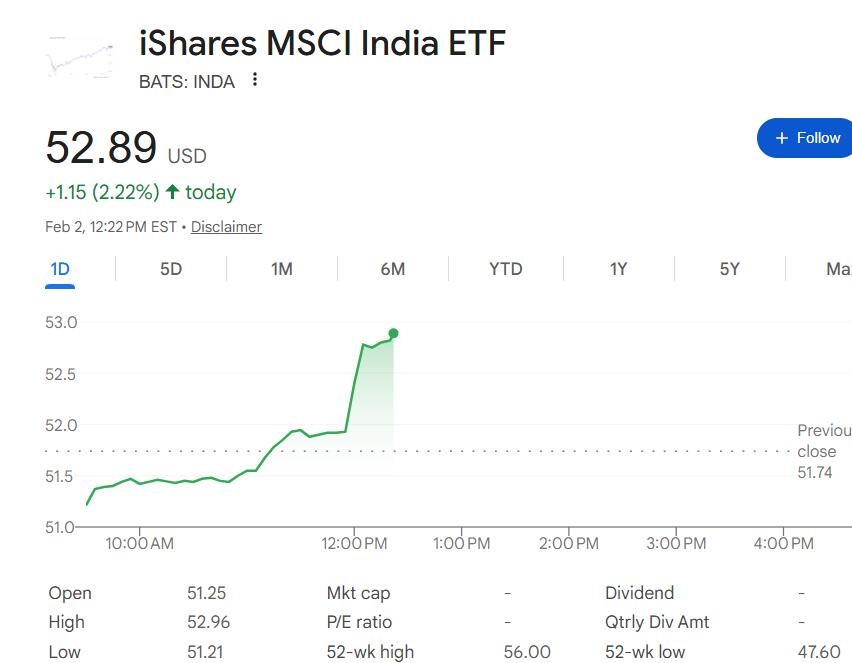
Trump's statements have driven up related Indian assets. The Indian ETF INDA listed in the U.S. saw its intraday gains expand to over 2%, while the Indian Gift Nifty stock index futures rose by 3.8%.
Earlier on Monday, U.S. Ambassador to India Sergio Gor revealed on the social media platform X that Trump had just spoken with Modi and wrote, "Stay tuned." India's Commerce Minister previously stated that the first phase of the U.S.-India bilateral trade agreement is "very close" to being finalized.
This breakthrough marks a significant turning point in trade relations between the two countries after a tariff dispute arose in August 2025 due to Russian oil issues. The agreement is expected to open a new chapter in trade relations and impact the global energy market landscape.
Frequent Interactions Between U.S. and Indian Officials Drive Agreement
Before Trump announced the agreement, earlier on Monday, U.S. Ambassador to India Sergio Gor posted on X that Trump had just spoken with Indian Prime Minister Modi. He stated that significant progress had been made in negotiations for the bilateral trade agreement (BTA) between India and the U.S., and the agreement is expected to be finalized soon.
India's Commerce Minister Rajesh Agrawal previously stated that the highly anticipated U.S.-India bilateral trade agreement is "very close" to reaching its first phase, but did not provide a specific timeline.
The BTA was officially proposed in February 2025 under the direction of the leaders of both countries and was announced during Modi's visit to Washington that month. It aims to more than double bilateral trade from the current $191 billion to $500 billion by 2030.
Modi and Trump spoke in December last year, and the two leaders agreed to work closely together to address common challenges and advance mutual interests. Modi stated at that time on X: "Had a very warm and productive conversation with President Trump. We reviewed the progress of our bilateral relations and discussed regional and international developments. India and the U.S. will continue to work together to promote global peace, stability, and prosperity."
Negotiations Stalled Due to Tariffs and Russian Oil Issues
According to Xinhua News Agency, in August 2025, the U.S. government imposed punitive tariffs on Indian goods exported to the U.S. citing India's import of Russian oil, raising the overall tariff rate on Indian goods to 50%. The Indian government has repeatedly stated that its energy import policy aims to protect the interests of domestic consumers.
The report mentioned that in response to U.S. Secretary of Commerce Gina Raimondo's statement on January 8, 2026, regarding the lack of a trade agreement between the U.S. and India being due to Modi not calling Trump, Indian Ministry of External Affairs spokesperson Arindam Bagchi responded on January 9 that this claim is "inaccurate." He stated that India and the U.S. had committed to negotiating a bilateral trade agreement as early as February 13 of last year, and multiple rounds of consultations have taken place, with Modi and Trump having spoken on the phone eight times in 2025.
Xinhua noted that in October 2025, Indian Minister of Commerce and Industry Piyush Goyal stated at the Global Dialogue Forum in Berlin that India does not intend to yield to U.S. pressure in trade, saying, "We will not rush to reach an agreement, nor will we accept agreements with strict deadlines or coercive nature."
Diversification of Energy Procurement Becomes Key to Agreement
According to media reports cited by Sina Finance this Monday, informed sources revealed that the U.S. had threatened to impose tariffs on India last year due to its purchase of Venezuelan oil, but has now informed India that it can soon resume relevant purchases to replace some of the imported Russian oil.
These informed sources indicated that after the U.S. imposed tariffs on India's procurement of Russian oil, India committed to significantly reducing its imports of Russian crude oil, and in the coming months, India's imports of Russian oil are expected to decrease by hundreds of thousands of barrels per day.
Indian Oil Minister Hardeep Singh Puri stated last week that as the volume of Russian oil imports declines, India is advancing the diversification of its crude oil import sources.
Trump Expresses Optimism About Agreement Prospects
Over a week ago at the World Economic Forum in Davos, Trump expressed confidence in the U.S.-India bilateral trade agreement. On January 21, when asked about the U.S.-India trade agreement, Trump said, "I have great respect for your Prime Minister. He is a tremendous guy and a friend of mine, and we will make a great deal."
U.S. Trade Representative Katherine Tai praised the trade agreement reached between India and the European Union in a media interview last week, stating that India has the upper hand in that agreement.
Tai pointed out that India has a competitive advantage due to its low-cost labor and growing manufacturing base, which will provide more opportunities to access the European market
