


How high does gold have to rise to be considered high?

The theoretical limit is at $8,400. JP Morgan assumes that as long as the nominal demand for gold from central banks and investors remains at the current level of $100 billion, the gold price may need to rise to around $8,400 per ounce for the actual tonnage of gold purchased to fall to a level that cannot support the upward trend. The structural bull market for gold may still be far from reaching a breaking point
How high will gold prices go before they "cool off"? JPMorgan believes the theoretical limit is $8,400.
As the metal market experiences significant turbulence, the JPMorgan commodity analyst Gregory Shearer team released the latest research report, reiterating a year-end target price of $6,300/ounce while proposing a quantitative framework to assess when gold prices might peak.
The bank believes that the medium-term framework for gold is rooted in "demand tonnage." Due to the extremely inelastic short-term supply of gold, when demand surges, gold prices must rise to attempt to restore market balance.
Gregory Shearer wrote:
"Only when prices are high enough to convert the same nominal demand impulse into a sufficiently low tonnage will the market imbalance driving prices up dissipate, provided that the purchasing willingness of investors and central banks (i.e., nominal capital inflows) remains unchanged."
In other words, the mission of rising gold prices is to "allow the same amount of money to buy less gold" until physical demand falls to a level that supply can cover. JPMorgan's answer is: "Before the appetite of investors and central banks weakens, this price may need to exceed $8,000/ounce."
380 tons: The "break-even point" for rising gold prices
To translate theory into prediction, JPMorgan conducted a regression analysis of quarterly demand tonnage from central banks and investors against changes in gold prices.
Data mining shows that physical demand from these two channels must exceed 380 tons for gold prices to rise in that quarter.
This conclusion has a high historical stability—long-term regression analysis since 2010 has yielded nearly the same break-even level (around 376 tons).
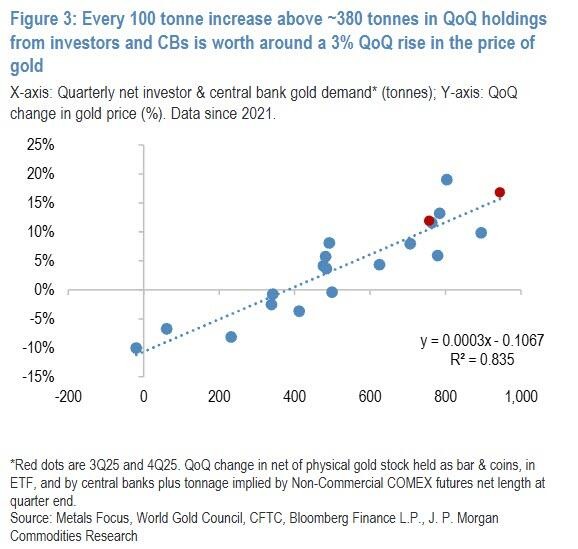
$8,400: The theoretical peak under nominal demand
From an investor's perspective, the most straightforward calculation is: How high must gold prices rise for the current amount of capital to be unable to purchase 380 tons of gold?
JPMorgan's data shows that in the past two quarters, the nominal demand from investors and central banks averaged slightly over $100 billion. Assuming this nominal capital scale remains unchanged, a simple division leads to the conclusion:
"Gold prices need to rise to about $8,400/ounce to reduce the tonnage data below 380 tons—where 380 tons is the historical threshold required to sustain price increases."
JPMorgan acknowledges that this is merely a limited heuristic model that does not account for changes in jewelry demand and scrap gold recovery supply. However, the bank emphasizes that the conclusion is clear:
"While the air above does indeed become thinner as gold prices rise, we believe that we are not yet close to the risk of a structural rebound in gold collapsing 'under its own weight.'"
