


Tax rumors "raid" Hong Kong stocks! Institutional interpretation: excessive speculation, very low credibility

During the decline of stock prices of internet giants in the Hong Kong stock market, a widely circulated message about "China will adjust the identification of high-tech enterprises and related new tax policies" emerged. Everbright Securities believes that the rumor of "game tax rates aligning with liquor" is a common misconception. The two have completely different taxation logic and legal basis, and there is no foundation for "alignment." Moreover, tax rate adjustments require rigorous legislative or administrative procedures. The current macro policy focus is on "stabilizing growth, promoting innovation, and supporting industrial upgrades," and implementing a "one-size-fits-all" tax increase on key industries contradicts the overall policy direction
This Tuesday, the Hong Kong stock market was suddenly hit by tax rumors, causing a collective plunge in internet technology stocks. Several brokerages quickly voiced their opinions, stating that the related rumors were an over-interpretation, lacking validity in terms of tax types, legal and policy logic, and had very low credibility.
The Hang Seng Tech Index initially followed the external markets and strengthened in the morning, but suddenly plummeted around 10:50 AM, with the decline at one point expanding to 3.37%. By the lunch break, it was down 1.31%. Kuaishou once dropped over 7%, while Bilibili, Baidu, and Tencent Holdings all fell over 6%, and Alibaba nearly dropped 5%.
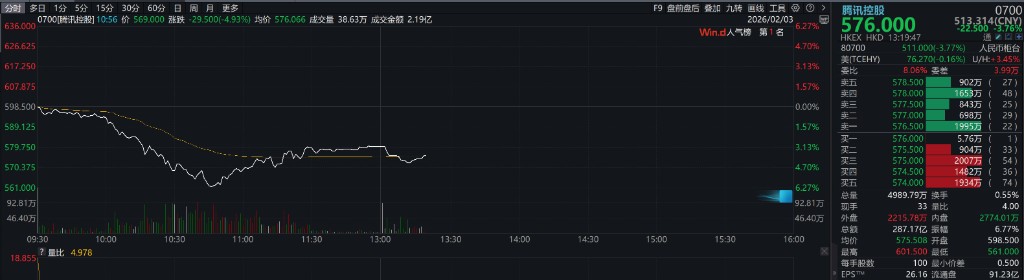
The market panic stemmed from a rumor about "China adjusting the recognition of high-tech enterprises and related new tax policies," which involved a potential increase in the tax rate for the financial industry and internet value-added services. Huachuang Securities believes that the aforementioned rumors are an over-interpretation, lacking substantial basis, and contradict the current policies aimed at promoting consumption. Everbright Overseas explicitly pointed out that the rumor does not hold up in terms of tax types, legal and policy logic, and has very low credibility.
Resurgence of Rumors Triggers Market Turbulence
The main reason for the market sell-off was a tax rumor. During the sharp decline in internet giants' stock prices, the news about the potential increase in VAT rates for the financial industry and internet value-added services (such as in-game purchases and advertising) spread widely, with rumors comparing it to the high tax rates on liquor.
Analysts pointed out that such "small essays" have circulated in the market before. Various versions have been circulating since 2019, but none have materialized. Last year, foreign media also reported similar news, but it did not come to fruition.
Institutions Refute: Confusion of Tax Types and Legal Constraints
In response to the rumor mentioning "game tax rates aligning with the 32% for liquor," Everbright Overseas pointed out in their interpretation that this is a common sense error.
The 32% tax rate applicable to liquor is a consumption tax (comprising ad valorem tax and specific tax), while in-game purchases and advertising services are subject to VAT, with completely different tax logic and legal basis, thus there is no foundation for "alignment."
From the current legal framework, the financial industry, gaming, and advertising all fall under the VAT "modern services" subcategory, with a statutory tax rate of 6%. According to the "Value-Added Tax Law of the People's Republic of China," which will be implemented starting January 1, 2026, the tax rate brackets are clearly defined as 13%, 9%, and 6%. The recent announcement No. 9 of 2026 issued by the Ministry of Finance and the State Administration of Taxation only involves adjustments to the tax rates for basic telecommunications services and does not mention financial and internet value-added services.
Institutions emphasize that tax rate adjustments require rigorous legislative or administrative procedures, and cannot be made arbitrarily based on market speculation, with no policy basis for categorizing the aforementioned industries into higher brackets.
Moreover, any future tax regulations may focus more on the verification and cleanup of tax incentive qualifications for certain enterprises (such as high-tech enterprise qualifications), rather than directly increasing statutory tax rates, with such impacts being limited and controllable.
Policy Logic: Tax Increases Contradict Macroeconomic Direction
In addition to legal constraints, multiple analyses suggest that this rumor is also difficult to reconcile with economic logic.
Huachuang Securities pointed out that if internet companies face tax increases, the costs are likely to be directly passed on to C-end consumers, which contradicts the current national policy of promoting consumption and cannot be logically extrapolated.
Everbright Overseas further analyzed that, the current macro policy focus is on "stabilizing growth, promoting innovation, and supporting industrial upgrades." The internet platform economy and overseas gaming are key support areas, and implementing a "one-size-fits-all" tax increase on key industries contradicts the overall policy direction. Although there is room for discussion on the tax burden issue in the financial industry, regulatory thinking is more inclined towards optimizing deduction rules and other structural adjustments, rather than simply and crudely raising tax rates to avoid impacting credit supply and financial stability.
Valuation and Outlook: Long-term Logic Remains Unchanged
Despite short-term sentiment being disturbed, the fundamental valuation of the Hong Kong stock market remains attractive. Data shows that as of January 30, 2026, the PE and PB ratios of the Hang Seng Index are 12.47 times and 1.27 times, respectively, which are at the 82% and 63% percentile levels since 2010. Meanwhile, the risk premium rate of the Hang Seng Index is 3.76%, indicating a good investment cost-performance ratio.
Galaxy Securities believes that the technology sector remains the main line for medium to long-term investment, and against the backdrop of rising prices in the industrial chain, domestic substitution, and accelerated AI applications, it is expected to trend upward. GF Securities suggests that, in the context of a declining dollar cycle and a moderate appreciation of the renminbi, Chinese equity assets are in a favorable repricing window. In terms of Hong Kong stocks, it is advisable to focus on opportunities arising from southbound capital inflows and valuation discounts, prioritizing technology leaders and internet platforms that possess both dividend capabilities and growth attributes
