


Stable bonds before the holiday, warm stocks after the holiday?

Research from TF SECURITIES shows that in 2026, the market is breaking the traditional "Spring Festival effect." Historical patterns indicate that bonds are strong and stocks are weak before the festival, with a style switch to small-cap growth afterward. However, this year, under the influence of a "late Spring Festival," policy expectations, and global liquidity support, the "spring frenzy" has arrived early and is more solid, with the market showing a strong competition between stocks and bonds. After structural interest rate cuts, the bond market may continue to fluctuate, while the stock market's style will shift from a simple switch to a complex pattern of "growth and dividends dancing together," requiring investors to pay attention to volatility risks under high crowding
The latest research from TF SECURITIES points out that the market performance at the beginning of 2026 is breaking traditional historical patterns. From 2026 to now, the Chinese capital market has shown significant characteristics of stock-bond differentiation. The Shanghai Composite Index has achieved sixteen consecutive days of gains and has once again crossed the 4100-point mark after ten years, while the bond market has experienced a "reverse V-shaped" trend of first declining and then rising. Standing before the important point of the Spring Festival, historical data indicates that: the A-share market typically completes the transition from fluctuation to rise after the Spring Festival, with the market style shifting from large-cap defensive before the festival to small-cap growth after.
The report indicates that for investors, this year's market environment presents three characteristics that differ from historical patterns: First, under the combined effects of the "14th Five-Year Plan" starting policy expectations, the global liquidity easing outlook, and the continuous tilt of household assets towards the equity market, this year's "spring rally" is based on a more solid foundation than in the past, and the pattern of market rise after the festival is expected to be strengthened.
Secondly, after the central bank's structural interest rate cut of 0.25 percentage points in January, the necessity for overall monetary easing in the short term has decreased, coupled with the accelerated supply of local bonds after the festival, it is expected to present a range-bound fluctuation pattern.
Finally, in terms of market style, TF SECURITIES believes that the post-festival market will find it difficult to present a simple style switch, and is more likely to enter a complex game phase where growth and dividend styles intertwine, with multiple logics coexisting.
Market Status: Revelry at 4100 Points and the "Reverse V" Reversal in the Bond Market
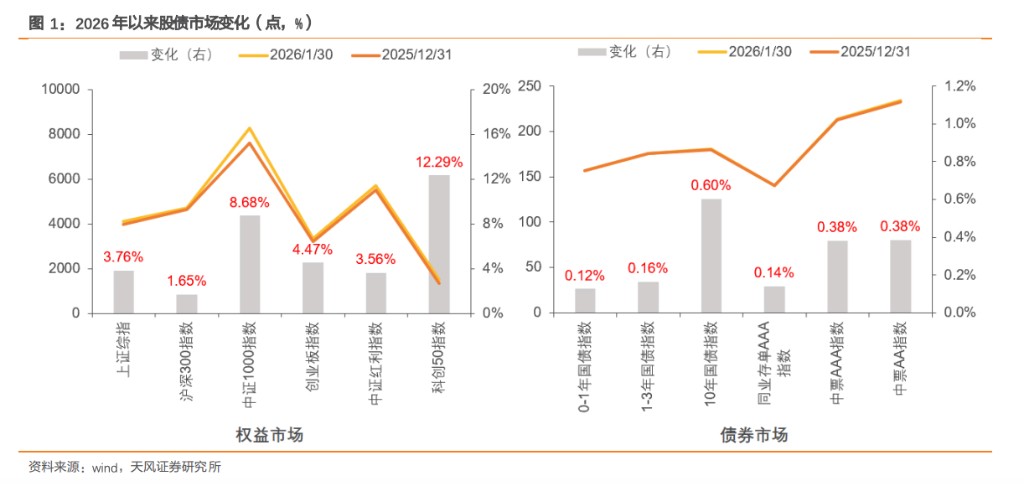
The market in the first month of the year shows a typical pattern of structural differentiation and liquidity rebalancing. The equity market has rapidly repaired under ample liquidity support, with the Shanghai Composite Index achieving consecutive gains and breaking through the 4100-point mark, with daily trading volume once exceeding 3 trillion yuan. Although the index subsequently entered a fluctuation phase, small and medium-sized stocks and technology growth styles remain the main structural directions.
During this period, the bond market experienced phase pressure, influenced by the diversion of active funds from the equity market and expectations of government bond supply, with the yield on 10-year government bonds rising to 1.9% and the 30-year rate breaking through 2.3%. Subsequently, the central bank announced a structural interest rate cut of 0.25 percentage points, coupled with gradually released allocation demand, stabilizing market sentiment, and by the end of the month, the yield on 10-year government bonds fell back to around 1.8%. This trend reflects that 1.9% has become a key resistance level for rising rates, while timely policy responses further clarified the tone of maintaining a stable and loose liquidity environment.
Historical Patterns: Stock-Bond Rotation Before and After the Spring Festival
Stock Market: From Defensive to Offensive Style Switch
Looking back at the historical data of the past decade (2015-2025), the A-share market shows a distinct seasonal pattern before and after the Spring Festival. In the 30 days before the Spring Festival, the market generally presents a fluctuating trend, with the probability of the CSI 300 Index rising at 63.64% and the average increase being close to flat, while the probability of the CSI 1000 Index rising is only 27.27%, showing significantly weaker performance, indicating a relative dominance of large-cap style. Correspondingly, defensive sectors such as banks and food and beverage have a higher win rate before the festival After the Spring Festival, the market usually welcomes the "spring excitement" trend within 30 days. The probability of the CSI 300 Index rising increases to 72.73%, with an average increase of 3.15%; the performance of the CSI 1000 Index is even more prominent, with a rising probability of 81.82% and an average increase of 8.71%, indicating a clear advantage for small-cap growth styles. Among them, industries such as TMT and high-end manufacturing perform particularly actively after the festival.
Historical data shows that in the 30 days before and after the Spring Festival, the years with style switching account for 81.82%, indicating a clear rotation pattern from defensive before the festival to offensive after the festival.
Bond Market: Phase Shift in Trading Logic
The bond market also exhibits significant cyclical characteristics before and after the Spring Festival. In the 30 days before the festival, the market usually shows a strong performance, mainly due to the central bank's increased open market operations to maintain liquidity stability, as well as strong investment demand from allocation-type institutions such as banks and insurance companies. Historical data shows that during this period, the average yield on 1-year government bonds declines by 5.73 basis points, while the yield on 10-year government bonds also shows an average decline of 0.43 basis points.
Entering the 30 days after the festival, the bond market may face certain adjustment pressures. Under the combined influence of changing policy expectations, increased bond supply, and the "teeter-totter" effect between the stock and bond markets, the average yield on 10-year government bonds rises by 1.03 basis points, and the average yield on 30-year bonds rises by 1.13 basis points. This reflects a significant shift in trading logic in the bond market before and after the Spring Festival: before the festival, the focus is mainly on "liquidity and certainty," while after the festival, it gradually shifts to the game of "economic growth and risk appetite."
The "Special Calendar Effect" of Late Spring Festival
From historical data, the calendar effect has a significant statistical significance on the short-term performance of the stock and bond markets. Based on market reviews from 2015 to 2025, there are clear patterns in asset trends before and after the Spring Festival, and the later timing of the Spring Festival in 2026 (in mid to late February) may amplify the occurrence probability of certain signals in historical patterns:
In the stock market, in general years, the market tends to fluctuate before the Spring Festival (reflecting the "holding cash for the festival" mentality), and only gradually opens the "spring excitement" trend after the festival. However, in years when the Spring Festival is later (such as 2015, 2018, 2021, and 2024), the probability of the CSI 300 Index rising before the festival reaches as high as 75%, significantly higher than the average level of 63.64% across all years, reflecting a strong willingness for funds to position themselves ahead of the festival.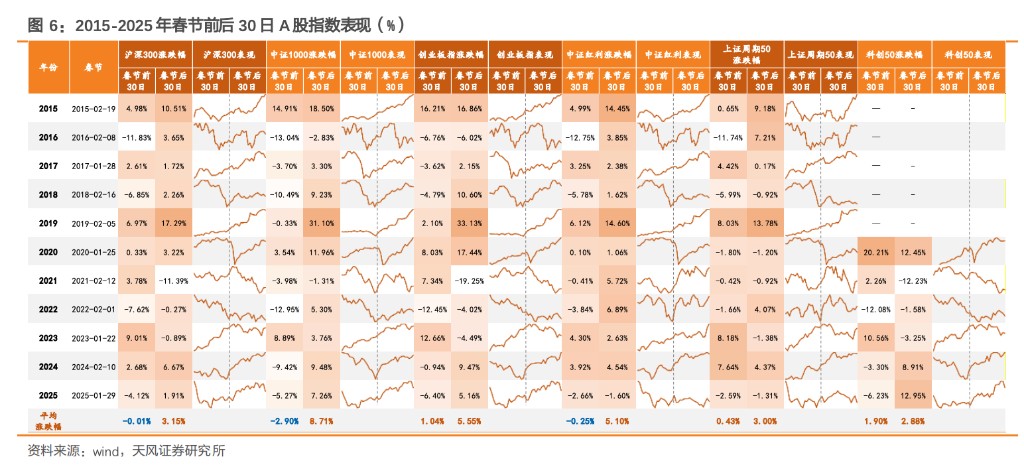
In the bond market, due to the usually loose liquidity environment before the Spring Festival, bond prices tend to strengthen; after the festival, with the economic expectations warming, yields are prone to upward pressure. In years when the Spring Festival is later, the probability of the yield on 10-year government bonds declining before the festival also reaches 75%.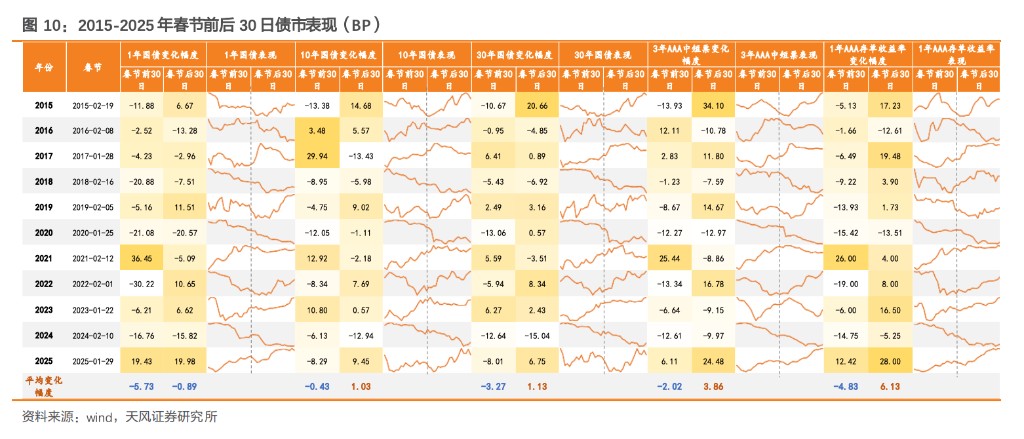 Overall, in years with a "late Spring Festival," the probability of both the stock and bond markets strengthening before the festival is relatively high (about 75%), this statistical feature is worth paying close attention to when assessing the market rhythm at the beginning of 2026.
2026 Outlook: Continuation of "Restlessness" and Style Reconstruction
Three Major Trends That May Be Strengthened
First, the foundation for the "spring restlessness" market is more solid. Whether it is the policy expectations at the beginning of the "14th Five-Year Plan," the prospects for global liquidity easing, or the trend of residents allocating funds to equity assets, all may reinforce the market's upward trend after the festival. The significant increase in non-bank deposits, combined with a clear AI industry mainline, may lead to a more sustained "Spring Festival restlessness" this year.
Second, consumption and travel trends are advanced and enhanced. This year, influenced by the "historically long nine-day Spring Festival holiday," consumer demand has been released significantly earlier than in previous years. In 2026, consumers' decision-making time for purchasing Spring Festival travel products is on average 7-10 days earlier than the same period in 2025. The scale of travel and consumption is expected to break through again, and the market's expectation for an "economic opening red" is more stable.
Third, the bond market's range-bound volatility may be strengthened. After the central bank's structural interest rate cut of 0.25 percentage points in January, the necessity for a total interest rate cut in the short term has decreased. If the pre-festival speculation on liquidity easing drives the bond market's recovery, the acceleration of local bond issuance and the warming of policy expectations after the festival may increase the probability of interest rate adjustments.
Two Major Trends That May Be Broken
First, the "strong bonds and weak stocks" model before the festival may be broken. This year, the expectation for the stock market's "spring restlessness" is strong and advanced, and the pre-festival market may not be a single risk-averse model, but rather a situation where both stocks and bonds have support, leading to intensified speculation.
Second, the stock market style switch may weaken. Historically, small-cap growth stocks usually outperform after the festival, but this year this trend may be constrained by two major factors: First, under the clear background of the prosperity of the AI and other industry mainlines, large-cap growth may strengthen simultaneously; second, the "high dividend" assets as a long-term base allocation logic remain solid, and the post-festival style may be "growth and dividends dancing together," rather than a simple complete switch.
