


Concerns over intervention fade, hedge funds restart "short yen" trades

As Japan is about to hold a key election, hedge funds are restarting their bets against the yen, expecting the yen to weaken. Prime Minister Kishi Sanae emphasized the benefits of a weak currency, leading to a significant shift in market sentiment, with an increase in bullish options trading for USD/JPY. Kishi's remarks have fueled bullish sentiment for USD/JPY, and the yen has steadily declined since Kishi won leadership in October last year, reaching an 18-month low. The market expects USD/JPY to rise to higher levels, while real money investors are taking a more cautious stance
As Japan approaches a key election this weekend, hedge funds are restarting their bets against the yen, anticipating further weakness in the currency.
Prime Minister Kishi Sanae emphasized the benefits of a weak currency ahead of the February 8 vote, bringing the USD/JPY back into market focus. She called this snap election to consolidate her leadership, with polls indicating that her party is likely to secure a majority on its own—an outcome that could give her greater leeway to implement fiscal stimulus and increase Japan's already heavy debt burden.
The options market is reflecting this shift. According to Bloomberg, citing data from the Depository Trust & Clearing Corporation, the volume of call options on USD/JPY worth $100 million or more on Tuesday exceeded that of put options of the same size. As demand for call options rises, the premium for hedging against downside risks in USD/JPY relative to upside risks has fallen to its lowest level in nearly two weeks.
This marks a significant shift in market sentiment. Previously, on January 23, the New York Fed's currency inquiry and subsequent statements from President Trump had caused a sharp rebound in the yen. However, after Treasury Secretary Yellen reaffirmed the strong dollar policy and Powell was nominated as the next Fed chair, pressure on the yen quickly resumed.
Traders Revisit "Kishi Trade"
Antony Foster, head of G-10 spot trading at Nomura International in London, stated:
The market has stabilized somewhat now, and the extreme bubble in the precious metals market has also calmed down. Hedge funds are increasingly returning to carry trades and Kishi trades. The Japanese election will be held this weekend, and the market expects USD/JPY to rise to higher levels, especially in the case of a Kishi victory.
The yen has steadily declined since Kishi won the leadership of the Liberal Democratic Party last October, hitting an 18-month low against the dollar last month. It has now further rebounded to 156.2.
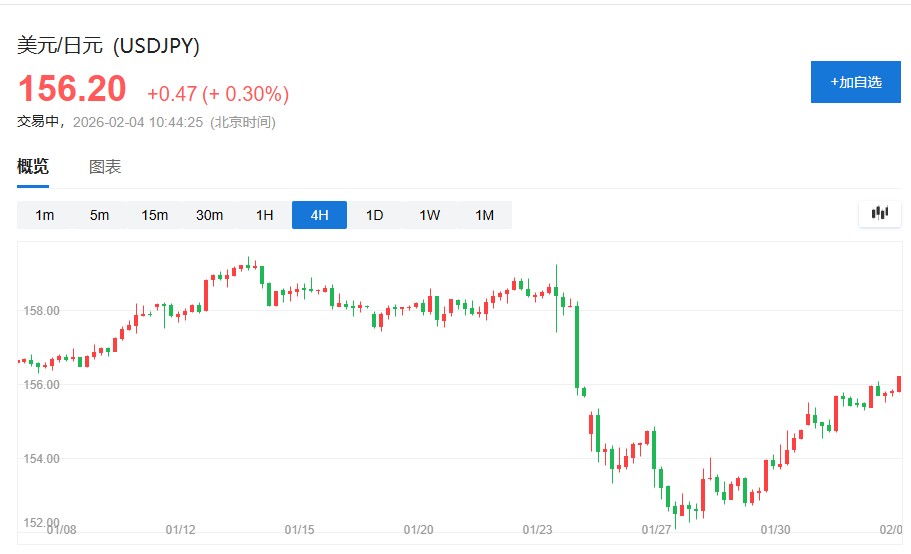
Kishi's latest remarks have further fueled bullish sentiment for USD/JPY. Mukund Daga, global head of foreign exchange options at Barclays, noted:
Comments over the weekend suggesting that a weaker yen benefits exporters seem to have rekindled market interest in buying USD/JPY.
In contrast, actual fund investors, such as asset management companies, have taken a more cautious stance amid recent volatility, waiting for clearer signals on the next direction of the currency pair. Ivan Stamenovic, head of G-10 currency trading at Bank of America in the Asia-Pacific region, stated: “Actual funds are basically in a wait-and-see mode, using options for protection rather than making a clear commitment to the direction of USD/JPY.”
Risk Warning and Disclaimer
The market carries risks, and investments should be made cautiously. This article does not constitute personal investment advice and does not take into account the specific investment objectives, financial situation, or needs of individual users. Users should consider whether any opinions, views, or conclusions in this article are suitable for their specific circumstances. Investment based on this is at one's own risk
