


OpenAI Codex evolves again: reasoning speed increased by 40%, significantly reducing programming latency

OpenAI's core programming tool Codex has received a major upgrade. OpenAI has not only launched a standalone desktop application but also achieved breakthroughs in the underlying model performance: the GPT-5.2 and GPT-5.2-Codex models have achieved an overall speedup of about 40% while maintaining the same parameter weights
OpenAI is accelerating the upgrade of its AI programming ecosystem, attempting to regain market influence from strong competitors like Anthropic.
The official developer account of OpenAI announced today that its core programming tool Codex has received a significant upgrade. OpenAI has not only launched a standalone desktop application but has also achieved breakthroughs in the underlying model performance: the GPT-5.2 and GPT-5.2-Codex models have achieved an overall speed increase of about 40% while maintaining the same parameter weights.

For developers and enterprise users, speed is the primary productivity factor for AI programming tools. OpenAI stated that this 40% speed increment is entirely due to engineering optimizations of the inference stack.
This means that all API customers can enjoy rapid responses without changing any code or adjusting model architectures. In multi-agent collaboration scenarios, lower latency will directly translate into a more coherent development experience, significantly reducing the waiting time from logic generation to code implementation.
From "Conversational Assistant" to "Command Center"
The newly released Codex desktop application marks a paradigm shift in OpenAI's programming strategy. Unlike traditional conversational interfaces, Codex is designed as an "Agent Command Center."
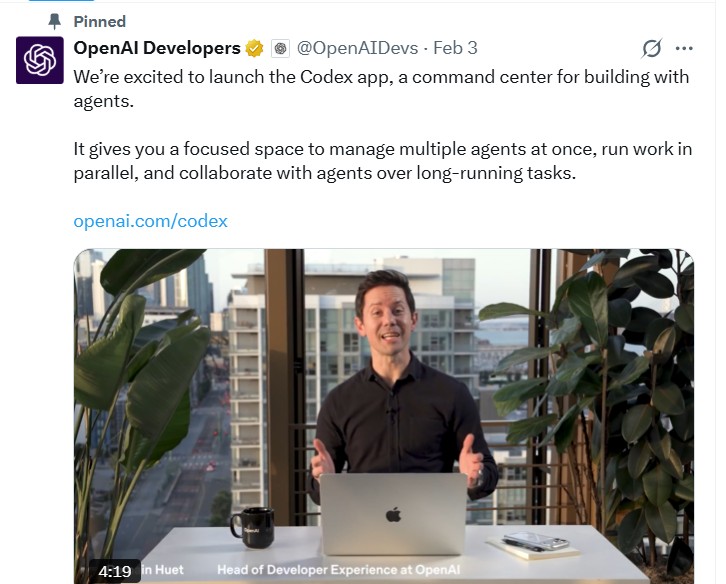
It allows users to call multiple AI agents to work in parallel. Through the "Worktrees" feature, developers can assign different agents to handle UI design, backend architecture, and bug scanning separately without interference. Additionally, Codex integrates the MCP protocol, allowing AI agents to directly operate external software.
OpenAI CEO Sam Altman candidly discussed the competitive advantages of AI programmers:
"Models do not run out of dopamine. They do not get frustrated, nor do they run out of energy. They will keep trying, and their motivation will never deplete."
Targeting Anthropic's "Billion-Dollar Deal"
OpenAI's intensive updates are highly targeted. According to Reuters, although OpenAI leads in the general large model field, it has lagged behind Anthropic in the AI programming niche market.
Data shows that Anthropic's programming tool Claude Code achieved an annualized revenue of $1 billion within just six months of being made public. To reclaim this high-value "treat," OpenAI has not only significantly increased speed but also offered "limited-time benefits": both ChatGPT free users and Go version users can experience Codex, while Plus and enterprise version users will see their rate limits doubled For the market, the evolution of Codex has lowered the barriers to software development. As some observers have noted, this has ushered in the era of "Vibe Coding"—even non-technical personnel can command a legion of Agents through text instructions to "create" a fully functional application in just a few minutes
