


SAIC Volkswagen is ready to compete fiercely with new forces

Bottoming out, charging forward
Author | Chai Xuchen
Editor | Zhou Zhiyu
In the recently concluded year of 2025, the Chinese automotive market experienced a brutal reshuffle. New forces, joint ventures, and the BBA (Benz, BMW, Audi) brands have gone through ups and downs, and the industry's reshuffling has become faster and more frequent.
In an environment where independent brands are accelerating their offensive, for joint venture brands facing challenges from all sides, surviving has become the most critical issue. In the quagmire, SAIC Volkswagen responded to doubts with its performance: a total of 1.06 million units sold by the end of 2025, stabilizing its base and maintaining its qualification for the "Million Club."
This joint venture giant has initially completed its bottoming out, but the market ahead will become increasingly crazy, and it has also prepared a series of strategies accordingly.
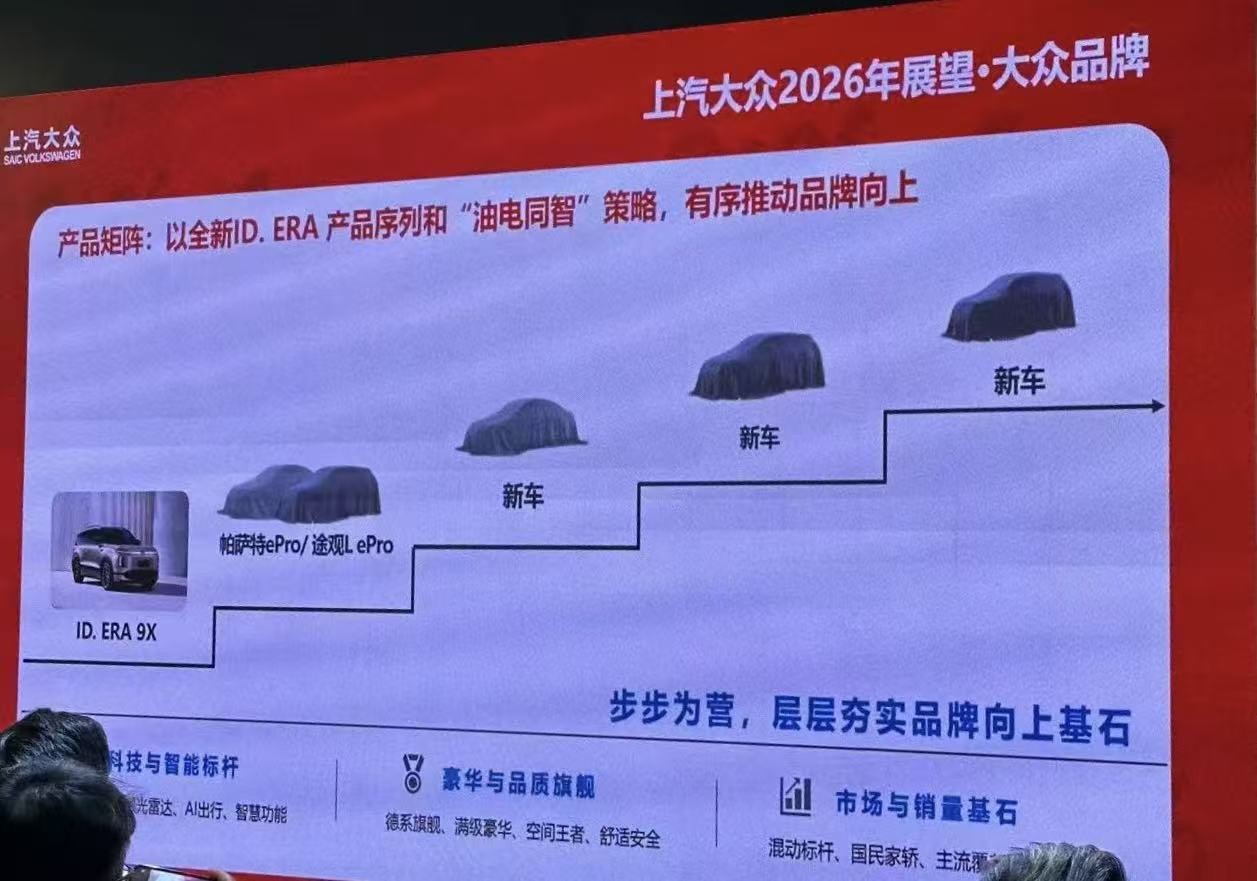
Fu Qiang, Vice President of Sales and Marketing at SAIC Volkswagen, told Wall Street Insight, "In 2026, we will officially enter a strategic counterattack, with the core being a new series of new energy products named ID. ERA. At the same time, the SAIC Audi brand will focus its efforts. SAIC Volkswagen will launch 7 new energy models in 2026."
"Starting in March, we will enter a period of intensive new product launches, basically introducing a heavyweight product every quarter, with new products launched every month." Fu Qiang said, which also means that SAIC Volkswagen is preparing to truly "fight" with new forces in 2026.
Stabilizing the Base
Last year was a bottoming year for SAIC Volkswagen.
Against the backdrop of an overall shrinkage in the fuel vehicle market, the market share of SAIC Volkswagen's fuel vehicles actually increased, reaching 8.3%. The total annual sales reached 1.06 million units, which is not easy in the current context of declining fuel vehicles.
Analyzing the sales structure reveals that what supports SAIC Volkswagen are still the products familiar to consumers: the Passat, Lavida, and Tiguan, which, despite the rise of domestic new energy models and price wars among joint venture brands in 2025, still maintain monthly sales of around 20,000 units each. On the other hand, SAIC Audi's annual sales were 47,000 units, which, although not meeting expectations, achieved a 23% year-on-year growth rate that outperformed the market.
Currently, Volkswagen still maintains the top sales among foreign automotive brands in China, and SAIC Group hopes to regain the top position in sales among listed automotive groups in China this year. This requires a specific analysis of SAIC Volkswagen's strengths and weaknesses from last year to focus on overcoming them.
In fact, almost all joint venture brands in China face the dilemma of fuel vehicles dominating the market. This may be due to the industry's low sensitivity or path dependence. Balancing the large scale of fuel vehicle business with the demand for new energy transformation is undoubtedly a challenge.
Last year, the sales of SAIC Volkswagen's new energy models were still mainly from the ID. series, but aside from the Volkswagen ID.3, which could steadily contribute over 3,000 monthly sales, the market performance of other models did not meet expectations, and their proportion in SAIC Volkswagen's overall sales was relatively limited.
This is the core challenge faced by SAIC Volkswagen last year: the urgency of transformation, but the mainstay remains fuel vehicles. However, it is unrealistic to rashly dismantle the fuel vehicle pillars to go ALL-IN on electric vehicles. Compared to deliberately pursuing a high proportion of new energy, what SAIC Volkswagen urgently needs is a clear product plan and future development direction In the view of industry insiders, the most rational decision is to adopt a dual-track parallel strategy, tapping into the potential of fuel vehicles while increasing investment in new energy vehicles.
Last year, SAIC Volkswagen's core strategy was to advance both fuel and electric vehicles simultaneously. "We will continue to invest in fuel vehicles, leveraging our advantageous resources to strengthen the first curve, while the new energy sector must also perform well on the second curve," said SAIC Volkswagen General Manager Tao Hailong to Wall Street Insights.
A year ago, from the Teramont Pro to the Passat Pro, Tiguan L Pro, and Lavida Pro, SAIC Volkswagen used intelligence to attract a batch of existing fuel vehicle users who hoped for smarter vehicles. As market feedback indicates, the Pro family is expected to see explosive sales in 2025, with the Teramont Pro accounting for more than one-third of the series. This proves that users are not abandoning fuel vehicles, but rather non-intelligent fuel vehicles.
However, from the perspective of the overall industry development trend, the domestic transition to new energy is unstoppable. The ultimate goal of SAIC Volkswagen in stabilizing its fuel vehicle base is actually to store energy for electric vehicles.
By stabilizing the foundation of fuel vehicles, cash flow and brand presence are secured, providing the strongest backing for SAIC Volkswagen to launch a full-scale attack in the new energy sector. The core of the next phase of strategy is to rely on new energy models with core competitiveness to reclaim market share.
Transition from Defense to Offense
Entering 2026, SAIC Volkswagen's stance has fundamentally changed. If previously it was "following," now the core keyword for SAIC Volkswagen this year is: counterattack.
The arsenal for this counterattack is fully stocked. SAIC Volkswagen will launch 7 new energy products in 2026, covering all technological routes including pure electric, hybrid, and range-extended, completely filling the gaps.
The most anticipated new energy series, ID.ERA, was introduced by SAIC Volkswagen's Vice President of Sales and Marketing Fu Qiang, who stated to Wall Street Insights, "The launch of the ERA series is entirely based on products developed from 0 to 1 for the Chinese market."
The ERA debut is a flagship; it is understood that the ID.ERA 9X is a range-extended vehicle with a comprehensive range of over 1000 kilometers, which will directly compete with popular models such as Aito M9, Li Auto L9, Lynk & Co 900, and ZEEKR 9X.
This is not only a flagship SUV but also embodies SAIC Volkswagen's ambition in the range-extended technology route. In an era where Li Auto and Aito dominate with range extension, SAIC Volkswagen is no longer stubborn about pure electric but pragmatically embraces market demand. The emergence of ID.ERA signifies that Volkswagen must not only have German technology but also Chinese speed and definition.
For SAIC Volkswagen, the success or failure of ID.ERA 9X is crucial to the success of the joint venture 2.0 model. Beyond the ID.ERA series, another important layout for SAIC Volkswagen in the new energy sector comes from the AUDI brand.
As a product of deepening cooperation between SAIC and Audi, the entire AUDI brand is another trump card for 2026. The first model, AUDI E5 Sportback, will directly enter the luxury pure electric coupe market, while the subsequent SUV product E7X will further expand AUDI's luxurious lineup with a sense of technology.
According to SAIC Volkswagen's official plan, 7 new energy models will be launched in 2026, covering pure electric, hybrid, and range-extended power modes. Fu Qiang stated, "Starting from March 2026, SAIC Volkswagen will enter a period of intensive new product launches, basically introducing a heavyweight product every quarter, with new products launched every month." However, the process inertia of joint ventures, the long cycle of brand recognition reconstruction, and the fierce competition in the new energy vehicle market all indicate that this transformation will not happen overnight.
Tao Hailong bluntly stated, "There are certain differences between joint ventures and new forces, especially those represented by Huawei. However, the outside world may not understand that joint ventures need to break away from the traditional technology-oriented model and transition from the joint venture 1.0 era, which is mainly focused on technology introduction, to the joint venture 2.0 era, which is extremely challenging."
In his view, the success of SAIC Volkswagen's transformation cannot solely depend on product launches; more importantly, it is about whether the company's system, culture, and philosophy can adapt to the requirements of the new automotive era. To this end, SAIC Volkswagen has undergone a series of organizational system reforms internally. In terms of the marketing team, SAIC Volkswagen has introduced Huawei's GTM organization and fully implemented the IPD and IPMS process systems.
For a traditional joint venture automaker, this is akin to a "blood transfusion."
Accelerating the Revolution
In the traditional joint venture automaker model, research and development, production, and sales are often fragmented in a "silo" structure. Products are defined in Wolfsburg, Germany, production is handled by Chinese factories, and sales companies are responsible for selling cars. This model was highly efficient in a seller's market era, but it is too slow in the rapidly changing smart electric era.
Tao Hailong believes that to sustain development in the Chinese market, staying at the table is crucial. The next 3 to 5 years are extremely critical, and how each product is positioned and what goals are achieved need to be coordinated through a combination strategy.
Introducing the IPD process means that SAIC Volkswagen will break down departmental barriers and achieve "customer demand-oriented" research and development. Product definitions will no longer be closed-door creations but will be based on keen insights into the Chinese market. Each vehicle project team will become an independent "combat unit" responsible for the final market results.
Introducing the GTM process means that marketing will be prioritized. Even while the product is still on paper, how to sell it, to whom, and what the core selling points are will already be determined. This will greatly shorten the cycle from SOP (mass production) to market delivery, truly achieving "launching means delivery, delivery means volume."
SAIC Volkswagen's general manager Tao Hailong and his predecessor Jia Jianxu are both typical "action-oriented" leaders. They understand that to compete with new forces, having good products is not enough; they must also have decision-making speed and execution efficiency comparable to those of new forces. Learning from Huawei is aimed at making this elephant learn to dance, even to learn to "sprint."
The Chinese automotive market in 2026 is destined to be a more brutal elimination race.
For SAIC Volkswagen, this is not only a battle for sales but also a battle for models. It is attempting to carve out an unprecedented path: while maintaining German quality and manufacturing heritage, it aims to gain flexibility and intelligence comparable to new forces through comprehensive localization and organizational transformation.
If the success of the ID.3 was merely a test for SAIC Volkswagen in the new energy waters, then the dual-line attack of the ID.ERA and AUDI brand in 2026, combined with Huawei-style organizational reconstruction, represents the full firepower of its main fleet.
Once, people doubted whether an elephant could turn around. Now, SAIC Volkswagen is attempting to complete its iteration amid the industry's reshuffling climax, aiming to ultimately stay at the table
