


Could the plummet in software stocks trigger the next round of credit crisis?

JPMorgan Chase believes that Business Development Companies (BDC), due to holding approximately $70 billion in software industry loans (accounting for 16% of their portfolios), are becoming a focal point of risk in the credit market. The severe decline in the software sector, impacted by the disruption of AI technology, has led to a decoupling of the prices of related loan assets. If a wave of defaults occurs in the industry, BDCs may face substantial losses, and their risk resilience is undergoing a severe test
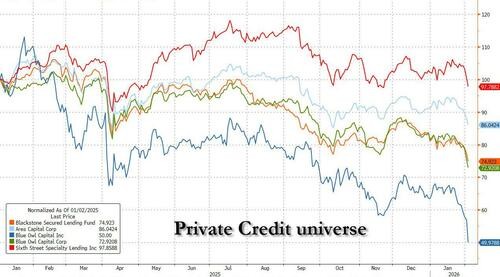
Wall Street analysts warn that the massive software debt held by BDCs could become a potential trigger for the next round of credit crisis, and this concern has begun to manifest in the market.
BDC, or Business Development Company, is an important component of the private credit market, specifically providing funding to small and medium-sized enterprises (typically private companies), holding a significant amount of debt from software companies (approximately 16% of their investment portfolios). As the software industry faces an unprecedented wave of sell-offs, BDCs are confronted with severe asset impairment risks.
According to a recent report released by JP Morgan credit analyst Kabir Caprihan on February 3, despite BDC management continuously assessing their exposure to the software industry over the past year, market sentiment has sharply deteriorated following recent declines in software loan prices and significant drops in BDC stock prices. Data from Goldman Sachs shows that the software sector has declined on 9 out of the past 12 trading days, testing critical support levels, and its long-term performance relative to the semiconductor sector has been an "epic disaster."

The reasons for this collapse primarily focus on the disruptive threat of artificial intelligence technology. Goldman Sachs clients pointed out that the new agent features launched by Anthropic and the decline in earnings per share (EPS) of some AI-related companies (such as Publicis and IT) have exacerbated market panic. Investors are concerned that AI could be the terminator for software companies, and this panic has severely impacted BDCs, which are viewed as major lenders in the software-as-a-service (SaaS) space, as if any slight disturbance could cause BDCs to "catch a severe cold."
While it is currently impossible to determine which companies will emerge as the ultimate winners or losers, JP Morgan believes that the BDC industry needs to undergo a stress-testing moment similar to that experienced by aviation leasing companies during the pandemic. As a "self-evident" story in the eyes of credit analysts and traders, BDCs are facing a critical moment where they must prove their risk resilience, and the market is reacting strongly to this.
$70 Billion Risk Exposure
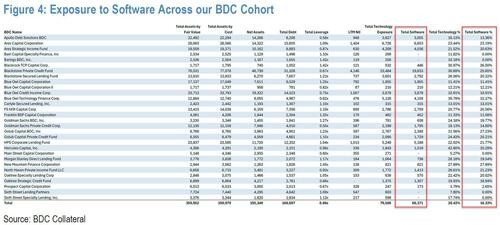
According to tracking data from JP Morgan, as of the third quarter of 2025, the total investment portfolio of the 30 BDCs they monitor is approximately $359 billion, with exposure classified as "software" amounting to about $70 billion, accounting for approximately 16%. When considering broader technology exposure, the total is around $80 billion.
The risk exposure varies significantly among institutions. The software exposure of the Blue Owl Technology Fund is as high as approximately 40%. Notably, in a subsequent updated report, JP Morgan pointed out that the software loans under Sixth Street BDC's TSLX account for as much as 31.68% of its total investment portfolio's fair value Some institutions show a deep reliance on the industry.
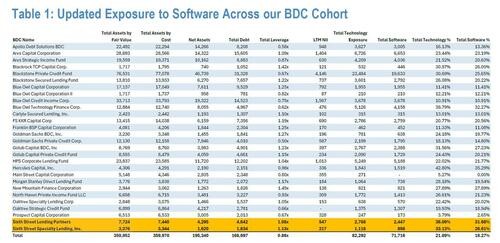
Although management has attempted to focus on investing in "mission-critical" software companies and has conducted bottom-up AI risk assessments of the portfolio, it remains difficult to define winners and losers. JP Morgan believes that it is currently impossible to determine whether AI is a bubble or the end of the software industry, but both extreme views are unsettling the market.
Extreme Stress Test: Asset Shrinkage in Worst-Case Scenarios
To assess potential impacts, JP Morgan conducted stress tests on the software portfolios of BDCs. In a simplified "33% rule" scenario (where 33% of companies default, 33% become zombie companies, and 33% survive), these 30 BDCs would face approximately $22 billion in losses, with total net assets decreasing by 11% and leverage rising from 0.86 times to about 1.0 times.
In a more severe "extreme scenario"—assuming a 75% default rate in the software industry and a recovery rate of only 10%—the entire industry would face cumulative net losses approaching $50 billion within a year, with book value diluted by 24%. Even in such extreme circumstances, most BDCs would maintain leverage below 2 times, with some institutions that initially had lower leverage (such as OTF) demonstrating strong resilience.
High-Risk Loans of Focus
The report also details specific software loan assets under pressure within BDC portfolios. JP Morgan analyzed the broadly syndicated loan (BSL) market and found that several software loans have seen significant discounts in the secondary market, contrasting sharply with the high valuations on BDC balance sheets.
Among them, Cornerstone OnDemand is one of the widely held risk assets, jointly held by six BDCs, with its TLB 1L loan price dropping about 10 points since November 2025, currently trading at around 83, while the average mark price for BDCs in the third quarter remains at 97. Additionally, Finastra's loan trading price has fallen to 88, well below the average mark price of 101.
Other notable large loans include Medallia ($1.8 billion loan, market mark around 80, but FSK marks it above 90) and Auctane ($1.3 billion loan). Cloudera's loan price has also recently dropped about 13 points, although its proportion in the NMFC and BCRED portfolios is relatively small. These price dislocations indicate that the asset impairment pressure on BDCs may just be beginning.
