


The worst since 2018! AMD dropped 17% during the session, is the earnings report guidance the culprit?

After releasing its financial report on Tuesday, AMD's stock price gapped down 11.2% on Wednesday, with intraday losses expanding to 17%, marking the largest decline since 2018. Despite the fourth-quarter performance exceeding expectations, the first-quarter revenue guidance fell short of analysts' expectations, leading to market disappointment. The median revenue guidance from AMD is approximately $9.8 billion, lower than some optimistic analysts' forecasts. Analysts pointed out that investors have doubts about AMD's competitiveness in the AI chip market, resulting in a significant drop in stock price
On the first trading day after releasing its earnings report post-market on Tuesday, AMD's stock price gapped down 11.2% on Wednesday, and by the end of the morning session, the intraday decline had expanded to over 17%, marking the largest intraday drop since October 2018. If the decline remains above 13% by the close, AMD will erase all price gains since entering 2026.
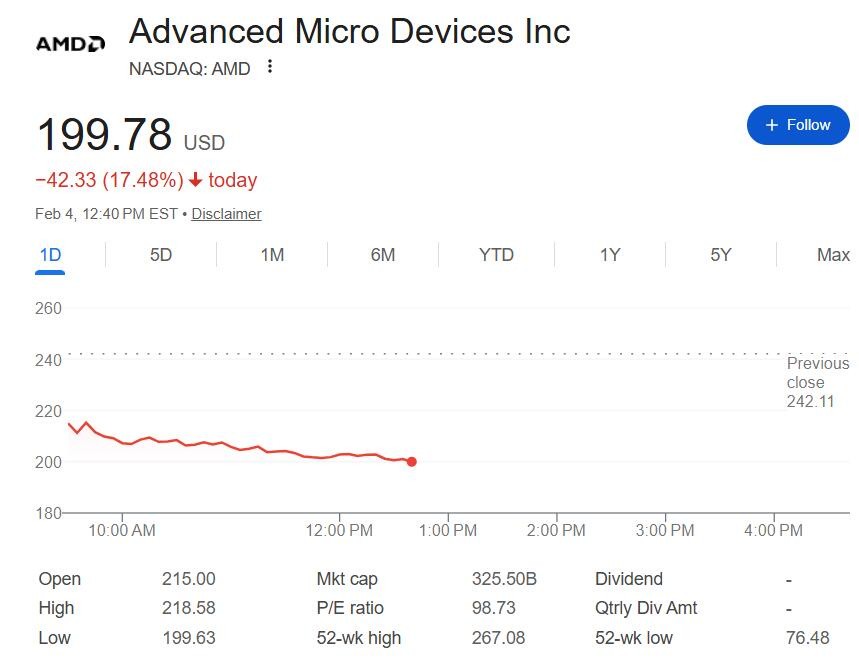
Overall, AMD's fourth-quarter performance exceeded Wall Street expectations, but why did the stock price plummet? Analysts believe part of the reason is that AMD's first-quarter revenue guidance did not meet some analysts' high expectations, and investors have doubts about AMD's ability to catch up with NVIDIA amid fierce competition in the AI chip market.
AMD's first-quarter revenue guidance median is approximately $9.8 billion, which, while higher than the nearly $9.4 billion consensus expectation from analysts, is lower than the record high revenue of $10.27 billion in the fourth quarter and does not meet the expectations of some optimistic analysts who anticipated revenue exceeding $10 billion.
This weak guidance disappointed the market, as investors had originally hoped to see greater returns amid the AI spending boom. At the same time, while AMD reported increased revenue from older chips sold in China, it negatively impacted profit margins. Bernstein analyst Stacy Rasgon stated, "Without the boost from the Chinese market, the overall performance actually did not exceed 'in line with expectations' by much," and pointed out that "short-term AI business data has not shown a real inflection point in growth."
This sharp decline also reflects that investors are reassessing valuations in the AI sector with a more cautious attitude. AMD is trading at a forward price-to-earnings ratio of 33.16 times, and at such a high valuation, any execution deviation could lead to severe adjustments.
Strong Earnings Performance but Unable to Alleviate Competitive Concerns
The earnings report showed that AMD's revenue in the fourth quarter of last year grew by 34% year-on-year to $10.3 billion, exceeding the analyst consensus expectation of $9.65 billion. The adjusted earnings per share (EPS) for the quarter was $1.53, nearly 16% higher than the analyst expectation of $1.32.
As a major beneficiary of AI spending, the data center business grew by 39% year-on-year to $5.38 billion in the fourth quarter, significantly surpassing the analyst expectation of $4.97 billion. Sales related to personal computers (PC) grew by 34% to $3.1 billion.
Media reports suggest that the competitive pressure AMD faces in the booming AI chip market is becoming increasingly pronounced. Tech giants are increasingly using custom AI chips, and Google's multi-billion dollar advanced processor supply agreement with Anthropic adds pressure on AMD.
AMD disclosed after the market on Tuesday that shipments of MI308 chips to Chinese customers generated $390 million in revenue in the fourth quarter, but it expects such sales to drop to about $100 million this quarter, indicating a weakening demand for this increasingly outdated product AMD stated that it is still seeking to sell the updated MI325 processor to China but has not yet obtained the relevant licenses.
Diverging Views Among Wall Street Analysts
Chris Rolland from Susquehanna said, "First of all, expectations are quite high. Secondly, they announced revenue from shipments to the Chinese market this quarter, which was unexpected. This was not within market expectations, so when you take that into account, the actual extent of the outperformance is not as large as we imagined."
However, Rolland pointed out that demand for AMD's data center chips remains strong, and the company has also hinted at several gigawatts (GW) of large contracts in the future.
AMD CEO Lisa Su maintained her usual optimistic tone during the earnings call, reiterating the company's forecast that AI revenue will reach tens of billions of dollars by 2027. She dismissed potential component shortage issues, stating that the company would be able to meet the expected increase in orders. She told analysts, "There is no doubt that demand remains strong. Therefore, we are working with our supply chain partners to increase supply."
Lisa Su stated that demand for next-generation AI servers, including shipments to OpenAI and other customers, is expected to accelerate significantly in the second half of this year.
AMD's recent agreements with OpenAI, Oracle, and the U.S. Department of Energy reflect the growing market interest in its MI series AI accelerators. In October last year, AMD reached an agreement with OpenAI, which may hold a 10% stake in AMD and will deploy 6 GW of AMD Instinct GPUs over several years. Oracle also announced plans to deploy 50,000 AMD AI chips starting later this year.
Decline or Buying Opportunity
Despite the sharp decline in stock price, some analysts believe this pullback may provide a buying opportunity for investors.
Market observer Thomas Hughes noted that AMD's post-earnings drop looks like a buying window that bulls want. Although the performance was better than consensus expectations, the whisper numbers' anticipated increase will not arrive until later this year.
According to MarketBeat tracking, the first batch of revised opinions includes numerous reiterations of ratings and target prices, as well as some future-focused target price increases. Future growth includes the launch of Helios rack-scale solutions in the second half of this year, which will significantly accelerate growth. Most analysts have set AMD's target price between $280 and $300, indicating a potential upside of 40% to 50% from key support levels, with the possibility of reaching new all-time highs.
Investor reactions to AMD's performance stand in stark contrast to Super Micro Computer (SMCI), which saw a significant rebound in stock price after its earnings report, rising nearly 17.8% in early trading on Wednesday.
Super Micro Computer raised its annual revenue guidance after hours on Tuesday, indicating continued strong demand for AI-optimized servers. This optimistic outlook highlights that downstream AI infrastructure spending remains robust, even as investors question the speed at which chip manufacturers can translate demand into short-term profit growth AMD is trading at a high valuation with a 40x forward price-to-earnings ratio, indicating that the market expects perfect execution of chip releases, infrastructure launches, and customer transactions. However, the key catalysts MI450 and Helios rack-scale solutions are still ahead, and their potential to drive the market is increasing day by day.
Risk Warning and Disclaimer
The market carries risks, and investment should be approached with caution. This article does not constitute personal investment advice and does not take into account the specific investment goals, financial situation, or needs of individual users. Users should consider whether any opinions, views, or conclusions in this article align with their specific circumstances. Investment based on this is at one's own risk
