


AI trading is more selective! Arm's performance exceeded expectations but still plummeted 8% after hours, with smartphone supply chain and memory constraints becoming the focus

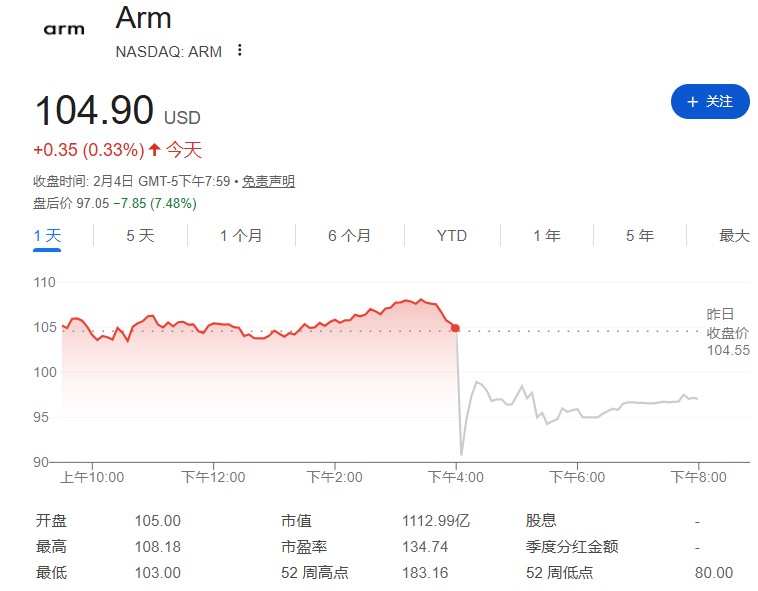
Arm's revenue and EPS for the third fiscal quarter both exceeded expectations, but due to licensing revenue falling short of expectations and Q4 guidance not meeting the market's highest expectations, the stock price plummeted over 8% in after-hours trading. At the same time, the company still faces pressure in the smartphone supply chain, and memory shortages remain severe. Although the CEO emphasized that the data center business will double in growth and major shareholder SoftBank has no intention of reducing its stake, market sentiment remains pressured by a reduced tolerance for high valuations
Despite delivering a report with revenue and profit both exceeding expectations, the stock price of British chip design giant Arm Holdings Plc fell more than 8% in after-hours trading on Wednesday.
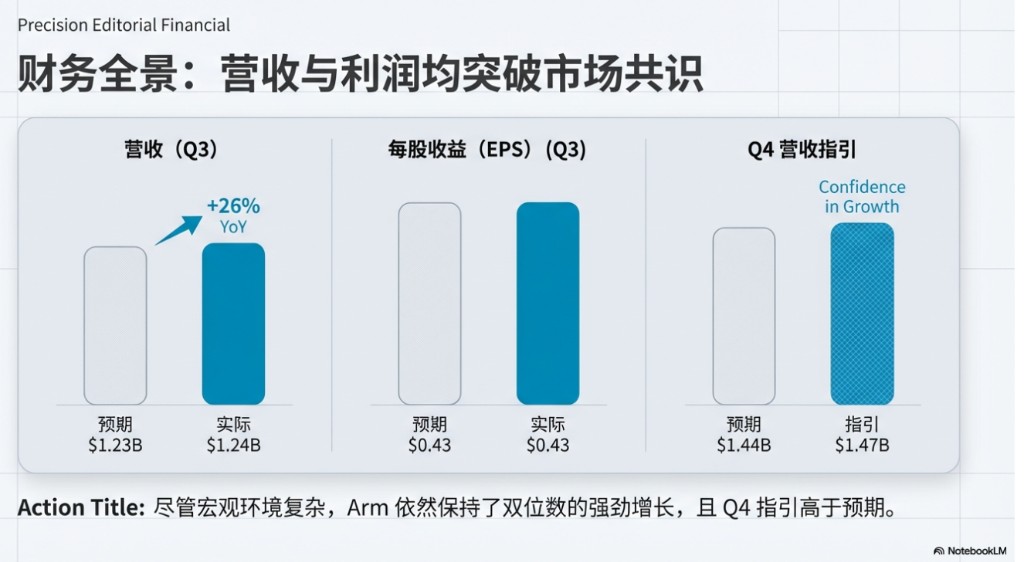
This drastic market reaction indicates that investors have significantly raised the bar for companies related to artificial intelligence. Arm reported a 26% year-on-year revenue growth in the third quarter to $1.24 billion, slightly above the analyst expectation of $1.23 billion; at the same time, the company's guidance for fourth-quarter revenue had a midpoint of $1.47 billion, also higher than the market average expectation of $1.44 billion. However, according to data compiled by Bloomberg, some optimistic buyers had expectations as high as $1.5 billion, and Arm's guidance clearly failed to meet the appetite of these most aggressive investors.
In addition to the extremely high demands for growth rates, market sentiment is also being suppressed by the outlook for the smartphone industry. As an important source of revenue for Arm, the smartphone market is facing dual pressures from a shortage of memory chips and slowing growth. Competitor Qualcomm also provided a weak performance outlook on Wednesday, further exacerbating market concerns about the fragility of demand recovery in mobile devices. Additionally, the "licensing revenue," a key indicator for measuring future design adoption rates, unexpectedly fell short of expectations this quarter, triggering the sell-off.
Licensing Fees "Unexpectedly" Miss Expectations
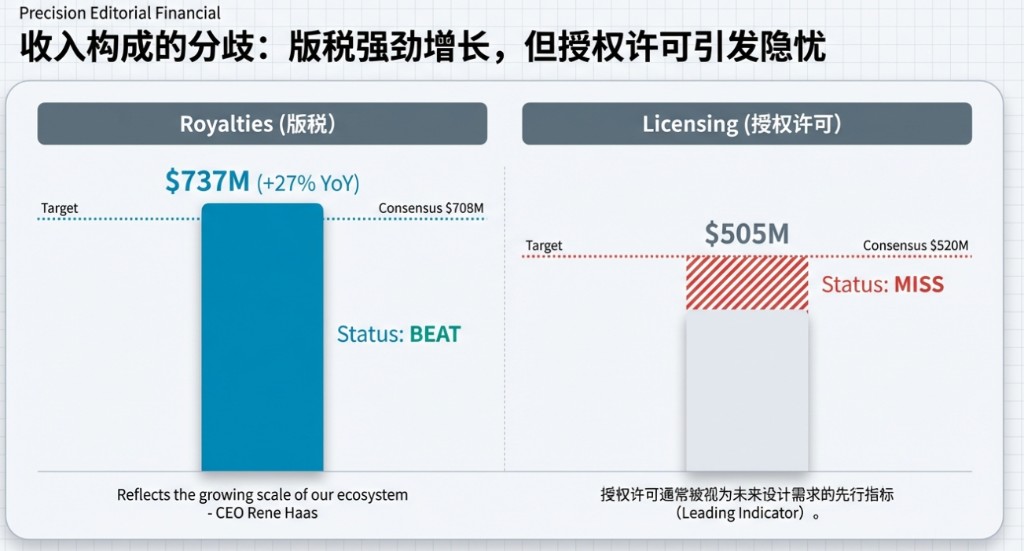
Arm's royalty revenue (charged per chip shipment) was $737 million, up 27% year-on-year, significantly exceeding the FactSet consensus expectation of $708 million.
However, "licensing and other" revenue was $505 million, below the market expectation of $520 million. Since licensing revenue is often related to customers' future product planning, the market was more sensitive to this gap in after-hours trading.
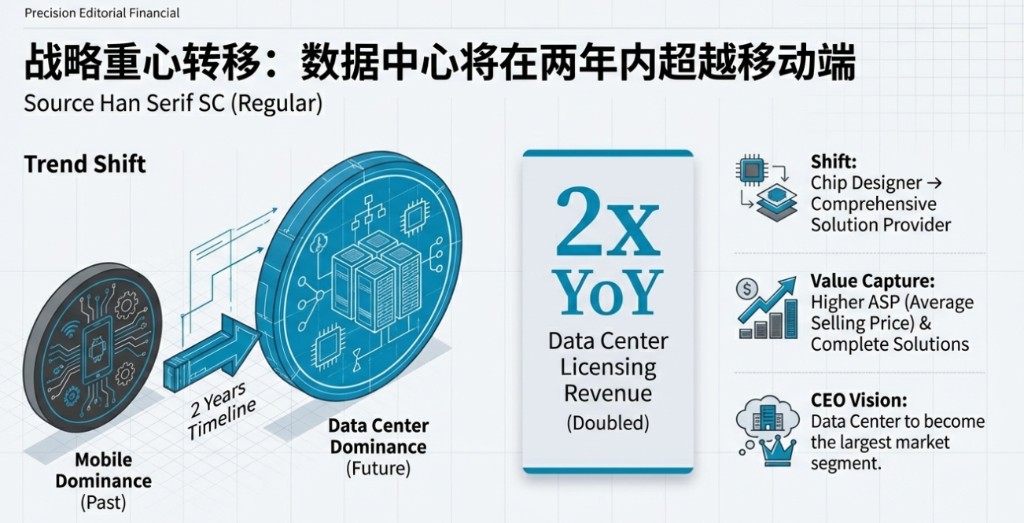
Bloomberg also noted that Arm disclosed that "data center-related product licenses doubled year-on-year," indicating that the company is accelerating its search for a second growth curve outside of mobile, but in the short term, smartphones remain an important revenue base.
Slowdown in Smartphones and Memory Shortages as Focus Variables
The company expects next quarter's revenue to be about $1.47 billion (midpoint), with adjusted EPS of $0.58, both higher than market average expectations. However, the market is more concerned about whether such an upward adjustment is sufficient to offset worries about the smartphone sector in an environment where AI narrative valuations are high and sentiment in the chip sector is weak.
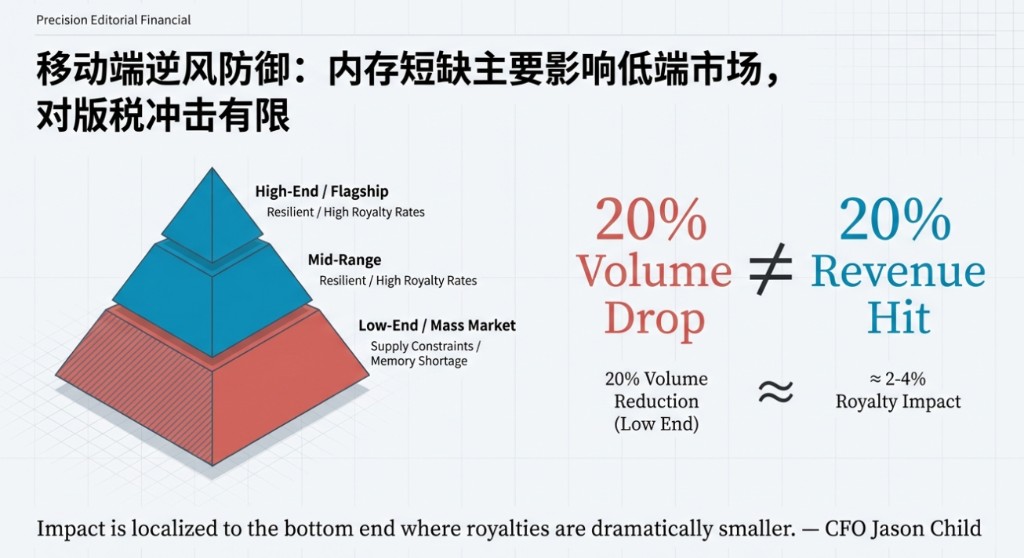
Arm also responded to concerns about "memory shortages/cost increases potentially suppressing the smartphone supply chain." CFO Jason Child stated during the conference call that supply chain constraints are more likely to first appear in low-end models:
"At the lowest end of the segmented market, we may feel the most supply chain constraints."
He also emphasized that the royalty levels corresponding to low-end products are lower, so the impact is controllable, and provided a stress test:
"If you assume our shipment volume decreases by 20% next year, converted to smart mobile royalties, the worst impact would be 2% to 4%."
This statement resonates with recent signals from the industry chain: high-end models are more inclined to "maintain configurations," while low-end models are more easily squeezed by supply and cost fluctuations.
Arm bets on CPU and data centers
In the AI narrative, Arm is trying to shift its growth focus from "AI in mobile phones" to "inference in data centers." Haas emphasized on the conference call that as AI shifts from training to inference, CPUs may benefit in certain scenarios, especially in "AI agent" applications:
"AI agents and conversations with AI agents... are very suitable for CPUs because CPUs are very power-efficient, always on, and have very low latency."
Bloomberg reported that Haas mentioned in an interview that the demand for Arm's designs in the data center market "exceeded expectations," but he was reluctant to provide a "vague" long-term growth target, preferring to maintain a conservative guidance tone and focus on execution. Meanwhile, the company expects data center customers to become its largest market in about two years.
SoftBank has no plans to reduce holdings
In response to previous speculation about major shareholder SoftBank Group possibly selling its stake, Haas reassured investors on the conference call. He clearly stated that he has communicated with Masayoshi Son.
"He (Masayoshi Son) assured me that he has no intention of reducing his holdings."
Currently, SoftBank still holds about 90% of Arm's shares. Although the management's stance is firm, considering AMD's recent severe drop, the worst in nearly nine years, and Qualcomm's weak guidance due to rising memory prices, Arm still needs to face the pressure of valuation reconstruction across the entire semiconductor sector in the future
