


Amazon conference call: $200 billion spending shocks stock price! Satellite project burns $1 billion in a single quarter, CEO defends "capacity equals monetization," AWS orders surge by 40%

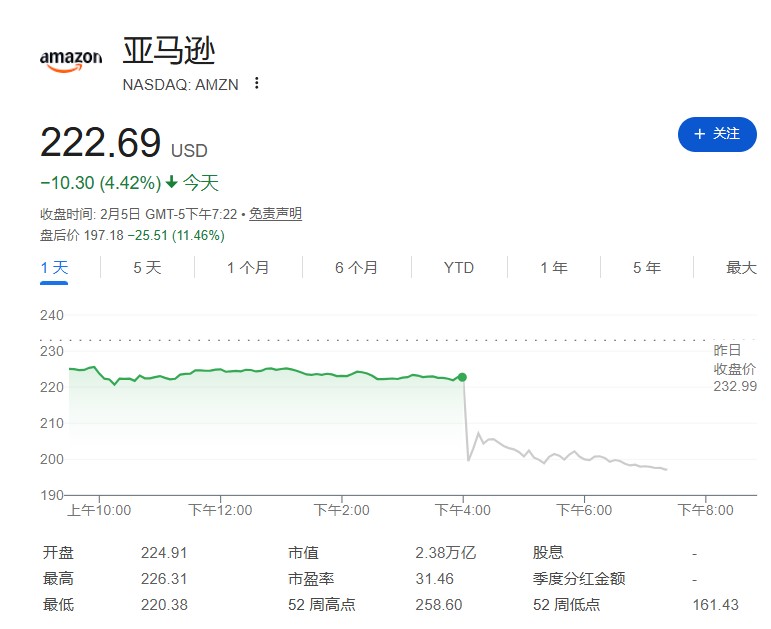
Despite AWS backlog orders surging 40% to $244 billion, the market was spooked by Amazon's projected capital expenditures of $200 billion in 2026, leading to an 11% drop in stock price after hours. The CFO warned that the low Earth orbit satellite project will incur an additional $1 billion in costs in Q1, severely dragging down profit guidance. However, the CEO defended that the massive investment is not a "Don Quixote-style fantasy," emphasizing that AI capacity "can be monetized as soon as it's installed," and betting on AI agents to reshape the e-commerce experience
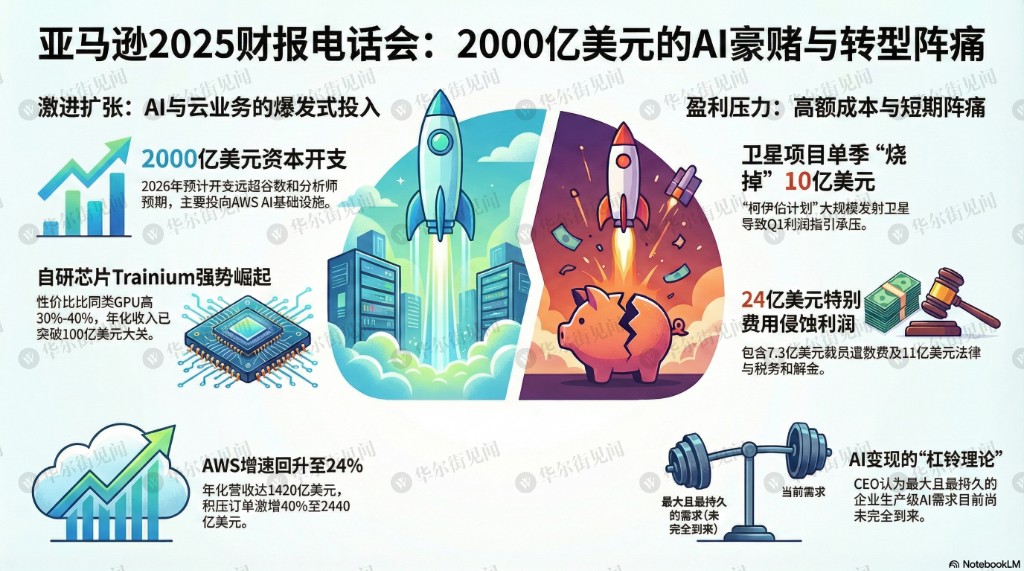
In the recently concluded Q4 2025 earnings call, despite Amazon AWS achieving its fastest growth in three years, the market was stunned by one number — an expected capital expenditure of approximately $200 billion in 2026. This figure is not only nearly 40% higher than analysts' expectations but also exceeds the recently announced cap of $185 billion by Google.
At a sensitive moment when U.S. tech stocks are experiencing "AI panic" and valuation cuts, Amazon's guidance triggered a dramatic after-hours stock price fluctuation of over 11%. However, during the hour-long conference call, Amazon's executive team, particularly CEO Andy Jassy, spent a significant amount of time justifying the necessity of such aggressive investments and released a wealth of incremental information regarding self-developed chips, AI monetization logic, and collaboration with OpenAI.
Where will the $200 billion be spent? "We are desperately installing capacity"
Andy Jassy made it clear that the vast majority of this $200 billion will be used for AWS, particularly for AI infrastructure. His core logic is: demand far exceeds supply, and there are no concerns about overcapacity.
Jassy candidly pointed out: "If you look at the capital we plan to spend this year, the vast majority is in AWS... because we have extremely high demand, customers really want AWS to handle core and AI workloads, and we are monetizing capacity at the fastest installation speed."
He attempted to reassure investors about return on invested capital (ROIC) by referencing AWS's early success:
"We have years of experience predicting demand signals in AWS... This is not some sort of quixotic topline grab. We are confident that these investments will yield strong capital returns. We have achieved this in our core AWS business, and I am very confident we can do the same here."
A veiled jab at Nvidia? "Monopolists are not in a hurry to lower prices because they have other priorities"
A highlight of the call came when discussing chip costs. Although Jassy did not name names directly, he sharply pointed out the pain points in the current AI chip market — they are too expensive, and suppliers lack the incentive to lower prices. This became the best reason for Amazon to vigorously promote its self-developed chip, Trainium (training chip).
Jassy stated:
"Customers are extremely eager for better cost-performance ratios. Typically, and understandably, those dominant early leaders are not in a hurry to achieve this goal (lower prices). They have other priorities. That's why we are building our own custom chip, Trainium, and it has really taken off. **”
Data shows that Amazon's self-developed chip business (including Graviton and Trainium) has an annualized revenue exceeding $10 billion, and is growing at a triple-digit percentage.
-
Trainium 2: Over 1.4 million chips have already been deployed, making it the fastest ramp-up chip in Amazon's history.
-
Trainium 3: Just launched, it is 40% more cost-effective than the previous generation, and it is expected that by mid-2026, the supply will be "almost fully booked."
Relationship with Anthropic and OpenAI: Not just customers, but part of the ecosystem
Regarding the highly anticipated collaboration between Amazon and Anthropic—Project Rainier, Jassy revealed that progress is going smoothly, with Anthropic building their next large model on Trainium 2, involving the use of 500,000 chips.
Interestingly, despite Amazon's strong support for Anthropic, Jassy also addressed the partnership with OpenAI. He confirmed the agreement announced last November and stated:
“This AI movement will not belong to just a few companies. Over time, it will belong to thousands of companies.”
Satellite Project: $1 billion burned in a single quarter drags down guidance
If AI spending is a long-term investment, then the "Project Kuiper/Amazon Leo" is a short-term profit killer. The CFO disclosed a surprising figure while interpreting the Q1 performance guidance.
“In the North America division, we expect costs related to Amazon Leo to increase by about $1 billion year-over-year.”
The CFO explained that Amazon plans to conduct more than 20 satellite launches in 2026 and over 30 in 2027.
Since most current manufacturing and launch service costs are expensed as incurred, this directly puts pressure on the Q1 operating profit guidance ($16.5 billion - $21.5 billion). This is also one of the most direct reasons for the market's bearish sentiment following the earnings report.
Layoffs and Lawsuits: $2.4 billion in costs "devour" profits
Regarding the market's concern over Amazon's large-scale layoff plan affecting tens of thousands of employees, the CFO confirmed three special expenses included in the Q4 earnings report, totaling a reduction of $2.4 billion in operating profit, which includes $730 million in severance costs.
-
$1.1 billion: For resolving tax disputes in Italy and a lawsuit settlement.
-
$730 million: Estimated severance costs. This directly confirms that Amazon is still undergoing layoffs and personnel restructuring without much publicity.
-
$610 million: Impairment of physical store assets.
Cloud business back on track, backlog orders surge 40%
Setting aside controversies over capital expenditures, layoffs, and the "burning money" of satellite projects, AWS's fundamentals are strong. Q4 revenue grew 24% year-over-year to $35.6 billion, with an annualized run rate of $142 billion.
Even more noteworthy is the backlog data: $244 billion, a year-over-year increase of 40%. This indicates a high level of revenue certainty in the future.
Brian Olsavsky (CFO) added that AWS's operating profit margin reached 35%, an increase of 40 basis points year-over-year. Although future depreciation and AI investments may pose headwinds, efficiency improvements are offsetting these costs.
AI reshaping e-commerce retail: Betting on "agentic shopping"
In addition to the cloud business, AI's penetration into e-commerce is also a focus. Jassy praised the company's AI shopping assistant Rufus, stating that 300 million customers have used it, and customers who have used Rufus have a 60% higher purchase conversion rate.
He even used a metaphor to explain why businesses need to inject private data into model pre-training at this stage, for which Amazon launched Nova Forge:
"It's a bit like teaching a child a foreign language when they are very young. This will become part of their foundation for future learning and make it easier for them to learn other languages later."
In response to concerns that external general AI (such as ChatGPT) might siphon off e-commerce traffic, Jassy introduced the concept of "agentic shopping" and believes that consumers will ultimately choose the retailer's own AI agents.
"Consumers want a wide selection, low prices, fast delivery, and trust. Horizontal agents excel at aggregation, but retailers are better at delivering on these four points."
On the "barbell theory" of AI monetization: The biggest gains are yet to come
In response to analysts' questions about whether the "AI market is top-heavy" (mainly driven by a few large model vendors burning cash), Jassy presented a very vivid "barbell market" perspective.
He believes that current AI demand is "barbell-shaped": on one end are AI labs like Anthropic, consuming massive amounts of computing power for training; on the other end are numerous companies working on productivity and cost optimization (such as customer service automation).
"And in the middle of this barbell are all the enterprise production workloads... I believe this part is likely to become the largest and most enduring piece of the pie."
Jassy emphasized that while AI demand has reached an "incredible" level, " the vast majority of demand is still in the middle of the barbell and has yet to arrive." Amazon believes that AI growth is just beginning.
 Amazon Q4 2025 Earnings Call Transcript Translation:
Amazon Q4 2025 Earnings Call Event Date: February 5, 2026 Company Name: Amazon Event Description: Q4 2025 Earnings Call
Speaker Segment
Operator: Thank you for your patience. Hello everyone, and welcome to Amazon's Q4 2025 financial performance earnings call. Currently, all participants are in listen-only mode. After the presentation, we will conduct a Q&A session. Today's meeting will be recorded. Now, I will turn the call over to Mr. Dave Fildes, Vice President of Investor Relations. Thank you, and please go ahead.
Dave Fildes, Vice President of Investor Relations: Hello everyone, and welcome to our Q4 2025 financial performance earnings call. Joining us today to answer your questions are: CEO Andy Jassy and CFO Brian Olsavsky.
As you listen to today's call, we recommend referring to our press release, which contains the financial performance, metrics, and commentary for this quarter. Please note that unless otherwise stated, all comparative data in this call is against the results from the same period in 2024.
Our comments today and responses to your questions reflect management's views as of today (February 5, 2026) and will include forward-looking statements. Actual results may differ significantly. More information about factors that could affect our financial performance is included in today's press release and in our filings with the U.S. Securities and Exchange Commission (SEC), including our most recent 10-K annual report and subsequent filings.
During this call, we may discuss certain non-GAAP financial metrics. Additional disclosures regarding these non-GAAP metrics, including reconciliations to comparable GAAP metrics, can be found in our press release, the accompanying slides for this webcast, and our filings with the SEC (all available on our Investor Relations website).
Our guidance incorporates the order trends we have seen to date and assumptions we currently believe are appropriate. Our performance itself is unpredictable and may be significantly affected by many factors, including fluctuations in exchange rates and energy prices, changes in global economic and geopolitical conditions, tariffs and trade policies, fluctuations in resources and supply (including storage chips), changes in customer demand and spending (including concerns about economic recession, inflation, interest rates, regional labor market constraints, world events), internet growth rates, online commerce, cloud services, and the impact of emerging technologies, as well as various factors detailed in our filings with the SEC.
Our guidance assumes (among other things) that we will not achieve any additional business acquisitions, restructurings, or legal settlements. We cannot accurately predict demand for our goods and services, and therefore, our actual results may differ significantly from our guidance Now, I will hand the meeting over to Andy.
Andy Jassy, President and CEO: Thank you, Dave. Our reported revenue is $213.4 billion, a year-over-year increase of 12% (excluding currency effects). Operating income is $25 billion, and free cash flow for the past 12 months is $11.2 billion.
We are seeing strong growth, and with the emergence of incremental opportunities in areas such as artificial intelligence (AI), chips, low Earth orbit satellites, quick commerce, and meeting the everyday essential needs of more consumers, we have the opportunity to make Amazon a more meaningful business and achieve strong returns on invested capital in the coming years, and we are investing for that. Even though we are still in the early stages, we have already seen strong demand in these areas.
Let's start with AWS. The growth of AWS continues to accelerate to 24%, the fastest growth rate we have seen in the past thirteen quarters, with a quarter-over-quarter increase of $2.6 billion and a year-over-year increase of nearly $7 billion. AWS now has an annualized revenue run rate of $142 billion, while our chip business (including Graviton and Trainium) now has an annual revenue run rate exceeding $10 billion, with year-over-year growth reaching triple digits.
I want to remind everyone that achieving 24% year-over-year growth on an annualized run rate of $142 billion is fundamentally different from our competitors achieving higher percentage growth on a significantly smaller base. We are adding more incremental revenue and capacity than anyone else and continue to expand our lead. As businesses refocus on migrating infrastructure from on-premises to the cloud, we are seeing strong growth in core non-AI workloads. At the same time, AWS has the broadest set of features, the strongest security and operational performance, and the most active partner ecosystem.
AWS continues to win the cloud transformation projects of most large enterprises and governments. Since our last earnings call, we have announced new agreements with numerous institutions, including OpenAI, Visa, NBA, BlackRock, Perplexity, Lyft, United Airlines, DoorDash, Salesforce, the U.S. Air Force, Adobe, Thomson Reuters, AT&T, S&P Global, National Bank of Canada, London Stock Exchange, Choice Hotels, Accenture, Indeed, HSBC, CrowdStrike, and many others. Among the top 500 startups in the U.S., the number using AWS as their primary cloud provider exceeds the total of the next two providers combined.
We are adding a significant amount of EC2 core computing capacity every day, most of which is powered by our custom CPU chip Graviton. Graviton offers a cost-performance advantage of 40% over leading x86 processors and is widely used by over 90% of AWS's top 1,000 customers Graviton itself is a business with an annualized run rate of several billion dollars, with a year-over-year growth of over 50%.
We consistently see customers wanting to run their AI workloads where they run the rest of their applications and data. We also find that when customers run large AI workloads on AWS, they simultaneously increase their usage of core AWS services. However, the biggest reason AWS continues to gain market share in AI is that we have a unique and extensive, bottom-up AI stack capability. In the field of AI, we are doing what we have always done at AWS: solving customer challenges. Let me give a few examples.
The first challenge is having a strong foundational model to generate inferences or predictions. As customers delve deeper into applying AI, they realize the need for choice, as different models perform better on different dimensions. In fact, most complex AI applications leverage multiple models. Whether customers want cutting-edge models like Anthropic's Claude, open models like Llama, or cutting-edge intelligent models like Amazon Nova that have lower costs and latency, or video and audio models like 12 Labs or Nova Sonic, Amazon Bedrock allows customers to easily use these models to run inferences in a secure, scalable, and high-performance manner. Bedrock now has an annualized run rate of several billion dollars, with customer spending increasing by 60% quarter-over-quarter.
The second challenge is how to fine-tune models for your applications. Customers sometimes think that as long as there is a good model, there will be a good AI application. This is not entirely correct. Post-training and fine-tuning models for applications require a lot of work. Our SageMaker AI services, along with fine-tuning tools and Bedrock, make this work easier for customers.
The third challenge is how to have a customized version of a foundational model that best utilizes the company's "secret sauce" (i.e., its own data). So far, companies typically try to leverage their own data to shape the model later in the process (usually through fine-tuning or post-training). There is debate in the industry about this, but we believe that companies would prefer to use their own data to train the model as early as possible in the pre-training phase if feasible. This way, the model has the best foundation for learning and evolving based on what is most important to each business. It's a bit like teaching a child a foreign language when they are very young. It becomes part of their foundation for future learning and makes it easier for them to learn other languages later on.
To address this need, we have just launched Nova Forge, which provides customers with early checkpoints of the Amazon Nova model, allowing them to safely mix their proprietary data with model data during the pre-training phase and enable their own unique Nova customized version — which we call "Novellas," meaning training with their data early in the process This is very useful for building model-based agents. Currently, there are no other similar products on the market, which could be a game changer for companies.
Another challenge is cost. I have said many times that if we want AI to be widely used as companies hope, we must reduce inference costs. A significant barrier at present is the cost of AI chips. Customers are eager for better cost-performance ratios, but it is often understandable that the dominant early leaders are not in a hurry to achieve this, as they have other priorities. This is why we built our own custom chip, Trainium, and it has indeed taken off.
We have delivered over 1.4 million Trainium2 chips, which is our fastest chip release in terms of capacity increase ever. Trainium2 offers a cost-performance ratio that is 30% to 40% better than comparable GPUs, representing a business with an annualized revenue run rate in the billions, with over 100,000 companies using it, as Trainium is currently the main support for Bedrock usage.
We recently launched Trainium3, which has a cost-performance ratio 40% better than Trainium2. We are seeing very strong demand for Trainium3, and we expect that nearly all of the Trainium3 chip supply will be booked out by mid-2026. While we are still building Trainium4, we have already seen very strong interest.
Looking ahead, the main way companies will derive value from AI will be through agents, some of their own and some from others, and there are several customer challenges in this area that we are well-positioned to address. Building agents is harder than it seems. To this end, we built Strands, a service that can create agents from any model.
Once the agents are built, businesses are concerned about deploying them into production environments, as these agents need to connect securely and scalably to compute, data, tools, memory, identity, policy governance, performance monitoring, and other elements. This is a new puzzle that had no solution until we launched Bedrock AgentCore. Customers are very excited about AgentCore and its ability to unlock deployments.
Customers also want to leverage other useful agents, and we have built several, including agents for programming, Amazon Q for knowledge workers to utilize their own data and analytics, AWS Transform for software migration, and Amazon Connect for call center operations. We continue to add new features, and usage continues to grow rapidly. For example, the number of developers using Amazon Q grew by over 150% quarter-over-quarter In addition to customer-guided agents, customers are also excited about agents that require less human interaction. They can operate fully autonomously, running for hours or days, scaling quickly, and remembering context. At the recent AWS re:Invent conference, we introduced Frontier Agents to achieve this. Autonomous agents for coding tasks, AWS DevOps agents for detecting and resolving operational issues, and AWS security agents for proactively protecting applications throughout the development lifecycle have already brought significant changes to our customers.
We expect to invest approximately $200 billion in capital expenditures at Amazon, primarily for AWS, as we have extremely high demand, and customers really want to use AWS for core and AI workloads. We are installing and monetizing this capacity as quickly as possible. We have deep experience in understanding the demand signals of the AWS business and converting that capacity into strong returns on investment capital. We are confident this will be the case again.
Next, let's talk about the Stores business. We continue to expand our selection, including over 400 new beauty brands in the U.S. by 2025, such as Bobby Brown Cosmetics, Charlotte Tilbury, and Laura Mercier, as well as new fashion brands like Away Luggage, Converse, Diesel, Michael Kors, Nike, and The North Face. Our ultra-low-price product Amazon Haul has increased the selection of items under $10 to over 1 million and expanded to serve customers in more than 25 countries and regions.
We continue to see strong customer response to everyday essentials and groceries. By 2025, the growth rate of everyday essentials in the U.S. is nearly double that of all other categories, accounting for one-third of all items sold in our stores. We have become the preferred grocery destination for over 150 million Americans, primarily through online shopping and Whole Foods. With total sales exceeding $150 billion, Amazon has clearly become a major grocery retailer at this point.
Customers in thousands of towns across the U.S. can now access same-day delivery of fresh groceries, as well as millions of other items. Customers using this service shop more than twice as frequently as those who do not. We plan to expand to more communities in 2026 and plan to open over 100 new Whole Foods stores in the coming years, committed to making grocery shopping easier, faster, and more affordable for customers. We remain dedicated to maintaining our price advantage and continue to meet or beat the prices of other retailers. A recent study shows that Amazon has been the lowest-priced retailer in the U.S. for the ninth consecutive year, averaging 14% lower than other major online retailers In 2025, we achieved the fastest delivery speed ever for global Prime members. In the United States, the number of items delivered on the same day increased by nearly 70% compared to the previous year. We also continued to improve delivery speeds for rural customers, with the average monthly number of customers receiving same-day delivery services in rural areas nearly doubling year-on-year. Same-day delivery is our fastest-growing delivery service, with nearly 100 million customers in the U.S. using it last year, and the team continues to innovate.
We launched Amazon Now in India, Mexico, and the UAE, providing ultra-fast delivery of thousands of items in about 30 minutes or less, and we are testing it in several communities in the U.S. and the UK. Although it is still in the early stages, customers love it. For example, in India, customer response has exceeded our most optimistic expectations, and we see that once Prime members start using it, their shopping frequency doubles.
Expanding our same-day delivery coverage also means significantly extending order cutoff times, which is significant for customers. For example, on Christmas Eve, customers in about 4,000 cities in the U.S. can order items before noon and receive them the same day.
Another example is our recently launched "Add to Delivery" feature, which allows Prime members in the U.S. to add items to their upcoming Amazon delivery with just a tap, without having to check out again or pay additional shipping fees. Just six months after its launch, "Add to Delivery" accounted for about 10% of all Prime orders fulfilled on the Amazon network each week. While it may seem simple on the surface, there is a lot of invention behind this feature, as we need to determine in real-time and with extremely low latency which of Amazon's hundreds of millions of products can be added to the customer's upcoming delivery, showcase them, find ways to include them in the package, and deliver them within the same customer commitment time.
The store team is also continuing to innovate and leverage AI to serve customers. Our AI shopping assistant Rufus is rapidly expanding. Rufus can research products, track prices, and purchase items in our store when they reach a set price. It can now also shop and make purchases for customers in tens of millions of other online stores through our Agentic Buy for Me feature. Last year, over 300 million customers used Rufus. Additionally, the number of times customers used Lens (our AI visual search tool that finds products through mobile camera, screenshots, or barcodes) increased by 45% year-on-year.
Next, let's talk about Amazon Ads. We are pleased with the continued strong growth of our full-funnel products, generating $21.3 billion in revenue this quarter, a year-on-year increase of 22%. Sponsored Products ads in our store remain our largest advertising product, combining trillions of shopping, browsing, and streaming signals with advanced AI and machine learning, enabling us to provide highly relevant and useful ads to customers
We have seen continuous growth in Prime Video advertising, which has now launched in 16 countries/regions and has made a meaningful contribution to our revenue growth. The global average ad-supported audience for Prime Video is 315 million viewers, up from 200 million at the beginning of 2024.
Our advertising team is also innovating using AI. We recently announced Ads Agent, which allows brands to use AI to create and optimize advertising campaigns at scale, implement effective ad targeting, and quickly generate actionable insights. Our Creative Agent enables advertisers to leverage conversational guidance and Amazon's retail data to research, brainstorm, and generate full-funnel advertising campaigns from concept to completion, reducing a process that used to take a week to just a few hours.
We are continuing to invent and see momentum in several other areas, and I will mention a few examples. First is live sports on Prime. The fourth season of Thursday Night Football has broken more records. This is our highest-rated season ever, with an average viewership of over 15 million, a 16% year-over-year increase, achieving double-digit growth for the third consecutive year. The wildcard game between the Packers and the Bears was the highest-streamed NFL game in history, with 31.6 million viewers, surpassing the previous record by over 4 million.
We have just launched Alexa+ to all customers in the U.S., free for Prime members and $19.99 per month for non-Prime members. Alexa+ continues to get better and stronger, and we have added new ways to interact with Alexa, including a new chat experience on Alexa.com, a redesigned mobile app, and new integrations with third-party devices like Samsung TVs and BMW cars. We have also added new features, such as answering Ring doorbells on behalf of customers and more ways to shop or manage the home.
Finally, the team has made rapid progress on Amazon Leo (note: the original text refers to Leo, which corresponds to the low Earth orbit satellite project known in reality as Project Kuiper), which will bring connectivity to consumers, businesses, and governments in areas without broadband access. Our enterprise-grade customer terminal, Leo Ultra, is the fastest satellite internet antenna ever, capable of providing synchronous download speeds of up to 1Gbps and upload speeds of up to 400Mbps. Leo will offer enterprise-grade performance and advanced encryption, bypassing the public internet through a secure dedicated network directly connected to AWS. We have launched 180 satellites and plan to conduct over 20 launches in 2026, **with more than 30 in 2027, and we expect to have a commercial launch in 2026. We have signed dozens of commercial agreements, including agreements with AT&T, DirectTV Latin America, JetBlue, and the National Broadband Network of Australia, with more agreements in progress **
This is a year full of innovation and progress, and we are already moving at full speed into 2026. Next, I will hand over the meeting to Brian for the financial update.
Brian T. Olsavsky, Senior Vice President and Chief Financial Officer: Thank you, Andy. First, let's start with our revenue financial results. Global revenue was $213.4 billion, an increase of 12% year-over-year, excluding a favorable impact of 150 basis points from exchange rates.
In the fourth quarter, we reported global operating income of $25 billion. This operating income includes three special charges that reduced operating income by $2.4 billion. The first charge was $1.1 billion related to tax disputes and litigation settlements concerning our Italian store operations. This charge primarily impacted our international segment and was mainly recorded in fulfillment and other operating expenses. The second charge was $730 million for anticipated severance costs. This charge affected all three of our segments and was mainly recorded in fulfillment, sales and marketing, and technology and infrastructure expense items. The third charge was $610 million for asset impairment, primarily related to physical stores. This charge mainly impacted our North America segment and was reported in other operating expense items.
Next, let's look at segment performance. In the North America segment, fourth-quarter revenue was $127.1 billion, an increase of 10% year-over-year. International segment revenue was $50.7 billion, an increase of 11% year-over-year (excluding the impact of exchange rates). Global paid units grew by 12% year-over-year, marking our highest quarterly growth rate for 2025.
The fourth quarter capped off the year strongly, as we delivered to customers during the holiday peak. Our sharp pricing, rich selection, and record-fast delivery speeds resonated with customers. They appreciated the convenience of receiving items quickly, from gifts for family and friends to everyday essentials and fresh groceries. Our millions of third-party sellers worldwide continue to be significant contributors to our broad selection. In the fourth quarter, third-party seller units accounted for 61% globally. We continue to invest in tools and services, including a comprehensive set of AI tools to help our selling partners manage and grow their businesses.
Turning to profitability, the North America segment's operating income was $11.5 billion, with an operating margin of 9%, up from 8% in the fourth quarter of 2024. The international segment's operating income was $1 billion, with an operating margin of 2.1%. Excluding the impact of the aforementioned special charges, the international segment's operating margin also achieved year-over-year growth.
We are satisfied with the performance of our fulfillment network throughout the peak season. Over the past few years, we have made significant progress in improving the cost structure of our network. In the U.S., our regionalized network is operating at scale, and we continue to make improvements. This regionalization has improved local inventory allocation, resulting in faster delivery and lower costs. Last year, U.S. Prime members received over 8 billion items delivered the same day or the next day, an increase of over 30% year-over-year, with groceries and everyday essentials accounting for half of the total
In 2025, we achieved the fastest delivery speed for Prime members globally for the third consecutive year while also reducing service costs. By leveraging our existing U.S. network, we can now provide fresh grocery delivery to customers in over 2,300 towns, all with same-day delivery. This year, we saw significant adoption of the service throughout the process. When customers use our fresh service, their monthly spending is noticeably higher than that of customers who do not purchase in this category. We also observed that customers buying fresh groceries added three times more items to their same-day delivery orders.
Looking ahead, we see opportunities to further enhance the productivity of our global fulfillment network while providing customers with faster speeds. We will continue to optimize inventory placement to reduce transportation distances, minimize package touchpoints, improve package consolidation, and introduce robotics and automation technologies to enhance efficiency and improve customer experience.
Moving to the advertising business. Advertising revenue grew by 22% in the fourth quarter, adding over $12 billion in incremental revenue in 2025 alone, as our full-funnel advertising approach connecting brands with customers is resonating. We are simplifying the advertiser experience, enabling brands to better reach customers anywhere.
Next is the AWS segment, with revenue of $35.6 billion, accelerating year-over-year growth to 24%. We achieved a quarter-over-quarter revenue growth of $2.6 billion, and AWS now has an annualized revenue run rate of $142 billion. This acceleration is driven by core services and AI services, as customers continue to modernize their infrastructure and migrate workloads to the cloud. Our AI products continue to resonate with customers, including our agent capabilities. This growth is partly due to our addition of over 1 gigawatt (GW) of capacity in the fourth quarter. In 2025, AWS added more data center capacity than any other company in the world.
AWS operating income was $12.5 billion. While we are seeing strong revenue growth, we remain focused on improving efficiency across the business. This includes investing in software and process improvements to optimize server capacity, developing more efficient networks using our low-cost custom network devices, and advancing custom chips. Meanwhile, we continue to rapidly develop products and services on behalf of our customers. As we have long stated, we expect AWS's operating margin to fluctuate over time, partly depending on our investment levels at any given point.
Turning to cash flow, our full-year operating cash flow increased to $139.5 billion, a year-over-year increase of 20%, primarily due to improved operating income and changes in working capital.
Now turning to our financial guidance for the first quarter. Net sales are expected to be between $173.5 billion and $178.5 billion for the first quarter. This guidance anticipates a favorable impact of approximately 180 basis points from exchange rates. Just a reminder, global currencies may fluctuate during the quarter. Operating income for the first quarter is expected to be between $16.5 billion and $21.5 billion
Regarding the operating profit guidance, there are a few points to mention. In the North America segment, we do expect costs associated with Amazon Leo (the satellite project) to increase by approximately $1 billion year-over-year. We plan to conduct more than 20 launches in 2026 and more than 30 in 2027, which means our spending on satellite launches is increasing each year. Selected enterprise customers are currently testing the Amazon Leo service, and we expect a broader commercial rollout later this year. Just a reminder, we are currently treating most of the Leo costs as incurred expenses. We expect that later this year, many of these costs (such as satellite manufacturing and launch services) will be capitalized.
In the international segment, we continue to increase our investment in store operations to enhance customer experience and encourage retail demand to shift online more quickly. This includes bringing faster delivery options, including the Amazon Now service that delivers to customers in 30 minutes or less. We also strive to maintain sensitivity to pricing and seller fees, and in some countries, we have had to take more aggressive measures to meet or beat competitor pricing. We like these investments because they satisfy customers, grow our business, and we believe they will generate long-term positive returns on invested capital.
As we enter 2026, I feel energized by the strong execution of our team. I want to thank all employees across the company for their hard work on behalf of our customers. We remain focused on driving a better customer experience, which is the only reliable way to create lasting value for our shareholders.
With that, let's move into the Q&A session.
Q&A Session
Operator: We will now open the line for questions. (Operator instructions) Our first question comes from Mark Mahaney of Evercore ISI. Please go ahead.
Mark Stephen Mahaney, Analyst: Okay, thank you. Brian, this question I want to direct to you or Andy. Regarding the strong long-term return on invested capital (ROIC), I think this is a point of debate in the market right now. Can you help us understand how you think investors will see this? Can you talk about the duration of the capital expenditure (CapEx) cycle you are experiencing, or what we should expect to see in terms of profitability? Or you could also discuss other minimum free cash flow generation levels that you do not want to fall below while going through this CapEx cycle. Please help us understand your confidence level in achieving strong long-term returns on invested capital. Thank you.
Brian T. Olsavsky, Senior Vice President and Chief Financial Officer: Okay, Mark. Thank you. I'll start with the financial aspect. Regarding the investments we are making, as Andy mentioned earlier, all the capacity we are gaining is being put into customer service and is having an immediate impact. We are also seeing long-term incremental revenue from other customers as well as backlog orders and commitments (people are eager to strike deals with us, especially for AI services) So you can see the impact on our profit and loss statement (P&L), reflected both through capital expenditures and the operating profit margin of AWS. The operating profit margin for AWS in the fourth quarter was 35%, an increase of 40 basis points year-over-year. As we discussed earlier, this will fluctuate over time. Of course, AI investments and the depreciation of that capital expenditure will create headwinds. But we are also working to offset this impact through efficiency improvements and cost reductions. So we will observe its development over time. But yes, we are seeing strong returns on invested capital. Clearly, the demand for these services is strong, and we remain optimistic about investments in this area.
Andy Jassy, President and CEO: I want to add that if you look at the capital we are spending and plan to spend this year, primarily in AWS, part of it is for our core workloads (i.e., non-AI workloads), as their growth is faster than we expected. But most of it is in the AI field, where we have tremendous growth and demand. When you are growing 24% year-over-year on an annualized revenue run rate of $142 billion, the growth is substantial. What we continue to see is that the speed at which we install this AI capacity is matched by the speed at which we monetize it. So this is a very rare opportunity. As I have shared multiple times, I firmly believe that every customer experience we know today will be reshaped by AI, and a whole new set of customer experiences that we have never imagined will become the norm in our daily operations and usage. I think another thing is that if you really want to use AI broadly, you need to put data in the cloud and put applications in the cloud. These are all significant tailwinds driving people to the cloud. So we will invest actively here, and we will invest to maintain our leadership in this area, just as we have done over the past few years.
Regarding forecasting demand signals and operating in a way that does not waste capacity while having enough capacity to meet demand, I think we have accumulated quite a bit of experience in AWS over the years. I believe we have proven this through AWS over the years in how to build data centers, how to operate them, and how to innovate within them (if you think about our chips and hardware, networking equipment, and our innovations in power). This is not some sort of unrealistic revenue grab. We are confident that these investments will yield strong returns on invested capital. We have already achieved this in our core AWS business, and I believe it will be very real here as well.
I think over time, what you will see in the AI field is that you will continue to see all the inference services (which will be the bulk of long-term AI workloads) continue to be optimized, and you will see higher utilization of these services. You will see prices normalize over a period of time. Then I think that companies that not only have infrastructure excellence but also have components that can provide better value for customers and better economic benefits for the company itself will have a financial advantage
I think if you take a look, we already have a very good start. Trainium supports most of our Bedrock services, which not only provides better prices for customers but also gives us better economic benefits. So we see this following the same pattern we observed in the early days of our core AWS investments. I am very confident that we will achieve strong returns on investment capital here.
Operator: Thank you. The next question comes from Doug Anmuth of JP Morgan. Please go ahead.
Doug Anmuth, Analyst: Thank you very much for taking my question. Can you talk about the performance of Project Rainier after its first full quarter of collaboration with Anthropic? I saw in the press release that 500,000 chips were mentioned, but a few months ago you mentioned reaching 1 million. Can you clarify that? Then as a follow-up to Mark's question, are there any financial guardrails or controls regarding revenue growth or positive free cash flow that we should consider? Thank you.
Andy Jassy, President and CEO: Okay. I'll start with the Trainium part. We are very excited about the growth of Trainium and its future. I think if you look at what happened in the early years of AI, you will see a lot of usage, but customers are really eager for better cost performance. Trainium's cost performance is 30% to 40% better than comparable GPUs. So this is very attractive to customers.
You mentioned Project Rainier. Anthropic is building— they are training their next Claude model on Trainium2, which is Project Rainier. We mentioned 500,000 chips there. You will see that number continue to increase. In addition to Project Rainier, they are also using a significant portion of Trainium2 for other workloads and their own API. But Trainium is already a multi-billion dollar annualized run rate business and is fully subscribed.
Additionally, you see Trainium3, which is the next version of Trainium that we just started shipping, and its cost performance is 40% better than Trainium2. We have—there is very substantial interest there. We expect that almost all of the supply will be committed for reservation around mid-year. We are building Trainium4. For Trainium4, which will be launched in 2027, there is already very substantial interest, and we have started discussions about Trainium5. So there is a lot of interest in Trainium at this time. I think people know about our chip capabilities and chip business, but I am not sure everyone realizes how strong we have become as a chip company over the past 10 years. If you look at what we have done with Nitro, if you look at what we have done with Graviton (our CPU chips), their cost performance is about 40% better than comparable x86 processors 90% of the top 1,000 customers of AWS are extensively using Graviton. If you combine Trainium and Graviton, this is a business with an annualized run rate far exceeding $10 billion. It is still in the early stages. So I am very optimistic about what we are seeing. Project Rainier is progressing very well. I believe Anthropic is very satisfied with this. We have learned a lot in the process, but this is just the early stage of possibilities. This is a large business that is growing and has huge potential.
I will also briefly comment on your second question. As I mentioned, I think this is an extremely unusual opportunity that could forever change the scale of AWS and all of Amazon. I also believe this is an extraordinary opportunity for the company to transform all customer experiences and enable startups to build entirely new experiences and businesses that previously might have taken much longer to accomplish. Therefore, we see this as an unusual opportunity, and we will actively invest to become a leader, just as we have done in the past few years and as I believe we will continue to do in the future.
Operator: Thank you. The next question comes from Ross Sandler of Barclays. Please go ahead.
Unnamed Participant: Great. Andy, you mentioned in previous calls that the current AI market is somewhat "top-heavy," with a lot of spending concentrated around a few AI-native labs. How do you see this changing as you look towards 2026? Specifically, how do you think you can help Amazon's AI efforts in both retail and AWS by expanding relationships with companies like OpenAI? Thank you.
Andy Jassy, President and CEO: What we are currently seeing in the AI space, I would describe as a true "barbell" market demand. On one end, you have AI labs that are currently consuming a lot of computing power, and there are some applications that I think are experiencing "explosive growth." On the other end of the barbell, you have many enterprises that are gaining value from AI in productivity and cost-avoidance type workloads. These include customer service, business process automation, or some fraud prevention aspects. And in the middle of the barbell are all the enterprise production workloads.
I would say that enterprises are currently at different stages in evaluating how to migrate these workloads, committing to migrating these workloads, and putting them into production. But I believe the middle part of the barbell is likely to become the largest and most enduring part. By the way, I would also place those companies that have been building and running entirely new businesses and applications on AI from the very beginning in the middle of this barbell. So for me, as I look at what is happening, if you look at the AI demand that has already been seen, it is incredible, but most of the demand will still come from the middle part of the barbell. This will come over time. As more companies have AI talent, as more people receive AI background education, and as inference costs continue to decrease (which is a significant part of what we are trying to do with Trainium and our hardware strategy) As the company achieves greater success in migrating these workloads to run on AI, all of this will come. So I think this is just a huge opportunity. Despite its unprecedented growth rate, as we discussed, it is still in a relatively early stage.
As for how we view the expansion of relationships with other companies like OpenAI. I would tell you that the movement happening in the AI field is very broad. It will involve many companies, and in fact, it already has involved many companies. There are many AI labs, but almost every company you talk to, almost every conversation we have regarding AWS starts with AI. So we have very important relationships with many different companies. I think we announced our agreement with OpenAI in November. We are excited about that agreement. It is a big deal, and we have a lot of respect for that company, and we hope to continue to expand our partnership over time. But this is not just about a few companies. Over time, this will be about thousands of companies.
Caller: Thank you. The next question comes from Michael Morton of Moffett Nathanson. Please go ahead.
Michael Morton, Analyst: Hello, good evening. Thank you for taking my question. This question is about the retail business. Andy, you talked about how enthusiastic you are about how this will change the overall experience. You also shared some encouraging data points about Rufus. We see all other internet platforms launching agreements. I would love to know what you think the impact of this will be on the retail business, and whether the in-site advertising portion of the retail business will face funnel compression as consumers get better answers over time. Any thoughts on this would be great. Thank you.
Andy Jassy, President and CEO: I am very optimistic about the customer experience that customers will ultimately use for agentic shopping. I think this is beneficial for customers. I believe it will make shopping easier for them. This is why we have invested so heavily in our shopping assistant, Rufus. If you haven't used Rufus recently, I really encourage you to try it out. It has improved a lot and continues to get better every month. By 2025, we expect to have 300 million customers using Rufus. Customers using Rufus are about 60% more likely to complete a purchase. So you see a lot of usage and growth, and I think it is very useful.
At the same time, I think we will establish relationships with third-party horizontal agents that can facilitate shopping. We need to work together to find a better customer experience. Currently, these horizontal agents still do not have any of your shopping history, they get many product details wrong, and they misprice many items. So we need to work together to try to find a better customer experience and a value exchange that makes sense for both parties. But I am hopeful that over time we will reach our goals. We continue to have many conversations. I think over time, you have to pay attention to which shopping agents consumers will use This reminds me in some ways of the early days when search engines recommended traffic to retailers. But this still only accounts for a small portion of total traffic and sales.
In that portion, you have to ask how many consumers would prefer to use a horizontal intermediary as a middleman between retailers and consumers, rather than wanting to use an excellent agent from that retailer — which has all the shopping history, has all the data, and if you just want to "spear fish" for something, it can make it easy for you to shop there, or if you want to discover, you can do that there, and it has the best data about shopping. I think many customers will ultimately choose to use an excellent shopping agent from that retailer because if you think about what consumers really want from retail and retailers, they want a very broad selection, they want low prices, they want very fast delivery. Then they want a retailer they can trust and that can take care of them. I think horizontal intermediaries do a decent job of aggregating selections, but retailers are much better at doing those four things. So I am very optimistic about the people using our shopping assistant. It has had a good start. I also expect that as we address the issues I mentioned earlier, we will collaborate with other third-party agents over time.
Operator: Thank you. The next question comes from Brian Nowak of Morgan Stanley. Please go ahead.
Brian Nowak, Analyst: Thank you for taking my question. Andy, I want to ask a question about the global retail business this year. I know you talked about a lot of investment areas to improve services, make them more sustainable in the long term, etc. But I assume you also expect to see sources of efficiency this year. Can you help us understand both sides of the retail business ledger this year? In which areas do you see potential for sources of efficiency and reducing service costs? And then how should we think about the investment areas that drive more sustainable growth, like robotics, etc.? How does that break down?
Andy Jassy, President and CEO: Okay. I would say that the core demand drivers remain the same as we continue to invest to keep retail business growth. We will strive to expand our selection. You have seen what we have done over the past few years. The expansion of selection is broad, and you will see it reflected at both ends. We have more luxury brands that have already established a presence on Amazon and have been successful, and they find that we can manage their brand presentation in the right way, and they are very happy. I mean, you just have to look at examples like L'Oréal and see how fast that business is growing and how happy our partners are.
Meanwhile, we are working to continue to expand the number of daily essentials we offer to customers. As I mentioned in my opening remarks, the growth of daily essentials in our business has been quite significant. Now, one in three units we move is a daily essential. We find that the more customers can rely on us for daily essentials and low average selling price (ASP) items, the more they choose to do more downstream shopping with us in various ways. We are just more at the forefront of their minds So I believe one important reason we are capturing more and more everyday essentials (you can see this in our fresh grocery business as well) is simply because our improvements in delivery speed over the past three years have been significant. This is something I get stopped on the street to talk about the most, which is, "I can't believe how fast it is from the time I place my order to when it arrives at my door, and how reliable you are."
Regarding delivery speed, what's happening with Quick Commerce is also interesting. We have a product called Amazon Now, which has launched primarily outside the U.S. in India, the UAE, and Mexico, delivering thousands of items to customers within 30 minutes. Its growth rate is indeed fascinating. I think it's like everyday essentials; when you can order more and more things from Amazon, if we provide an excellent experience for what you're looking for, you'll think of Amazon first. If you look at India (which is where we launched Quick Commerce the fastest), the shopping frequency of customers trying Quick Commerce is three times what it was before they tried it. So we believe these are all very exciting areas we are expanding into. You will see us continue to expand our fresh offerings, and we are very excited about that. We are now able to achieve same-day delivery of fresh products in thousands of cities worldwide. In the cities where we provide these fresh products, 9 out of the top 10 ordered items in that geographic area are fresh. So we have also achieved great success in that regard. After people buy fresh products from us, their shopping frequency doubles. So there are many things to like about this.
Regarding efficiency, Brian, we always have a long list of things we are working on. Today is no different. For example, the regionalization of our fulfillment network that I have often talked about, especially in the U.S. over the past few years. I have said that we have not yet finished refining this, and that is true. We just don't talk about it every time. But if you look at what we are doing there, we have expanded the number of regions. It was 8, now it's 10. We have extended regionalization to inbound delivery, making it more efficient and allowing us to deliver more products closer to customers faster. We are doing a lot of work and have made significant progress in being able to put more units into each box. When we can put more units in each box, it obviously saves on shipping, and when we do that, we drive better operating profit. We have made very significant progress there, but there is more planned. By the way, this improvement is also part of helping us achieve the "add to delivery" feature in near real-time, as I mentioned earlier.
As you mentioned, robotics is another focus for us. We have over a million robots in our fulfillment network. They are responsible for various functions, but this is still just a small part of what I believe we can achieve over time. This will allow us—we will always employ a large number of people in our fulfillment network, but they will leave more repetitive work to the robots, which means higher productivity for the business, safer for our teammates, and there are real cost efficiencies in that as well So, as usual, there is a lot of content on both sides of the ledger.
Operator: Thank you. Our last question comes from Goldman Sachs' Eric Sheridan. Please go ahead.
Eric Sheridan, Analyst: Thank you very much for taking my question. I have a few questions regarding AWS. Can you talk about the current status of your revenue backlog as of the fourth quarter? Additionally, can you discuss the supply-demand imbalance you are seeing regarding AI work in terms of internal use cases and external customer demand, and how you are considering narrowing these gaps as more capacity comes online in 2026? Thank you.
Andy Jassy, President and CEO: Yes, there are many parts to this. I'll start with the first question about the backlog. Our backlog is $244 billion, a year-over-year increase of 40%. I believe it grew 22% quarter-over-quarter. We have many ongoing deals. As I mentioned earlier, there is significant demand in both the AI space and the core AWS space right now.**
Your second question is about internal and external use cases and the impact on supply and demand. The vast majority of our capital expenditures and the capacity we have are consumed by external customers. Amazon has always been a very large customer of AWS, a very helpful customer because they have high demands and use the services very broadly, pushing the limits as we release new things. So they have always been a very important large customer, but they still only account for a small portion of the total, which is also true in today's AI and the entire AWS business. Internally, we have various ways of using AI. We have deployed or are building over 1,000 AI applications, ranging from the shopping assistant Rufus we just talked about, to Alexa+ (a truly large-scale generative AI application), to applications in our fulfillment network that allow us to make more accurate predictions, as well as our customer service chatbots, and our initiatives that make it easier for brands to create ads and optimize their cross-funnel advertising options, to sports live streaming. If you look at "Thursday Night Football," you can see Defensive Alerts that predict which player will blitz or pocket health. You can say that in every one of our businesses, you see extensive use of AI to improve customer experience. In many cases, it has completely reshaped previous possibilities. For example, using tools like Lens is great; you might see something you want to buy, just take a picture in the app, and it will find that item on the details page, allowing you to purchase it with one click. It's a bit like magic.
And externally, it's a bit like what I mentioned earlier. You have AI labs consuming a large amount of capacity, both for training and for inference and research across different applications and models. We see enterprises with a variety of workloads: customer service automation, business process automation, fraud prevention, completely reshaping their applications, agent coding applications, legal applications Suno is a very cool example of an AWS customer that is reshaping the way you write and produce music. So it really is comprehensive.
Regarding supply and demand, what I can tell you is that we achieved a 24% year-over-year growth on a $142 billion annualized run rate business. So we are growing at a truly unprecedented pace. I think every supplier would tell you (including us) that if we had all the supply we could digest, we could grow even faster. Therefore, we are extremely scrappy on this point. If you look at the past 12 months, we added 3.9 gigawatts of power. For reference, this is double what we had in 2022 when we were an $80 billion annual run rate business. We expect to double again by the end of 2027. Just in the fourth quarter, we added 1.2 gigawatts of power quarter-over-quarter. So our team is actively, scrappily, and creatively increasing capacity as quickly as possible. We will add more in 2026, 2027, and 2028. We are very optimistic that we can continue to maintain the current growth level.
Operator: Thank you all for joining today's conference call and for your questions. The replay will be available on our investor relations website for at least three months. We appreciate your interest in Amazon and look forward to speaking with you again next quarter
