


Tech giants spend 650 billion, increasing concerns, Jensen Huang "puts out the fire": AI demand is booming, and the huge expenditure is reasonable and sustainable

Jensen Huang stated on Friday that this "largest infrastructure construction in human history" is driven by "extremely high" computing power demands, and AI has become "very useful and very powerful," with its adoption rate becoming "extremely high." As long as people continue to pay for AI, companies will be able to profit from it. After a significant drop in software stocks on Tuesday, he said that the sell-off of software stocks is "the most illogical thing in the world," and AI will use software as a tool rather than reinventing it
As concerns about market bubbles intensify with tech giants increasing their spending in the AI sector, NVIDIA CEO Jensen Huang publicly stepped in to "extinguish the fire," endorsing the investments that often reach hundreds of billions of dollars.
On February 6th, Friday Eastern Time, Huang stated in an interview that the surge in capital expenditures for AI infrastructure in the tech industry is reasonable, appropriate, and sustainable, driven by an "extremely high" demand for computing power, marking "the largest infrastructure construction in human history."
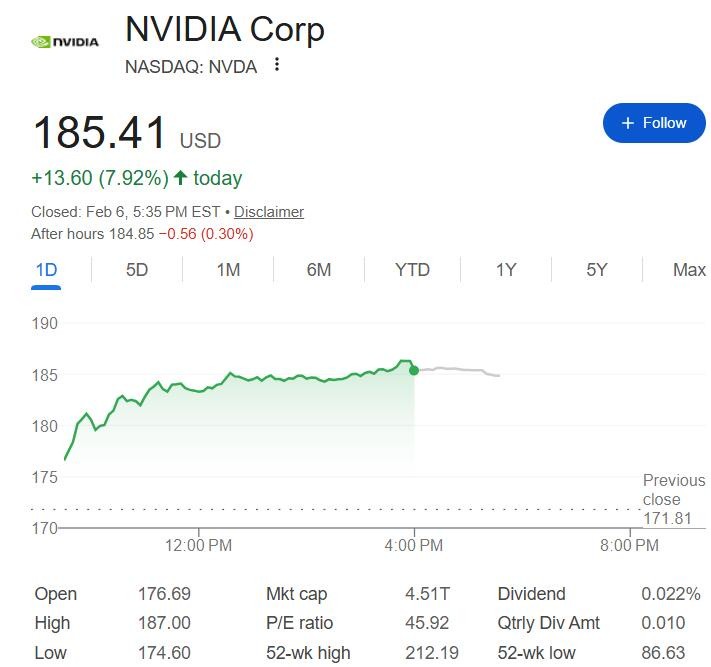
On the same day Huang made these remarks, AI concept stocks rebounded across the board. At the end of the trading day, NVIDIA's stock price rose to $187, up about 8.8% intraday, closing up nearly 7.9%, reversing a five-day decline and breaking free from the closing low set on December 17 of last year, although it still accumulated a drop of about 3% for the week.
Huang's comments come at a time when investors are seriously questioning whether AI can yield substantial returns amid ongoing high investments, and panic has been triggered by Anthropic's release of new tools that threaten to disrupt traditional software business models, leading to a sell-off in tech stocks. Goldman Sachs analysts even pessimistically compared the current software industry to newspapers that were disrupted by the internet in the early 2000s.
Reports on Friday indicated that the latest financial reports and guidance released over the past two weeks, along with previously announced plans, show that by 2026, NVIDIA's key customers Meta, Amazon, Google, and Microsoft are projected to have a combined capital expenditure of approximately $650 billion, an increase of about 60% from 2025. This expenditure scale of over $600 billion far exceeds the GDP of several medium-sized economies, with most of the funds allocated for purchasing NVIDIA's chips.
Wall Street Journal mentioned earlier that concerns about the efficiency of AI investments triggered severe sell-offs in the past week. According to FactSet data, the market capitalization of tech giants such as Microsoft, NVIDIA, Amazon, Alphabet (Google's parent company), Meta, and Oracle has collectively evaporated by about $1.35 trillion.
Last Thursday, after announcing a surprising 66% increase in Q2 capital expenditures, Microsoft's stock price fell by 10%, resulting in a one-day market cap loss of $357 billion, marking the second-largest single-day market cap drop in U.S. stock history. Following the announcement of expected capital expenditures for 2026 projected to increase by 50% from the previous year, Amazon's stock fell sharply on Friday, dropping about 10% when it hit a new intraday low.
AI companies are becoming profitable, and expenditures will continue to grow
Jensen Huang stated on Friday that the cash flow of all these tech companies will begin to rise, and the construction of AI infrastructure will continue for seven to eight years. He emphasized that AI has become "very useful and very powerful," with its adoption rate becoming "extremely high."
Huang said, "As long as people continue to pay for AI, AI companies will be able to profit from it, and they will keep doubling, doubling, doubling, and doubling."
He cited specific examples of how NVIDIA's customers are profiting from AI. Meta is using AI to transform its recommendation system, which originally ran on CPUs, into a system that uses generative AI and agents; Amazon Web Services (AWS) will influence the way this retail giant makes product recommendations through its use of NVIDIA chips; Microsoft will use NVIDIA-driven AI to improve its enterprise software.
Huang particularly praised OpenAI and Anthropic, two leading AI labs, stating that both are "making a lot of money." NVIDIA invested $10 billion in Anthropic last year, and Huang mentioned earlier this week that he would make a significant investment in OpenAI's next round of financing. He said, "If they can have twice the computing power, their revenue will quadruple."
He also pointed out that all the graphics processing units (GPUs) NVIDIA has sold in the past—even the A100 chip from six years ago—are currently being rented out, reflecting the ongoing demand for AI computing power. Huang believes that unlike the early days of internet infrastructure development, there is no idle infrastructure now.
$650 Billion Spending Record
According to reports on Friday, Alphabet, Amazon, Meta, and Microsoft are expected to reach approximately $650 billion in capital expenditures by 2026, marking an unparalleled investment boom this century. Each company's budget this year is expected to approach or exceed the total of their past three years, with any one of them setting a record for the highest single-year capital expenditure in the past decade.
Specifically, Meta stated that its full-year capital expenditures will rise to as much as $135 billion, potentially jumping about 87% year-over-year. In the second fiscal quarter ending December 2025, Microsoft's capital expenditures grew 66% to $37.5 billion, with analysts expecting Microsoft's capital expenditures to approach $105 billion in the fiscal year ending June 2026.
Alphabet's capital expenditure guidance released on Wednesday was set at a high end of $185 billion, exceeding analyst expectations and the spending scale of many industries in the U.S. Amazon announced on Thursday plans to invest $200 billion in capital expenditures by 2026, which also led to a sharp drop in stock prices.
Media compiled data shows that compared to the aforementioned Silicon Valley giants, including the largest U.S. automakers, engineering machinery manufacturers, railway companies, defense contractors, wireless operators, express companies, as well as ExxonMobil, Intel, Walmart, and subsidiaries spun off from General Electric, the combined spending of 21 companies is expected to be only $180 billion in 2026.
DA Davidson analyst Gil Luria stated that the four tech giants, including Microsoft, "view the competition for AI computing power as the next winner-takes-all or winner-takes-most market, and they are all unwilling to lose this competition."
Wall Street Worries About Investment Efficiency and Overcapacity
Wall Street has mixed reactions to such massive spending. Meta and Alphabet's stock prices rose, but Amazon and Microsoft faced market punishment. Since releasing their latest financial reports and outlooks, the total market value of the four companies has shrunk by more than $950 billion.
Paul Markham, investment director at GAM Investments, pointed out that the current market is shrouded in an "emotional contagion effect." He said, "The massive capital expenditures required for building large language models, the eventual return cycles, and concerns about potential overcapacity have become structural issues that continue to suppress market sentiment."
Tomasz Tunguz, an investor at Theory Ventures, stated that these tech giants were once "cash machines," but "now they suddenly need that cash, and they need more, so they are borrowing money." According to media statistics, by 2025, AI-related companies and projects have raised at least $200 billion from the debt market, with the issuance of related bonds expected to reach hundreds of billions in 2026 alone.
Tunguz previously published a blog post comparing the AI boom to past investment frenzies, noting that these frenzies do not always end well, but "during the rise, they are all huge catalysts for the economy."
Steve Lucas, CEO of Boomi, a company that helps businesses integrate data and software, stated, "I wouldn't question the potential of AI, but I would absolutely question the timeline for its development, and I would strongly question its economic benefits."
It remains unclear whether these companies can execute their grand plans. As data center construction upgrades, they are competing for limited electricians, cement trucks, and NVIDIA chips produced by TSMC. Luria stated, "Bottlenecks already exist, and there will be more in the future."
Jensen Huang Tried to "Put Out Fires" for Software Stocks on Tuesday
This is not the first time Jensen Huang has tried to "put out fires" for market anxiety this week. On Tuesday evening, after software stocks faced a sell-off, he stated at a Cisco Systems event that the sell-off in software stocks this week was "the most illogical thing in the world."
Huang said that software products are tools, and AI will use these tools rather than reinvent them. He countered, "There is a notion that tools are declining and being replaced by AI. Would you use a screwdriver or invent a new screwdriver?"
He noted that NVIDIA itself has widely adopted such tools, allowing employees to free up time to focus more on what the company excels at: designing semiconductors and computer systems.
On Tuesday, software-related stocks fell for the second consecutive day, as investors worried that tools released by AI model developers like Anthropic would ultimately automate a large amount of internal work within companies. An American software stock ETF fell by 4.1% that day, reaching its lowest level since April, with AppLovin and Unity Software being among the biggest decliners in the sector.
JP Morgan analyst Toby Ogg stated that investors' willingness to invest in technology remains very low. In his report, he wrote, "The environment we are in now is that the sector is not only guilty before being proven innocent, but now has been sentenced before the trial." However, some analysts have questioned the severity of the sell-off, stating that software companies providing essential tools for manufacturing operations are difficult to disrupt. Jefferies analyst Brent Thill stated that Intuit offers proprietary data and systems that help customers navigate complex U.S. tax laws, which gives it an advantage over AI
