


Gold - Asset Reallocation, Where is the Gold Price Heading?

Against the backdrop of declining dollar credit and asset reallocation, gold prices are expected to rise to USD 5,400-6,800 per ounce between 2026 and 2028. The proportion of gold reserves held by global central banks may increase from 21.4% to the historical median of 34%, with new demand expected to stabilize at 800 tons per year. Non-investment demand mainly comes from jewelry and industrial gold, which is expected to remain stable
Gold: Decline in Dollar Credit, Asset Reallocation, Average Price May Rise to $6800/oz in 28 Years
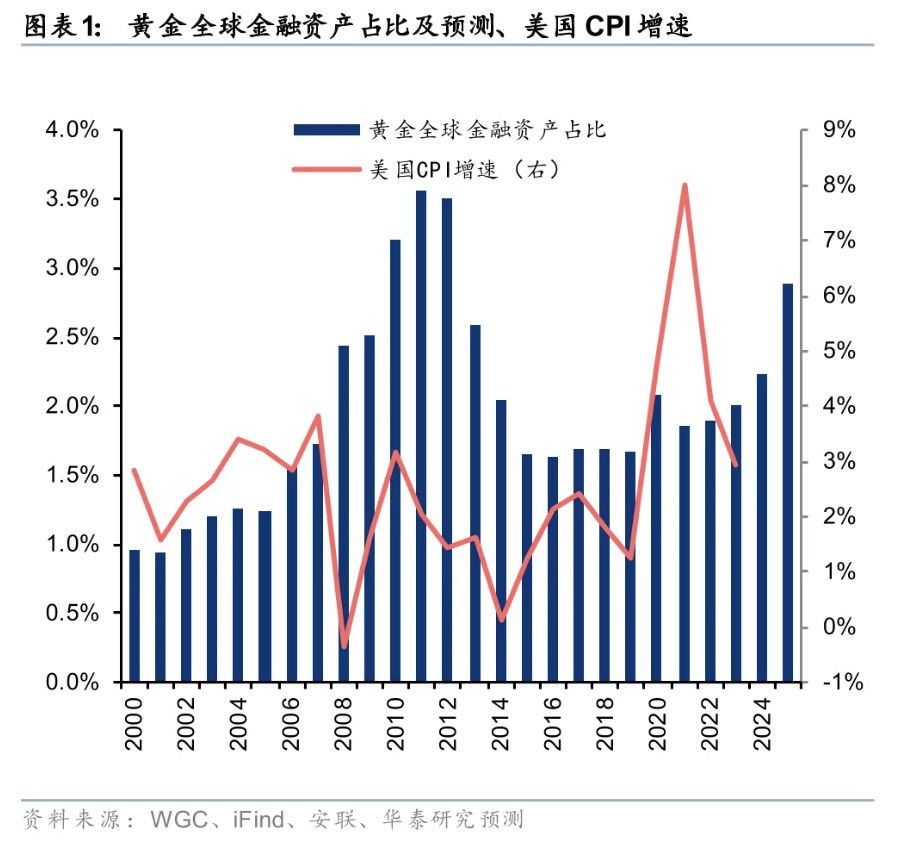
After 2022, in the context of de-globalization, central banks and other financial institutions are reallocating assets; the continuous increase in gold allocation has become the cornerstone of the medium to long-term rise in gold prices. Based on the allocation ratio of gold in global personal and institutional financial assets, we estimate the long-term price center of gold. If the risk of geopolitical conflicts becomes normalized and global assets continue to de-dollarize, the pricing anchor for gold may shift from a framework dominated by real interest rates to one focused on credit risk hedging. If the proportion of investable gold from 2026 to 2028 exceeds the 2011 peak (3.6%) and reaches 4.3-4.8%, gold prices are expected to rise to $5400-6800/oz during this period.
Central Banks' Long-term Accumulation of Gold, New Allocation Demand May Stabilize at 800 Tons/Year
According to Huatai Metals' "Supply and Demand Improvement May Become the Main Theme of the Metal Industry in 2026" (25-12-01), the long-term accumulation of gold by global central banks is mainly due to concerns over the credit of dollar assets, the need for stable exchange rates in extreme situations, and hedging against geopolitical conflicts. As of June 2025, the proportion of gold in reserve assets is approximately 21.4%; extrapolating based on the average recovery rate from 2019 to 2024 (approximately 1.45 pct per year); in the context of de-globalization, if the proportion of gold in central bank reserves rises to the historical median of 34% in 1990, global central banks may continue to accumulate gold until 2035. We expect that from 2026 to 2030, new demand from central banks may stabilize at 800 tons/year.
Non-Investment Demand May Continue to Stabilize: Jewelry Dominates Consumption, Industrial Demand is Rigid
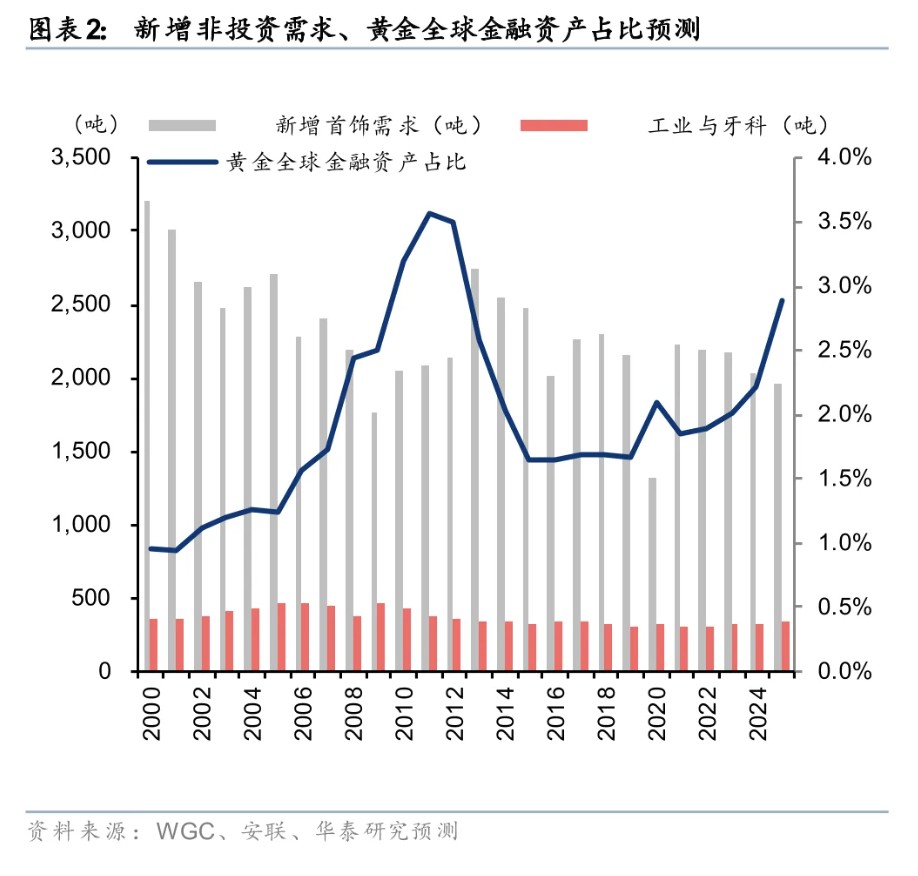
The non-investment demand for gold is mainly composed of jewelry gold and industrial gold, both of which may continue to stabilize. According to WGC data, the average demand for jewelry gold from 2015 to 2024 is approximately 2114 tons; high gold prices may temporarily suppress consumption willingness, but considering rigid demands such as weddings, the center may remain relatively stable; industrial applications are mainly concentrated in petrochemical and electronics fields, with low price sensitivity and relatively stable demand. We expect that from 2026 to 2028, the demand centers for jewelry/industrial gold may stabilize at 1951/332 tons/year.
Gold: Decline in Dollar Credit, Asset Reallocation, Average Price May Rise to $6800/oz in 28 Years
After 2022, in the context of de-globalization, central banks and other financial institutions are reallocating assets; the continuous increase in gold allocation has become the cornerstone of the medium to long-term rise in gold prices. Based on the allocation ratio of gold in global personal and institutional financial assets, we estimate the long-term price center of gold. If the risk of geopolitical conflicts becomes normalized and global assets continue to de-dollarize, the pricing anchor for gold may shift from a framework dominated by real interest rates to one focused on credit risk hedging. If the proportion of investable gold from 2026 to 2028 exceeds the 2011 peak (3.6%) and reaches 4.3-4.8%, gold prices are expected to rise to $5400-6800/oz.
Central Banks' Long-term Accumulation of Gold, New Allocation Demand May Stabilize at 800 Tons/Year According to Huatai Metals' "Supply and Demand Improvement May Become the Main Theme of the Metal Industry in 2026" (25-12-01), global central banks have been increasing their gold holdings in the long term, mainly due to concerns over the credit of dollar assets, the need for stable exchange rates in extreme situations, and safe-haven demand amid geopolitical conflicts. By June 2025, gold is expected to account for approximately 21.4% of reserve assets; extrapolating based on the average recovery rate from 2019 to 2024 (approximately 1.45 percentage points per year); in the context of de-globalization, if the proportion of gold in central bank reserves rises to the historical median of 34% in 1990, global central banks may continue to increase their gold holdings until 2035. We expect that the new demand from central banks from 2026 to 2030 may stabilize at 800 tons per year.
Non-investment demand may continue to stabilize: Jewelry dominates consumption, industrial demand is rigid
The non-investment demand for gold is mainly composed of jewelry gold and industrial gold, both of which may continue to stabilize. According to WGC data, the average demand for jewelry gold from 2015 to 2024 is approximately 2,114 tons. High gold prices may temporarily suppress consumption willingness, but considering rigid demands such as weddings, the demand center may remain relatively stable; industrial applications are mainly concentrated in petrochemical and electronics fields, with low price sensitivity and relatively stable demand. We expect that from 2026 to 2028, the demand centers for jewelry/industrial gold may stabilize at 1,951/332 tons per year, respectively.
Gold allocation by individuals and financial institutions is expected to gradually increase
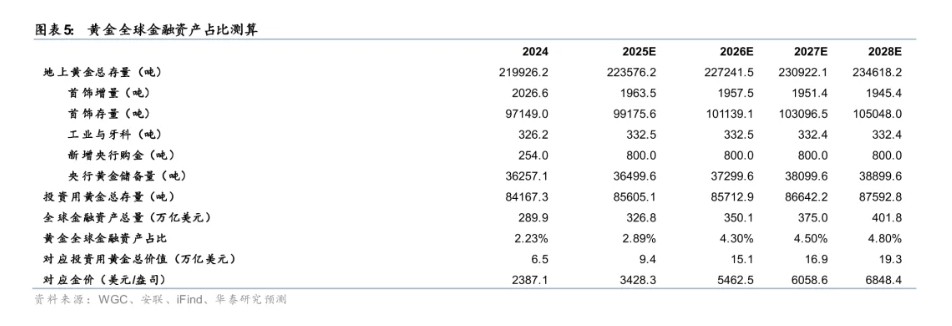
We expect that the gold allocation by individuals and financial institutions will gradually rise. According to data from the World Gold Council, by 2025, after deducting central bank and non-investment demand, we estimate that the global investable gold stock will be approximately 85,600 tons. We assume that the new supply of mined gold, after deducting central bank and non-investment demand, will mainly be absorbed by individual and financial institution investments. If the global new mined gold production for 2026/2027/2028 is 3,665/3,680/3,696 tons respectively, after deducting central bank demand and non-investment demand, the corresponding years' investable gold stock for individuals and financial institutions may increase to 85,713/86,642/87,953 tons, respectively.
The proportion of gold in financial assets still has room for increase
In the context of normalized global fiscal deficits and repeated challenges to the stability of major economies' monetary systems, the allocation ratio of gold in global financial assets may further increase. Referring to the aforementioned gold stock for individuals and financial institutions, based on the average LME gold price of $3,428/oz in 2025, the market value of investable gold, excluding central bank demand, is approximately $9.43 trillion, accounting for 2.89% of our estimated global financial assets for individuals and financial institutions in 2025 (approximately $327 trillion), still having room to increase from the peak of 3.6% during the liquidity easing cycle in 2011.
The average gold price from 2026 to 2028 may reach $5,400-6,800/oz
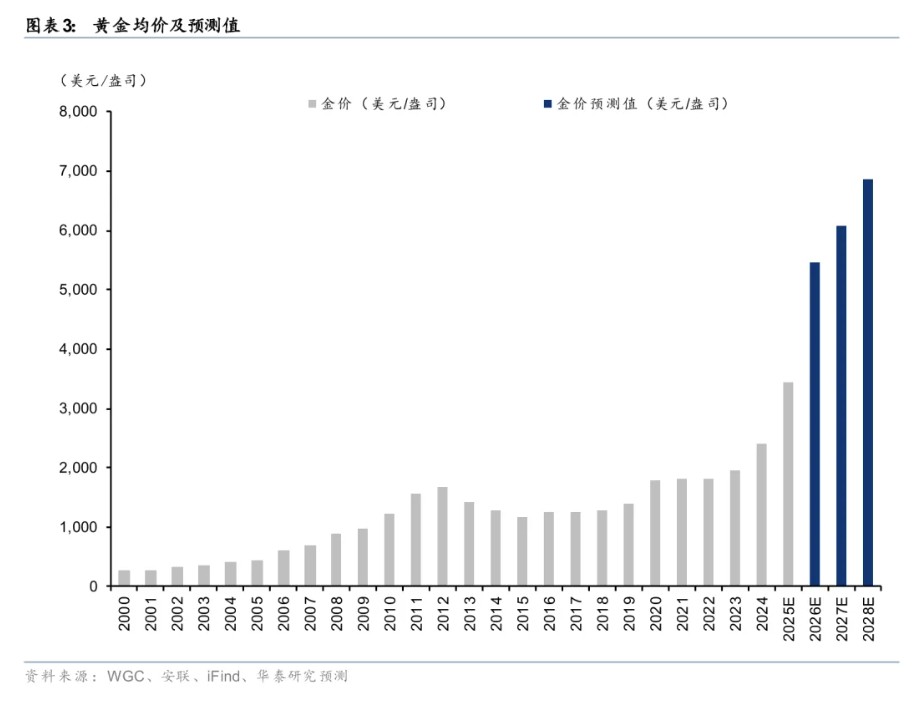
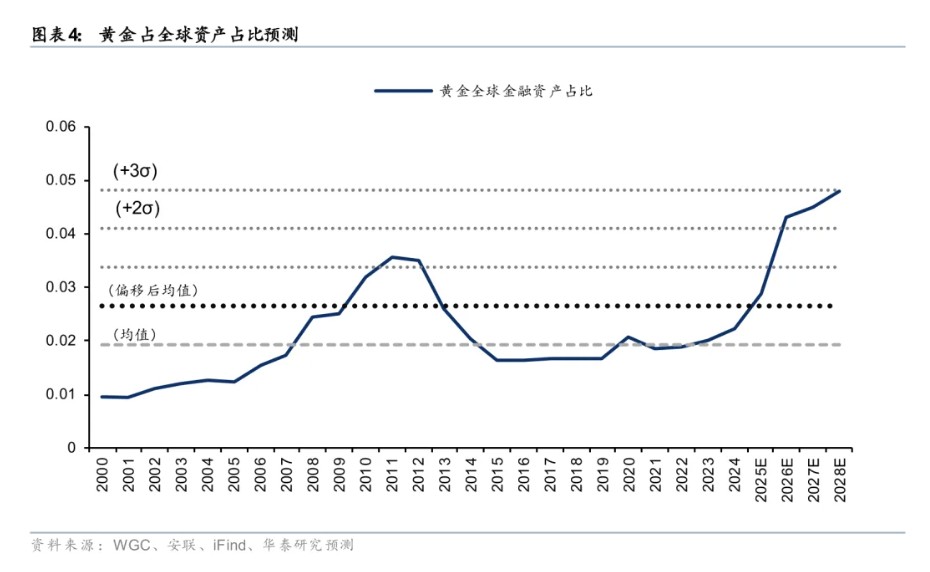
Based on the total amount of global financial assets and the gold allocation ratio, we estimate that the gold price may reach $6,800 per ounce by 2028. For 2026/2027/2028, we refer to the historical distribution of gold allocation ratios since 2000 and combine it with the structural shifts brought about by de-dollarization and geopolitical factors Assuming the mean (1.9%) shifts up by about 1σ to 2.7%, and adding an upward scenario of about 2-3σ, the investable gold proportion forms 4.3%/4.5%/4.8%. Furthermore, we expect the total global financial assets to reach USD 350.1/375.0/401.8 trillion by 2026-2028, which corresponds to an estimated total market value of investable gold of approximately USD 15.1/16.9/19.3 trillion. Combining the above global investment gold stock, we estimate that the expected gold price in 2026/2027/2028 may reach USD 5463/6059/6848 per ounce.
Risk Warning and Disclaimer
The market has risks, and investment should be cautious. This article does not constitute personal investment advice and does not take into account the specific investment goals, financial situation, or needs of individual users. Users should consider whether any opinions, views, or conclusions in this article are suitable for their specific circumstances. Investing based on this is at one's own risk
