


Bank of America Hartnett: Small-cap stocks are more worth betting on than tech stocks, tech giants are no longer winners

Bank of America Chief Investment Strategist Michael Hartnett stated that small-cap stocks are more worthy of investment than technology stocks, and tech giants are no longer the winners. He pointed out that Wall Street's bull-bear indicator has reached its highest level since 2006, signaling a sell. Hartnett advised investors to withdraw from technology stocks and cryptocurrencies and shift towards small-cap stocks that benefit from the recovery of the real economy. Recent market volatility is closely related to political factors, and the capital expenditure issues of tech giants also make them no longer safe
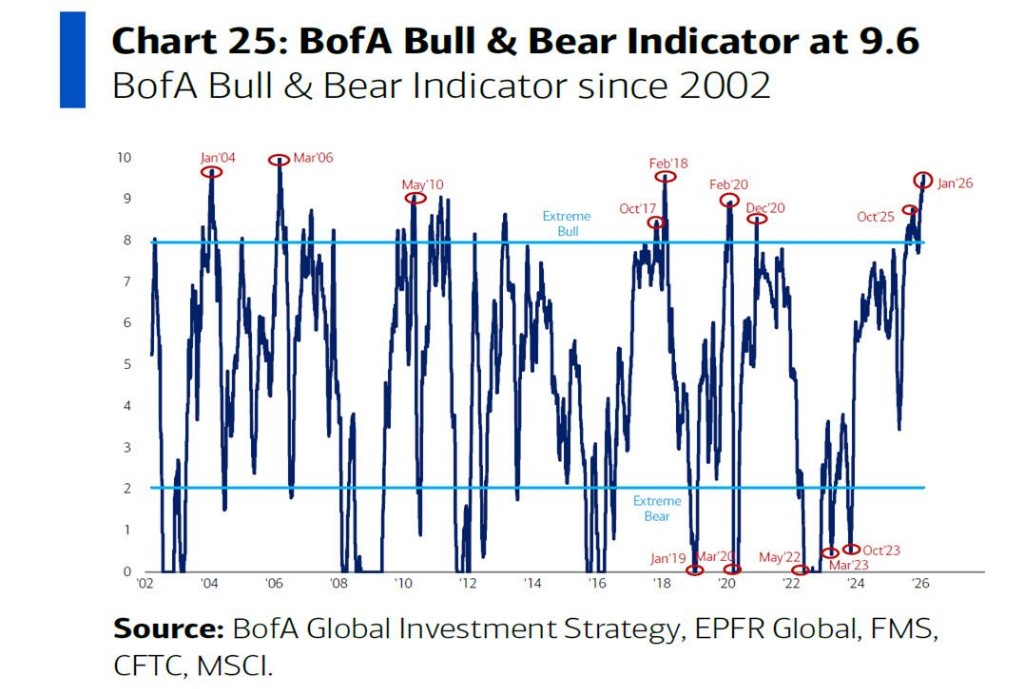
When Wall Street's Bull & Bear Indicator soared to its highest level since 2006, every breath the market took was filled with a sense of danger.
A month ago, Michael Hartnett, Chief Investment Strategist at Bank of America, redesigned this indicator to issue a clear "sell" signal. As of now, the indicator has further climbed to 9.6—an extreme reading not seen since March 2006.
Hartnett analyzed that this is the product of a triple overlap of "position peak, liquidity peak, and inequality peak."
For asset allocation in 2026, Hartnett's conclusion is simple and brutal: "long Main St, short Wall St."
In other words, funds should be withdrawn from crowded tech giants and cryptocurrencies and redirected towards small-cap stocks and international markets that benefit from the recovery of the real economy.
Alarm of the Bull & Bear Indicator
The path of this market correction precisely corroborates Hartnett's warning.
At the end of January, the market suddenly crashed, with software stocks experiencing a record drop for eight consecutive days, followed by panic spreading like an infectious disease: silver prices plummeted, Bitcoin recorded its largest drop since the FTX scandal, and then multi-strategy funds faced a deleveraging crisis leading to urgent basis trading issues.
Ultimately, as Google (GOOGL) and Amazon (AMZN) saw their stock prices plummet due to soaring capital expenditure guidance, this chill thoroughly penetrated the semiconductor sector and the "Magnificent Seven" (Mag 7).
It is worth mentioning that the trigger for this crash had a strong political color. Hartnett pointed out that Trump's mention of Kevin Warsh (seen by the market as a hawkish figure) as a nominee directly triggered a 30% weekly drop in Bitcoin.
Since October 2025, the cryptocurrency market has evaporated $2 trillion in market value, equivalent to 10% of U.S. consumer spending. Hartnett warned that this reversal of the wealth effect will have a substantial impact on the economy in the coming months.
The "Capital Expenditure Trap" of Tech Giants
Why is the once safe haven—Big Tech—no longer secure? The core issue lies in the dramatic changes in their balance sheets.
The market expects that the AI-related capital expenditures (Capex) of tech giants in 2026 will reach $670 billion, which is 96% of their combined cash reserves. In comparison, this ratio was only 40% ($150 billion) in 2023.
This means that tech giants are rapidly shifting from a "light asset" model to a "heavy asset" model. They no longer possess the best balance sheets and no longer have unlimited stock buyback capabilities. This fundamental shift in business model poses the greatest threat to the market leadership of tech stocks in the 2020s In stark contrast is the logic of "Main Street."
Hartnett believes that the Trump administration will intervene in energy, healthcare, credit, and electricity prices to lower inflation in response to voters' dissatisfaction with the cost of living. This policy direction, combined with AI's cooling effect on the labor market, will lead to an unexpected decline in inflation by 2026, benefiting small-cap and mid-cap stocks.
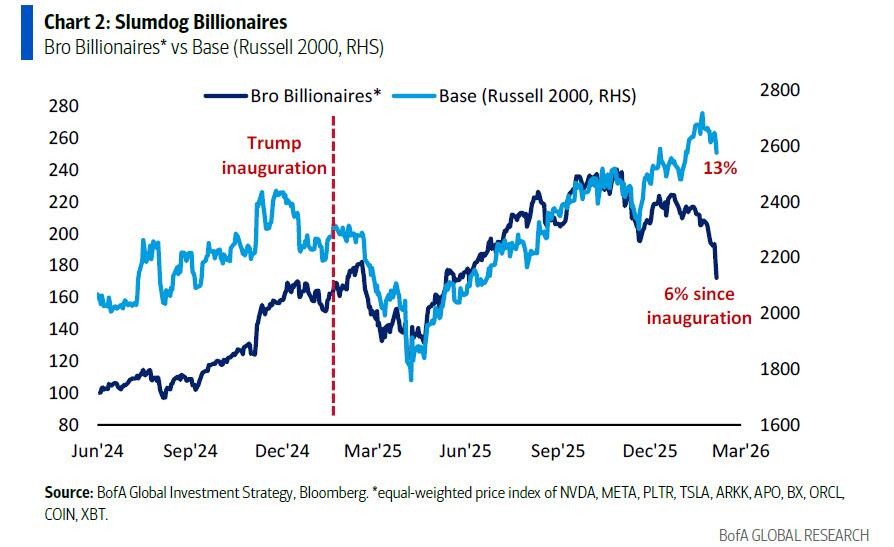
The facts have begun to validate this logic: since the new government took office, "Bro Billionaire plays" represented by NVDA, META, and Bitcoin have only risen by 6%, while small-cap stocks have increased by 13% during the same period.
Major Capital Migration: Escaping the Bubble, Seeking Value
The latest EPFR data shows that a dramatic style switch is occurring in the market:
- Safe-haven assets lose favor: Gold funds experienced their first weekly net outflow since November 2025 (USD 800 million), while cryptocurrency funds saw outflows of USD 1.5 billion. This seems to declare that the USD 70 billion that flowed into cryptocurrency ETFs since the election never existed.
- Value sectors attract capital: Funds are pouring into undervalued markets. The South Korean stock market recorded a historic weekly inflow of USD 5.2 billion, and European stock markets also welcomed their largest inflow since April 2025.
- Long bull market in bonds: Investment-grade bonds (IG bonds) have seen net inflows for 41 consecutive weeks.
Hartnett reminds investors to pay attention to key "bubble support levels": USD 133 for the Technology ETF (XLK), USD 58,000 for Bitcoin, and USD 4,550 per ounce for gold.
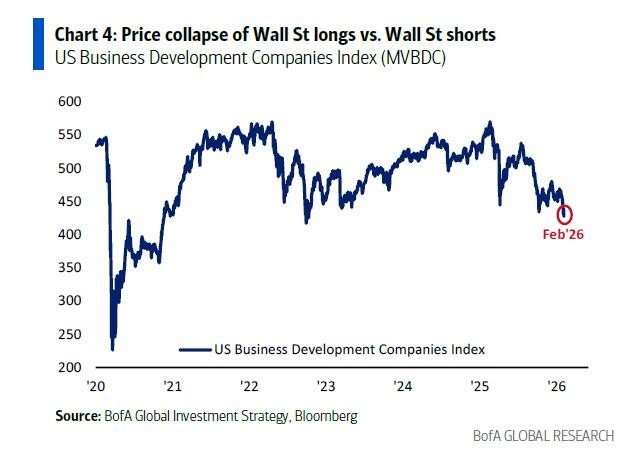
Hartnett also stated that unless a systemic event occurs—such as a surge in the dollar (DXY index reaching 100) and a corresponding collapse in government bond yields, the current decline should be viewed as a "huge, healthy, and overdue bubble deflation."
Outlook for 2026: Global Rebalancing
Looking further ahead, we are at a historical turning point similar to 1971, 1989, or 2009.
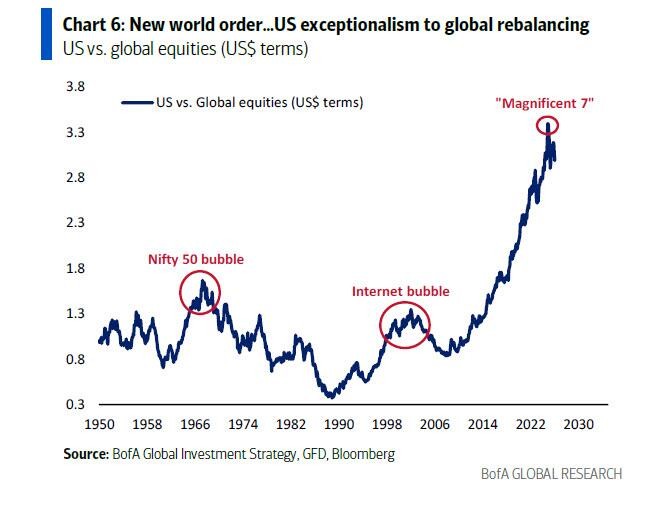
Hartnett believes that 2025-2026 marks the end of "American exceptionalism" and the beginning of "global rebalancing." In the new cycle, the winners will no longer be America's tech giants, but rather international stocks, Chinese consumer stocks, and commodity producers in emerging markets.
For investors, the tactical approach is very clear now: amidst the roar of the bubble bursting, seek out those long-ignored assets closely tied to the real economy
Risk Warning and Disclaimer
The market has risks, and investment requires caution. This article does not constitute personal investment advice and does not take into account the specific investment goals, financial situation, or needs of individual users. Users should consider whether any opinions, views, or conclusions in this article are suitable for their specific circumstances. Investment based on this is at one's own risk
