


Gold, silver, and copper will "consolidate" in the coming weeks! JP Morgan: This is just a bull market pause, and copper may rebound first in the second quarter

The metal frenzy has paused, but the dance is not over. During this "halftime" phase, blindly chasing high gold prices may face months of turbulent torment. Instead, focusing on signals of recovery in the manufacturing cycle and positioning basic metals at technical support levels may be the best strategy to capture the next wave of upward momentum
After months of one-sided rises and frenzied chasing, the global metal market seems to have hit a "ceiling." In response to the recent sharp price fluctuations, Wall Street's top investment bank JP Morgan issued a clear signal in a technical strategy report released on February 5: major metals such as gold, silver, and copper are expected to enter a "consolidation period" in the coming weeks.
However, this does not mark the end of the bull market. According to Jason Hunter, an analyst from JP Morgan's global market strategy team, the current adjustment is a necessary pause in the long-term upward trend.
He stated that for savvy traders, the key point of contention lies in "differentiation": compared to the typical "spike and drop" pattern of gold, base metals (especially copper) benefit from the support of the global manufacturing cycle, making their fundamental logic more solid, and are expected to rebound ahead of gold in the second quarter.
Gold: From "Parabolic" to "Wide Fluctuation"
"We believe that the recent movement of gold prices is a typical short-term spike and drop reversal, rather than the end stage of a long-term uptrend," wrote JP Morgan technical strategist Jason Hunter in the report.
Hunter indicated that technical charts show that after experiencing a parabolic rise, gold prices have shown clear signs of momentum exhaustion. He predicts that gold prices will form a wide fluctuation "holding pattern" in the coming weeks or even months. During this period, the $5,000 level and the $5,100-$5,150 range will constitute heavy resistance, limiting the short-term rebound space for gold prices.
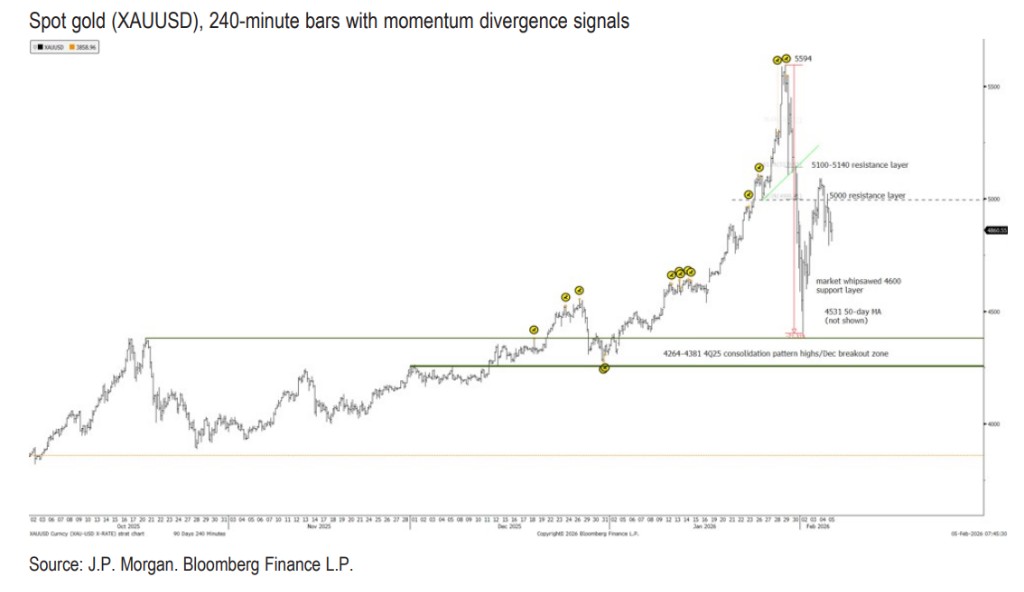
Despite facing a technical pullback in the short term, the core logic supporting the gold bull market—the theme of "currency debasement"—remains intact. The report specifically points out that the US Dollar Index (DXY) continues to operate below the 100 mark, which is a key long-term weak signal. As long as the dollar remains below this level, the market is likely to be affected by the resumption of the downward trend that began in early 2025.
Additionally, the S&P 500/Gold ratio recently broke below a decade-long support level, which is highly reminiscent of the market structure in the late 1970s, suggesting that the long-term trend of capital flowing into hard assets is far from over.
Therefore, the current decline is not a trend reversal, but rather a "halftime break" to digest the previous rapid gains.
Copper's "Expectation Gap": The Truth Behind PMI Data
Compared to gold's safe-haven attributes, copper's movement is more constrained by the global economic cycle.
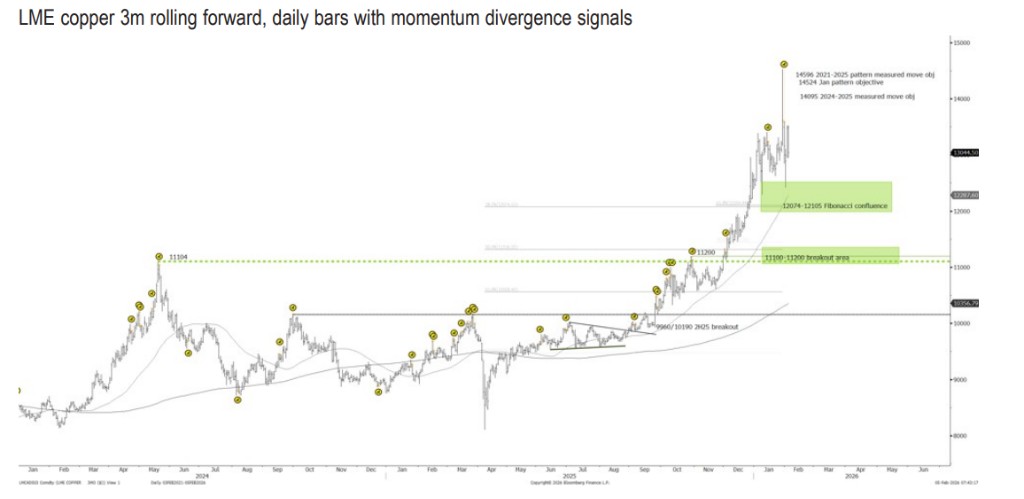
Recently, LME copper prices slowed down after reaching above $14,000, raising market concerns about whether copper prices have "departed from fundamentals."
JP Morgan's regression analysis found that the current year-on-year increase in copper prices implies that the global manufacturing PMI should reach around 53. However, the actual PMI reading is only around 50.5 On the surface, copper prices seem overly optimistic, having overdrawn future growth. However, JP Morgan's strategists offer a different interpretation through cross-asset comparisons—this is not an irrational boom in copper, but rather a collective bet by the market on a pro-cyclical recovery.
The report cites "simulated semiconductor stocks" as a reference. These assets are typically highly correlated with the manufacturing cycle and are less affected by the theme of "currency depreciation." Data shows that the price trend of simulated semiconductor stocks also implies that the PMI will rise to around 52 by the end of the first quarter of 2026.
"This cross-market context enhances the effectiveness of traditional technical analysis," Jason Hunter stated. Since both semiconductors and copper are pricing in a stronger manufacturing cycle, it indicates that the logic of pro-cyclical rotation is deeply rooted across asset classes.
Hunter believes that the current pullback in copper prices is more of a technical correction rather than a collapse of fundamental expectations.
Strategy Differentiation: "Strong Copper, Weak Gold" in Q2
Based on the above logic, JP Morgan has made predictions about the market rhythm for the coming months: during the consolidation period, base metals will receive more support than precious metals.
Although both require consolidation, the market drivers differ. Gold is currently mainly constrained by the crowding of "currency depreciation" trades and profit-taking; whereas copper, in addition to benefiting from the depreciation logic, also has the added strength of "pro-cyclical rotation" momentum.
Although LME copper has shown a deceleration pattern after reaching the mid-term target of $14,000-$14,596, it has not exhibited the severe "reversal" signals seen in gold.
JP Morgan predicts that this pro-cyclical momentum will help copper and base metals continue their upward trend "earlier" than precious metals in the second quarter after the consolidation ends.
To prepare for the upcoming consolidation period, JP Morgan advises investors to focus on specific tactical support levels.
For copper, the $12,074-$12,105 area is expected to provide initial bottom support for the market, making it an ideal position for short-term speculation; while the $11,100-$11,200 range is a breakout level from years of volatility, and as long as prices remain above this area, the long-term bullish structure remains solid.
In contrast, buying gold requires more patience. Strategists suggest first focusing on $4,500 (the 50-day moving average), but the more critical buying range is between $4,264-$4,381—this is the breakout area for the fourth quarter of 2025, which is expected to provide stronger support.
Additionally, Brent crude oil is also expected to maintain a range-bound oscillation. The upward momentum driven by geopolitical factors is blocked at the "high end of $60," and it is expected to struggle to break through $70. However, the dense moving averages in the $61.75-$62.18 area will provide a solid bottom for oil prices.
In summary, the conclusion of JP Morgan's report is: the metal party is paused, but the dance is not over During this "halftime" phase, blindly chasing high gold prices may face months of turbulent fluctuations. In contrast, focusing on recovery signals in the manufacturing cycle and positioning basic metals at technical support levels may be the best strategy to capture the next wave of upward momentum
